Saab’s Gripen E/F has secured over $10 billion in new export orders in under a year, ending a decade-long export drought and ushering in a resurgence for the Gripen platform. However, one major market has remained a hard nut to crack despite years of campaigning: India.
After losing multiple export contests to bigwigs like Lockheed Martin’s F-35 Lightning II and Dassault Aviation’s Rafale, the Saab Gripen-E/F made its official comeback in 2025, with Thailand ordering 4 of these jets and Colombia ordering 17.
In addition, Ukraine recently allocated about €2.5 billion ($2.90 billion USD) of a €90 billion ($104.4 billion USD) European Union loan to buy 20 new Gripen E fighters last month, a number which could eventually rise to 150, as indicated in a Letter of Intent (LoI) signed during Volodymyr Zelenskyy’s visit to Sweden last year.
Meanwhile, Canada is purportedly considering the purchase of 72 Gripen E/F fighters, which have been on offer since the country put its F-35 purchase on hold last year amid rising tensions with the United States. According to recent reports, Ottawa is now considering expanding its fighter jet purchase beyond 88 to include both the American F-35 Lightning II and the Gripen E/F.
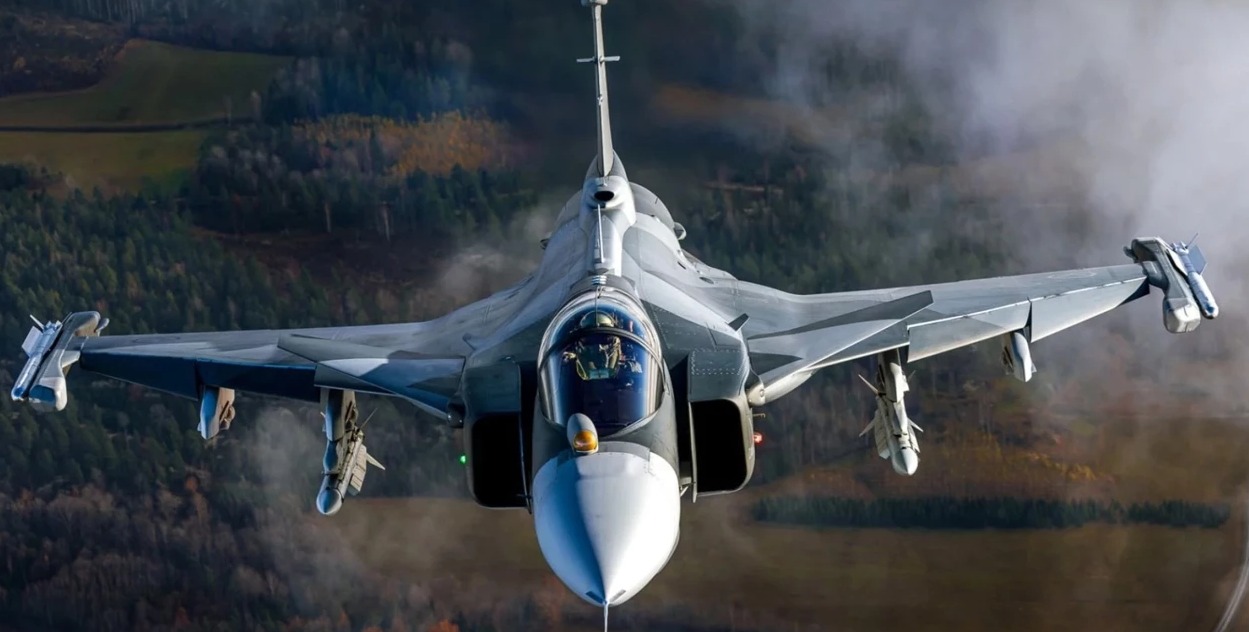
The Saab JAS 39 Gripen E is the latest single-seat, 4.5-generation multirole fighter that offers strong beyond-visual-range combat capability, a modern cockpit with a large-area display, and significant growth potential through its modular design. It is optimized for high availability, low operating costs, rapid turnaround, and operations from short or rough airstrips or dispersed bases.
In addition to the Gripen-E, Saab unveiled a twin-seat Gripen-F earlier this month, a variant that retains all of Gripen-E’s mission systems and capabilities, and has been developed primarily for training. In fact, it is believed that the two-seat jet variant could boost the aircraft’s export potential further, particularly as these jets could be very useful in combat situations, by “enhancing operational effectiveness in high-threat environments through shared workload and improved mission command.”
While Saab has been able to sway several countries, some of which were previously undecided or favored rival jets over the Gripen, it has so far been unable to convince a long-standing target customer—India—despite reports that New Delhi is in active contact with Saab.
SAAB Gripen For India
Saab has been pitching the Gripen jets to India for years and has been in the running since the Indian Air Force (IAF) first issued the Request for Information (RFI) for its Multi-Role Combat Aircraft (MRCA) fighter jet program in 2018.
Saab India renewed the pitch in August 2023 and has sustained the momentum since. “Saab will offer 114 state-of-the-art Gripen E fighters as a part of its response to the upcoming IAF RFP. With Gripen E, India will get next-generation combat air capability and world-class availability – ready to face any threat, anytime, anywhere, from any dispersed location,” the Swedish contractor wrote in a post on X at the time.
Subsequently, it assured India that it would deliver the first Gripen-E/F aircraft to the IAF within a record three years if awarded the contract.
The offer was sweetened ahead of Aero Show 2025 to include the transfer of Maintenance, Repair, and Overhaul (MRO) capabilities, the local production of aircraft components and engine assembly, and the establishment of a state-of-the-art Gripen Design Center in Bangalore. A full-scale replica of the jet was also displayed at the biannual air show.
Saab has maintained that this will allow India to develop systems tailored to its specifications and ensure complete control over its fighter systems, including the ability to execute upgrades and modifications on its own.

“We foresee that we can set up full-scale production in India, which will include everything, not just the airframe, but also systems and software. We have a plan to rapidly indigenize the platform. We have had favorable discussions with a host of private partners who will support us in our indigenization efforts,” the company said in 2025, appealing to India’s “Make in India” and “Aatmanirbhar Bharat” aspirations.
Separately, in an attempt to further entice New Delhi, Kent-Ake Molin, Head of the Gripen India campaign, said, “We would like to position India as a potential export hub for Gripen E aircraft and related systems. Our proposal promises a self-reliant defense industry that supports itself and serves international markets as well.”
Saab rejiged its export campaign earlier this year, with Mikael Franzen, Chief Marketing Officer for Gripen and Vice President of Business Area Aeronautics at Saab, emphasizing that the Gripen would complement the IAF’s fleet of French Rafale and indigenous Tejas fighter jets.
“The highest availability of any fighter gives an unrivaled combat mass to counter any adversary. Gripen will fit perfectly in the IAF together with Rafale and Tejas,” he stated, emphasizing the strategic autonomy associated with the purchase of the Swedish jets, as reported by the EurAsian Times.
India Hard To Crack
Despite receiving an attractive offer from SAAB that nearly met India’s requirements for technology, infrastructure, independence, and industry benefits, the Indian Air Force showed a strong preference for acquiring Rafale fighters.
According to reports in the Indian media, a Letter of Request (LoR) has already been issued by the Acquisition Wing of the Indian Defense Ministry to the French government officials, and a deal is expected to be signed between the two countries sometime this year.
Notably, the Rafale emerged as a natural choice for the IAF, as it already operates 36 of these jets, whereas an order for 26 Rafale Marine carrier-based jets for the Indian Navy was placed last year. The induction of 114 Rafales will enhance overall interoperability.
“A fleet that is the same or similar across variants makes training, maintenance, and logistics simpler. It will also add flexibility to the movement of pilots and technicians between units and missions, without the time- and resource-consuming steep learning curves. That saves money and gives planners great flexibility in mission planning,” as Wing Commander (R) JP Joshi (retd) argued in a previous EurAsian Times article.
According to open-source reporting, India would likely procure 18 Rafales off the shelf to immediately enhance operational capability, while the remaining 96 aircraft will be manufactured in India. This makes the deal a complete package and benefits the Indian industry, much like Saab has promised.
The IAF has historically favored larger, twin-engine platforms for better range, payload, redundancy, and perceived power projection in India’s threat environment vis-à-vis China and Pakistan. For example, the Rafale, Su-30MKI, the Mirage-2000, and the Jaguar operated by the IAF are all twin-engine fighters. Meanwhile, the country has developed an indigenous single-engine LCA Tejas fighter, which is being inducted by the IAF.
U.S. Drops “Indo” from Its Most Powerful Command — What Does It Mean for India, China & the QUAD?
“Gripen is a potent aircraft, no doubt, but I believe at one stage IAF made a choice to induct twin-engine platforms for high-value inductions. This decision likely eliminates Gripen as a choice. India is making its own LCA – going from Mk1 to 1A and Mk2 as a single-engine fighter, and would like perhaps to stick to twin-engine when it comes to foreign induction,” Air Marshal G.S. Bedi (retd.) told the EurAsian Times.
The single-engine Gripen has traditionally been viewed by Indian officials and strategists as lighter and better suited to lower-end roles, which they believed India’s LCA Tejas could also fulfill. Although the Gripen has evolved into a very advanced platform, the Tejas is both indigenously produced and more affordable per unit than the Gripen.
Moreover, India’s geopolitical and security realities have changed since the IAF first floated the RFI for the acquisition of combat fighters under the MRFA in 2018. For one, India needs a fifth-generation fighter jet to close the stealth gap with China, which operates the J-20 and J-35A, and Pakistan, which is speculated to acquire Chinese J-35s.
If the country has already made up its mind to buy Rafale, is in the process of inducting the Tejas Mk1A, and is actively working on its indigenous fifth-generation AMCA (Advanced Medium Combat Aircraft), it might make little sense for it to discuss the Gripen E/F, despite claims of “talks” in the Indian media.
Meanwhile, Russia has offered to supply India with ready-made aircraft, produce the Su-57 in India by leveraging existing Su-30MKI infrastructure, and provide assistance with India’s fifth-generation AMCA. Additionally, it has offered full-licensed production, technology transfer, and a “potential two-seat variant”, along with the source code.
The EurAsian Times recently published a detailed analysis of India’s prospective acquisition of the Su-57, which you can read here.
“A deal for a limited number of Su-57s may be considered, provided it helps advance the AMCA program rather than curtail it. Some important aspects, such as reasonable costs, firm delivery timelines, the transfer of critical technology, and the sharing of source code, must be agreed upon,” ex-Vice Chief of IAF, Air Marshal Anil Khosla, told the EurAsian Times. However, he added a caveat that “other options should still be monitored closely for any positive developments and the possibility of a better deal.”
- Contact the author at sakshi.tiwari13 (at) outlook.com
- Follow EurAsian Times on Google News