As expected, today’s proposed talks in Geneva between Iran and the US have been postponed. After none other than US President Donald Trump and Iranian President Masoud Pezeshkian signed the 14-point memorandum of understanding (MoU) electronically at Versailles in France yesterday, it seems there was really no need for another signing ceremony in Geneva.
But as an MoU is not a peace agreement, US Vice President J D Vance says that Washington and Tehran now have 60 days to finalize the real deal to end the war, and that this depends on how the 14 points in the MoU are implemented.
That means there are still many ifs and buts on the way to genuine peace and stability in the Middle East.
The agreements have been widely welcomed in Iran, but not in the United States. And that being so, it remains to be seen whether, after 60 days, Washington will retain the same enthusiasm for implementing the 14 points that President Trump has signed.
Incidentally, it was at Versailles in 1919 that President Woodrow Wilson had signed a treaty that gave birth to the League of Nations (LON), apart from sowing seeds of Nazism that surfaced under the leadership of Adolf Hitler in Germany. But such was the cruel history that the American Senate rejected the Treaty twice (in 1919 and 1920) and foiled Wilson’s commitment to join the LON.
If the way Iran is projecting the MoU as its total victory and America’s virtual surrender, and there seems to be enough merit in such an assertion, it is understandable why Trump is increasingly facing a backlash at home for what he has agreed with Iran. And if this momentum continues over the next two months, Trump could well be another Wilson.
A glance at the Iranian media makes it obvious that Iran perceives itself as having won the war. As “Javan”, a Persian-language daily, has written, the US, not Iran, would now see a regime change.
Interpreting the MoU, it said, “there will be withdrawal of US forces from West Asia. The naval blockade has been lifted. Trump now says, ‘I was never seeking regime change in Iran because it was impossible’.
He is lying — that was exactly what he came for, and he repeatedly claimed he would overthrow Iran’s government and destroy Iranian civilization. Now, some reports say he is seeking changes within his own cabinet — meaning regime change is happening, but inside the United States itself, just as during wartime, many US officials who opposed the war were dismissed. Now opponents of the agreement are being removed. This is a sign of Iran’s strength, which is evident in every clause of the understanding.
“Iran has given almost nothing and has obtained nearly everything it needed. This means the architecture of West Asia must now be viewed through an Iranian-made lens. Beyond battlefield and diplomatic victories, Iran has also achieved a major success by creating divisions within Washington’s leadership”.
The paper seems to have merits in its argument, given the fact that Point 2 of the MoU clearly says: “The United States of America and the Islamic Republic of Iran undertake to respect each other’s sovereignty and territorial integrity, and to refrain from interfering in each other’s internal affairs”.
But then the fact remains that when the US and Israel launched the war on Iran on February 28, assassinating the 86-year-old Supreme Leader Ayatollah Ali Khamenei and other senior figures, Trump had repeatedly said that the regime in Tehran, which has only oppressed the Iranian people, must change.
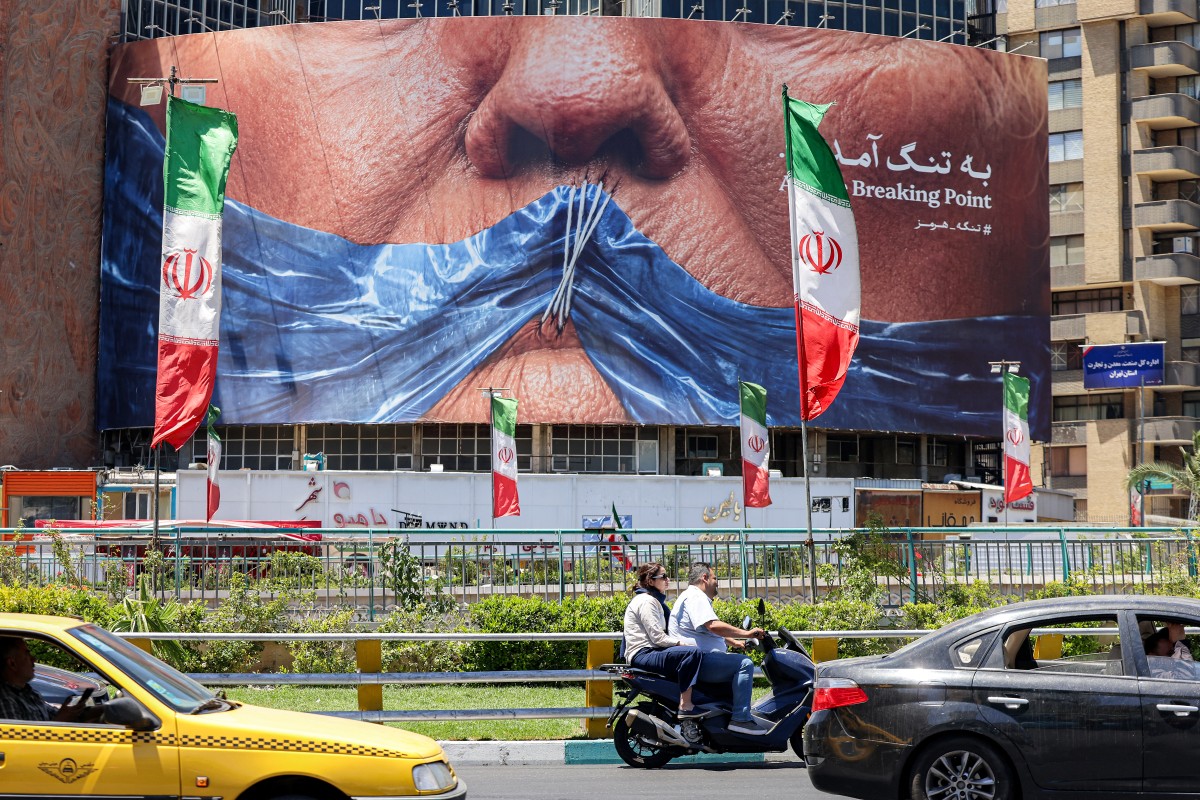
He had said that he was helping the Iranian people secure freedom from the evil and oppressive Islamic regime. And by doing so, he was promoting the cause of democracy and its accompanying liberal values.
But after 40 days of war and two months of shaky cease-fire, the Islamic Republic has emerged intact, and the Islamic Revolutionary Guard Corps (IRGC) high command has been further emboldened and armed with a new deterrent that appears even more powerful than all the weapons its adversaries damaged with airstrikes: its control over the Strait of Hormuz.
Trump has signed the MoU with this very regime!
Similarly, though Trump says that he has destroyed much of Iran’s defense industrial base and demolished some of its missile emplacements and mobile launchers, that was not his exact goal. He had said very emphatically during the initial days of the war that he was seeking “the total destruction of the nuclear and missile programs”.
Surprisingly, the MoU does not mention a single word about the missiles. On the issue of the nuclear program, the Islamist regime has given up almost nothing in the MoU. That it would not make a bomb is the regime’s old slogan.
So nothing new in it. What Iran would do with the tons of low-enriched uranium (nuclear material) remains to be discussed over the next 60 days. But then America, or for that matter, the nuclear scientists under the supervision of the United Nations, have been negotiating all this with Iran for years. The regime has proved itself to be masterful at stringing things along.
Now, even before any clarity, Trump has agreed to Iran exporting oil and derivatives immediately. Trump has promised that America would unfreeze Iranian assets worth tens of billions of dollars, lift sanctions, and help create a fund of at least $300bn for reconstruction and development.
None of Trump’s predecessors had done that.
Three other areas in the MoU seem particularly worrisome, each of which has been discussed in the EurAsian Times before.
First, Point 5 of the MoU will provide for the safe passage of commercial vessels at no charge for 60 days, while Iran and Oman will define the Strait’s postwar administration. But whether a final deal is struck or not, Iran has made clear that it intends to impose new restrictions and fees on commercial vessels transiting the Strait after the negotiation period ends. Iran’s lead negotiator, Speaker of Parliament Mohammad Bagher Ghalibaf, said outright that “the Strait of Hormuz will never return to its previous condition”.
If that happens, Iran will effectively be exercising sovereignty over the Strait of Hormuz. It will be in contradiction to what Trump has said all along that the toll in the Strait is “not acceptable” and “cannot happen”.
As pointed out in EurAsian Times, under international law, tolls or transit fees are legitimate only for artificial passages, such as the Suez or Panama canals, not for natural ones, such as the Strait of Hormuz.
Article 26 of the UNCLOS prohibits states from levying charges on vessels merely for passage, allowing fees only for specific services rendered. It says, “ No charge may be levied upon foreign ships by reason only of their passage through the territorial sea”.
Even Iran cannot stretch the argument that the Strait falls under its territorial jurisdiction (nautical miles, or 22 km, out of the total 39km width) beyond a point. Because the Strait also falls within Oman’s territorial waters. Thus, the entire width of the Strait consists of the overlapping territorial seas of both Iran and Oman.
But, unlike Iran, Oman is not talking of imposing transit fees or tolls. In fact, since Iran has no jurisdiction beyond 12 nautical miles from its coast, “it cannot charge a toll if your ship uses the Omani coastline.”
And it so happens that, though it has not been adequately pointed out, the shipping lanes lie mostly within Omani territorial waters, according to the Encyclopedia Britannica.
Secondly, Point 4 of the MoU, which talks of the US removing the naval blockade against Iran, mentions that “ the United States of America further undertakes to remove its forces from the proximity of the Islamic Republic of Iran within 30 days after the final deal”.
Does this mean that Trump has decided to remove American Central Command from the region?
As explained in the EurAsian Times earlier, way back in the 1980s, the Strait of Hormuz was nearly closed when Iran, then fighting Iraq, planted mines, targeted ships, and threatened maritime traffic. The resultant “Tanker War” led to the US Navy’s Fifth Fleet entering the region and subsequently establishing a permanent American military presence.
Now, US military installations housing thousands of personnel are located in Qatar, Bahrain, Kuwait, the UAE, Iraq, Jordan, and Saudi Arabia, supporting air, naval, and ground operations. The US today has approximately 40,000 to 50,000 troops in the Middle East. Iran wants them to be moved out.
Iran’s broader strategic goal is for the Gulf countries to see the American bases in their territories as magnets for escalation rather than shields, and then ask the Americans to leave.
So far, responses from the Gulf kingdoms have not met Iranian expectations because they fear that, in the absence of US forces, Tehran would find it easy to establish its regional supremacy by reviving its past policies to create pro-Iranian Shiite-led regimes in Iraq, Bahrain, Lebanon, and Syria.
There is also a school of thought that without American presence, Iran will find it easier to fulfill its nuclear ambition, something that will make the Arab allies who currently fall under the US security umbrella, including Saudi Arabia and the UAE, take security into their own hands, which, in turn, could include attempts to build, or just buy, a nuclear weapon from countries like Pakistan and North Korea.
Besides, a US withdrawal from the Gulf would not only create a power vacuum in the Middle East that China, Russia, or others might exploit but also send a message to other longtime American allies and partners in other parts of the world, particularly in the Indo-Pacific, that the United States may not defend them should they be attacked.
In other words, it is a question of the reputation of a country that prides itself on being the world’s number one power. But the wording of the MoU makes it appear that Trump has overlooked this factor.
Thirdly, and this is most important, Point 1 of the MoU, which is bilaterally signed by Trump and the Iranian President, talks of “ permanent termination of military operations on all fronts, including in Lebanon”, “ensuring the territorial integrity and sovereignty of Lebanon”, and “ the permanent termination of the war on all fronts, including in Lebanon”.
How can there be a commitment on Lebanon without the Lebanese government being a party to the MoU? This question was also discussed in the EurAsian Times earlier. The wording of the MoU violates Lebanon’s sovereign equality under Article 2(1) of the UN Charter. State sovereignty means Lebanon alone decides its negotiating partners and terms.
In short, if Trump has agreed with Iran that it can make Lebanon’s border and security of its proxy Hezbollah, it implies a third state can not only trade away another state’s foreign policy but also blur the line between state and non-state actors. Hezbollah is not a state and does not constitute an independent country under international law.
In that sense, the MoU sets a precedent and incentivizes other states to build proxies and demand a seat at the negotiating table on their behalf. It also amounts to legitimizing the trend of “creating a proxy in a conflict and then demanding concessions on it in unrelated talks”.
The target here happens to be Israel. The MoU seems to mandate an Israel Defense Forces (IDF) withdrawal from southern Lebanon without guaranteeing Israeli northern border security, which Israel views as a severe compromise of its defensive interests.
In other words, by making Israel’s actions against Hezbollah a factor in the MoU with the US, Iran has succeeded in denying Israel its right of “self-defense”, which is an inherent right of every country under Article 51 of the UN Charter.
It is highly unlikely that Israel will ever accept the MoU.
Incidentally, Hezbollah killed four Israeli soldiers, and Israel carried out a wave of retaliatory airstrikes in south Lebanon and the Bekaa valley that killed at least 18 people in the last 24 hours.
Viewed thus, it is difficult to state with confidence that the 60-day negotiations, as outlined in the MoU, will necessarily culminate in an enduring peace agreement in the Middle East. After all, an MoU is not a formal treaty, so commitments are not binding.
Even Trump realizes this, as his MAGA base is badly split on the MoU. As he has said, therefore, “I can exit any time and go back to dropping bombs again.”
In other words, if President Wilson could go back on his words, President Trump can do likewise.
- Author and veteran journalist Prakash Nanda is Chairman of the Editorial Board of the EurAsian Times and has been commenting on politics, foreign policy, and strategic affairs for nearly three decades. He is a former National Fellow of the Indian Council for Historical Research and a recipient of the Seoul Peace Prize Scholarship.
- CONTACT: prakash.nanda (at) hotmail.com