“It’s not the plane, it’s the pilot,” is one of the most memorable dialogues from the Tom Cruise-starrer Hollywood film, “Top Gun: Maverick,” whose climax showed an incredibly skilled pilot, Maverick, and Rooster, playing his wingman, flying a vintage enemy F-14 Tomcat after being downed over hostile territory.
Although never explicitly named in the film, the adversary bombed by American forces in Top Gun: Maverick was clearly Iran, and the enemy F-14 Tomcats belonged to the Islamic Republic of Iran Air Force (IRIAF)—one of the last air forces in the world still flying the American-origin fighter jet.
The film was visually stunning, but military observers were too quick to dismiss it as pure Hollywood fiction.
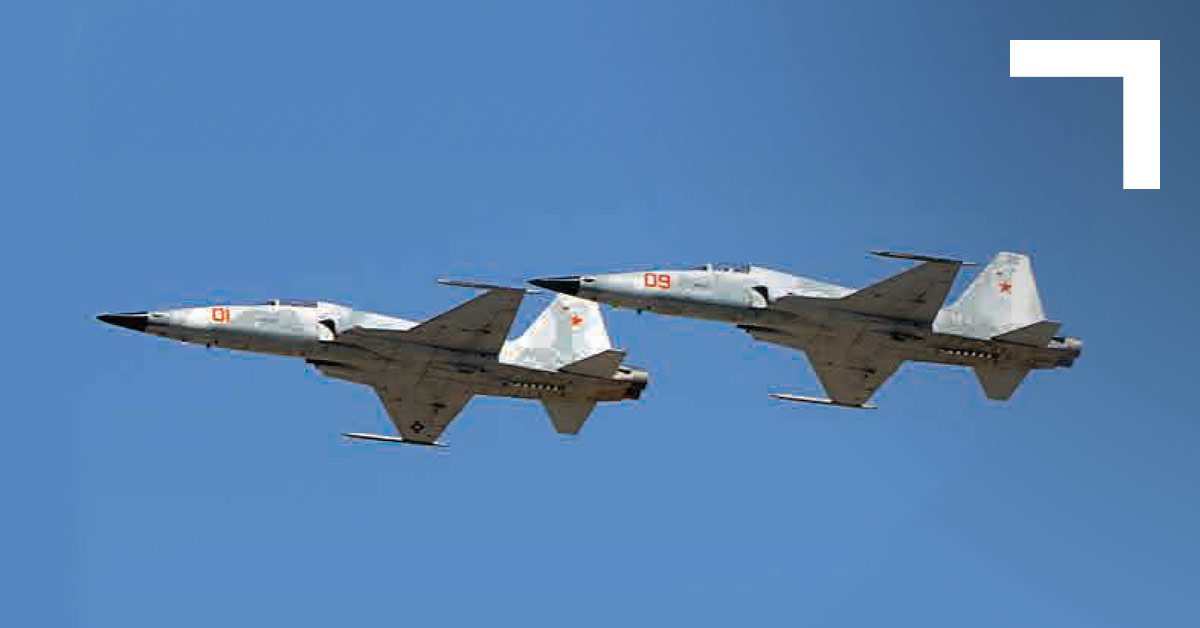
However, the Iranian pilots reportedly actually did the “impossible” and the “unthinkable” during the initial days of war with the United States, and flew a Top Gun-level mission on their age-old F-5 Tiger II to bomb Camp Buehring (also known as Al Udairi) in northwestern Kuwait, a major staging ground for US military operations in West Asia. And, they succeeded.
Not only did the Iranian pilots dare to go on what may have seemed like a suicide mission, but they also lived to tell the tale in a televised interview that was broadcast on June 17.
How Did They Do It?
In the interview, three F-5 pilots, including a commander and two pilots, publicly recounted their March 1, 2026, low-altitude bombing mission against Camp Buehring in Kuwait, which NBC News had reported in April, days after the ceasefire.
The Commander, whose identity remains concealed, told the interviewer that planning for an attack on Camp Buehring began immediately after they learned that the US and Israel had launched joint strikes on their country. “We immediately wanted to carry out a retaliatory operation,” the Commander stated, adding that Camp Buehring is “a highly strategic base with one of the highest troop concentrations and capacities.”
Camp Buehring is a major US Army staging, training, and logistics hub in the Middle East, as previously noted by the EurAsian Times. At its maximum capacity, the base can house up to 14,000 soldiers, although the exact strength there could not be determined.
The Commander said that they planned to fly the mission at an extremely low altitude to evade radar detection, and vowed to see it through.
“We flew at very low altitude. At some points, we passed beneath high-voltage power lines and flew below 50 feet,” he said. This is an extraordinarily low altitude, given that the typical training altitude from flight standards is about 500 feet, or over 152 meters, as the Commander himself emphasized. “We were practically skimming the ground… We would even pass beneath power lines,” he added.
Iranian TV aired interviews with F-5 jet pilots who hit Camp Buehring in Kuwait on March 1.
They flew in total radio silence below 15m to evade radar, deliberately bypassed other targets (power lines, refineries) to hit the base directly.
They reported major fires and… pic.twitter.com/7PI1Ck3dQb
— Clash Report (@clashreport) June 17, 2026
Camp Buehring has layered air defenses, including Patriot missile batteries, multiple shorter-range systems, advanced radar coverage, and persistent regional surveillance networks. All these systems went on ‘high alert’ after the US launched “Operation Epic Fury” on February 28, and Iran retaliated with ballistic missile and drone strikes on American military bases across the West Asian region.
The Commander further noted that they were aware that the facility had multiple layers of air defense systems. “Although we knew interception and surveillance sites were active, we maintained complete radio silence. We entered the waters of some neighboring countries and flew so low that at one point we passed between two ships,” he stated.
The jets turned to direct overflight once the crew had safely entered Kuwaiti airspace, as they had to deploy unguided free-fall bombs that required a direct approach to the target before release. “We had to fly directly over the target… As soon as we reached the base, we carried out a heavy bombing,” the Commander disclosed on television.
Although the extent of damage caused on the day has not officially been revealed, the pilots told the interviewer that they saw American helicopters and other aerial assets based at the facility bursting into flames. They said there were explosions at the site, and emphasized that the devastation was worse than anticipated.
The pilots reported that the strikes caused chaos and confusion, likely because the base personnel had not anticipated Iranian fighter jets intruding into their airspace.
Therefore, amidst all the pandemonium triggered at the facility, “Three [enemy] F-15 aircraft… were mistakenly engaged and destroyed simultaneously.”
“During our turn, we saw them firing missiles at targets in the sky. My back-seat cockpit officer told me an explosion had happened in the sky, and we were confused about where it was coming from. By mistake, their aircraft also took off, and the 3 American F-15s that were coming for a counterattack toward Iran, the Kuwaitis mistook them for targets & shot them down,” one of the pilots said.
With their bombing run complete, the Iranian jets conducted a deception operation, which allowed them to exit the Kuwaiti airspace and land at a predetermined spot in Iran.
“After the bombing, we carried out a deception maneuver… They were unable to track or intercept us,” the pilots recalled.
One of the pilots who took part in the operation said that he saw American military equipment being destroyed for as long as he could maintain visual contact following the strike. Additionally, he noted that no one had been worried about equipment shortages and that all Iranian Air Force personnel had been in mourning for the girl students who were killed in a school in the southern city of Minab during attacks by the US and Israeli forces.
“We never assumed we would return,” he recalled.
The Commander concluded that the mission lasted about 50 minutes and that only a few people knew the strike was planned. “Iran and the Iranian people are our first priority, and our own lives come last. If necessary, we will strike the enemy again.”
Notably, when the F-5 Tiger II strike on a Kuwaiti base was reported in April 2026, observers had expressed amusement at the fact that an Iranian second-generation fighter jet was able to penetrate the Kuwaiti airspace and bomb the strategic Camp Buehring military base despite a layered air defense.
Given that these aircraft are over five decades old, no one expected Tehran to employ these jets during the war, much less use them for penetrating and bombing US military bases in nearby Gulf countries. Therefore, the mission’s success could be credited, at least in part, to the US and Kuwaiti confidence in the Iranian Air Force’s binding limitations.
At the same time, the mission exposed the vulnerability of the US layered defense network, which had otherwise been projected as impenetrable. The F-5s bypassed Patriot systems and short-range air defense networks that were expected to create overlapping interception zones. While Patriots are optimized for ballistic missile defense, shorter-range air defense systems could, in an ideal situation, have detected and downed low-flying jets.
Experts have since noted that although technological supremacy is crucial in modern combat, it can be undermined by factors such as pilot skill, improvisation, timing, route selection, deception, and enemy complacency. The Iranian pilots, in fact, demonstrated that mere platform prestige is not enough for survival in contested airspace.
The latest revelations from the pilots sparked social media discourse, with several netizens and observers drawing parallels between the mission and the film Top Gun, and lauding the daring mission, while others, critical of Iran, dismissed it as mere propaganda.
An Iranian-American journalist, Borzou Daragahi, quoted the video of the interview to ask, “Meanwhile, where are the pilots that the US allegedly rescued from Isfahan?” He was referring to the crew of the F-15E that were downed by Iran and then rescued by the US military in a high-stakes operation.
Interestingly, a video of an Iranian F-4 Phantom allegedly flying at very low altitude over the Persian Gulf was posted to X by a Tehran-based netizen. “This video was released back in 2015 by an Iranian F-4 Phantom pilot. They were training at low altitude over the Persian Gulf. Iranians have been getting ready for a day like this for years,” the user wrote.
These claims, like the testimony of the three pilots who purportedly bombed the base with their F-5 Tiger IIs, could not be independently verified. However, if it happened the way they described, it is proof that experienced pilots in older aircraft could still penetrate modern layered defenses through tactics rather than technology.
At last, the mission is the vindication of the dialogue: “It’s not the plane, it’s the pilot.”
- Contact the author at sakshi.tiwari13 (at) outlook.com
- Follow EurAsian Times on Google News