Since Donald Trump assumed office, the Lockheed Martin F-35 Lightning II has suffered a string of setbacks as several existing and prospective customers have scaled back or abandoned their planned purchases. However, Canada is sending mixed signals on its ongoing review of the 88-jet order.
Canadian Prime Minister Mark Carney put the purchase of 88 F-35 stealth fighters under review in March 2025 amid rising tensions with the Trump administration. The country will receive the 16 F-35A fighters that have been paid for, whilst it decides its next course of action for the remaining 72 jets.
Shortly after Canada halted its F-35 purchase, it received an offer from Saab for Gripen-E/F fighters, which has been modified over the past year to make it more attractive to the Royal Canadian Air Force.
The Swedish manufacturer has offered a package comprising 72 Gripen E/F fighters and 6 GlobalEye surveillance aircraft, along with local manufacturing, full technology transfer (ToT), source code access to mission systems, sovereign data control, and full independent upgrade and maintenance capability for the Royal Canadian Air Force (RCAF).
While the review was expected to be published by the end of summer 2025, it has been indefinitely delayed, with no clarity on when a decision will be made, further straining the already-strained US-Canada relationship.
Interestingly, though, a recent CBC report states that the Carney administration is now considering expanding its fighter jet purchase beyond 88 to include both the American F-35 Lightning II and the Swedish Gripen E/F to bolster Canadian air power.
Citing industry and government sources, the report stated that discussions are underway to acquire a larger mixed fleet of both jets. Canada would acquire 72 to 88 F-35A Lightning II jets even if it proceeds with the purchase of Gripen-E jets, the report stated, adding that the country is considering purchasing at least 72 Gripens.
“There could easily be a fleet of 140 aircraft,” the CBC report stated, citing an informed source.
While the claims could not be independently verified, we know that the Carney government has given enough signs that it is not yet ready to abandon the F-35, even in the face of a sustained trade row with Washington and frequent public arm-twisting by the Trump administration.
For example, Lt.-Gen. Jamie Speiser-Blanchet, the commander of the RCAF, attended the ceremony marking the start of the final assembly of Canada’s first F-35A, and Canada has already paid for key components for 14 additional F-35s.
Officials in the Canadian administration, including Defense Minister David McGuinty, have continued to keep the mystery alive, suggesting that the country is open to buying another foreign aircraft. However, RCAF officials and Canadian conservatives have urged PM Carney to complete the purchase, arguing that the F-35 is the only fifth-generation fighter available to the RCAF capable of countering threats from countries like Russia and China and ensuring interoperability with the US under the NORAD framework.
Earlier, the US had suggested that not buying the F-35s would endanger NORAD, the binational defense pact with the United States.
It is pertinent to note that some experts believe that Carney never even intended to abandon the F-35, and that the review was an eyewash and a symbolic gesture aimed at sending a diplomatic message to Washington amid what was seen as US bullying. In fact, the CBC report underlined that Carney “could use the fate of the F-35 program as part of negotiations over the renewal of the Canada-U.S.-Mexico Agreement (CUSMA).”
Losses For Lockheed
Since Donald Trump took over as President in January 2025, several existing F-35 buyers have slashed their purchases, and prospective buyers have reneged on their commitments to buy the aircraft and started seeking alternative jets. This has been attributed to Trump’s unilateral tariffs, faltering commitment to NATO, and the US President’s unreliability as a staunch defense partner.
Many believe that the US President could weaponize their purchase of F-35 in a potential disagreement or diplomatic unrest, and probably withhold the spares or software upgrades needed to fly the aircraft.
“The world has changed … and this ally of ours … could bring limitations to use, maintenance, components, and everything that has to do with ensuring that aircraft will be operational and used in all types of scenarios,” the outgoing Portuguese Defense Minister Nuno Melo said at the time, referring to the US policies.
By August, Spain had also announced that it was shelving plans to purchase the fifth-generation stealth aircraft.
While Spain had allocated about 6.25 billion euros, or $7.24 billion, in its 2023 budget to buy new fighter jets, the Spanish government’s decision to use the majority of the extra 10.5 billion euros for defense in Europe made it impossible to buy the American stealth aircraft, as reported by the EurAsian Times at the time. The decision was made amid calls for self-reliance across Europe, driven by fractures in the transatlantic relationship.
Later that year, the Swiss government slashed its original purchase of 36 F-35A jets, citing high costs, and walked back on a deal that was signed in 2022 despite criticism at home.
In December 2025, the Swiss government announced that it had instructed the Defense Ministry to purchase only as many F-35A fighter jets as could be bought within the previously agreed budget of $7.54 billion.
“Due to the foreseeable additional costs, it is not possible from a fiscal point of view to maintain the originally planned number of 36 F-35A. Due to the decision of the Federal Council, it does not require any additional credit, and the will of the people is met,” the Swiss government said in a statement.
The Swiss government had reportedly assumed that the agreed amount was the fixed procurement price, but the US later clarified that this was a miscommunication and attributed the additional costs to inflation. Nonetheless, the move came after Trump imposed a 39% tariff on Swiss goods, which emboldened critics to vociferously oppose the purchase of US fighter jets.
Meanwhile, India, which was verbally offered the F-35 by US President Donald Trump and Vice President J.D. Vance in February 2025, appears to be making no progress. The F-35 jets also participated in the Aero India show in Bangalore and grabbed global media limelight, as it was the first time the F-35 shared a venue with the Russian Su-57.
In August 2025, Trump imposed a 50% tariff on India, one of the highest in the world, likely as a punishment for buying Russian oil. Additionally, Trump’s repeated claims about ending the Indo-Pakistan war of 2025, an assertion New Delhi vehemently rejected, further deteriorated the bilateral ties.
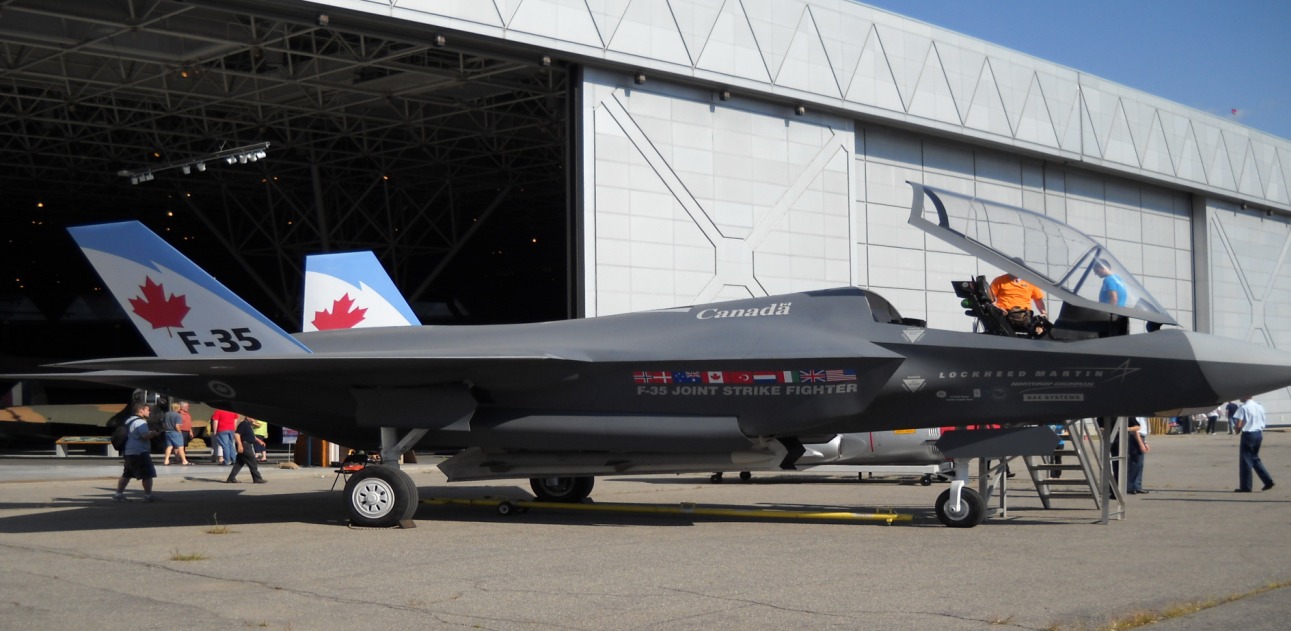
In addition to multiple F-35 setbacks, the manufacturer received a rude shock when it lost the contract for the next-generation F-47 to Boeing in March 2025. The announcement came as a big upset to Lockheed, which had earlier withdrawn from the US Navy’s F/A-XX next-gen fighter contest.
For a company that gave America both of its fifth-generation fighters, i.e., F-35 and F-22, the loss of the F-47 contract may have been rather painful.
In April 2025, Lockheed Martin Chief Executive Jim Taiclet claimed that the company could integrate 80% of sixth-generation NGAD technology into its fifth-generation F-35 Lightning II, which is already in production at half the cost, and create what he called the “fifth-generation plus” variant of the F-35.
“We’re basically going to take the [F-35] chassis and turn it into a Ferrari,” Taiclet stated. “It’s like a NASCAR upgrade, so to speak, where we would take the F-35 [and] apply some of those co-funded technologies both from NGAD and the F-35 program. Eventually, there’ll be 3,500 of those [F-35] chassis out there at various stages of technology and capability [worldwide]. We think we can get most of the way to sixth-generation at half the cost.”
For now, it is safe to say that a favorable decision from Canada would therefore be a much-needed boost for Lockheed Martin.
- Contact the author at sakshi.tiwari13 (at) outlook.com
- Follow EurAsian Times on Google News