Japan must reinforce and transform its defense capabilities with a stronger “sense of urgency and crisis” than ever before, Defense Minister Shinjiro Koizumi said Tuesday, as Tokyo released its annual white paper that once again flags risks from China, North Korea and Russia.
In the preface to the 598-page Defense of Japan report, Koizumi wrote that the security environment surrounding the country is now the most severe and complex since the end of World War II.
He pointed to the rapid military build-ups by Beijing and Pyongyang, their expanding cooperation with Moscow, and the new forms of warfare demonstrated by Russia’s invasion of Ukraine, warning that a serious crisis capable of shaking the postwar order cannot be ruled out in East Asia.
Japan is already accelerating its military modernization. Defense spending has been pushed higher, with the budget for the current fiscal year exceeding 9 trillion yen for the first time, while Tokyo deepens security partnerships across the Indo-Pacific.
Missile launchers are being stationed on remote southwestern islands closer to potential flashpoints, the Self-Defence Forces are moving to field longer-range “counterstrike” weapons that could hit targets beyond Japanese territory, and rules restricting arms exports have been loosened to allow greater transfers of equipment and technology to like-minded partners.
In the Indo-Pacific, “not only are China and North Korea further strengthening their military capabilities, China-Russia and Russia-North Korea are also reinforcing their cooperation,” he also added.
The new white paper said China was “intensifying its activities” in the region around Japan, “extending beyond the so-called first island chain to the second island chain”.
It listed a series of incidents in 2025, including activities by Chinese aircraft carriers and the “unusual close approach” by Chinese aircraft to Japanese planes in two incidents in June and July.
Japanese jets scrambled 595 times in the year to March 31, 2026, including 366 sorties against Chinese aircraft and 214 for Russian planes. This compares to 704 the previous year and was the fewest since at least 2021.
Japan decided in April to lift its self-imposed ban on weapons exports, but the white paper highlighted issues in the country’s production base that could jeopardize procurement and innovation.
Koizumi also said that he and US counterpart Pete Hegseth had “exchanged candid views” on the “unwavering” US-Japan alliance, while also increasing security cooperation with the Philippines, Australia and South Korea to realize a “Free and Open Indo-Pacific”.
“As the security environment becomes increasingly and rapidly severe, what is required now is to strengthen resilience against crises all across the entire Indo-Pacific region,” Koizumi said.
“In order to do so, Japan will build and expand multilayered networks among allies and like-minded countries, and enhance interconnectivity with like-minded countries and others in every area.”
Meanwhile, China has repeatedly voiced concern at what it sees as a return to “new militarism” by Tokyo.
After World War II, Japan adopted a pacifist constitution in 1947, with Article 9 renouncing war as a sovereign right and prohibiting the maintenance of military forces, seeking a peaceful global order.
“Aspiring sincerely to an international peace based on justice and order, the Japanese people forever renounce war as a sovereign right of the nation and the threat or use of force as a means of settling international disputes. In order to accomplish the aim of the preceding paragraph, land, sea, and air forces, as well as other war potential, will never be maintained. The right of belligerency of the state will not be recognized,” reads Article 9 of the Japanese Constitution.
Japan, the only victim of a nuclear attack in history, also adopted the “Three Non-Nuclear Principles” of non-possession, non-production, and non-introduction of atomic weapons. Even though all five victors of the Second World War built their nuclear weapons.
Japan relinquished wars of aggression, militaristic societies, and the production of nuclear weapons. In the post-war era, Tokyo directed the nationalistic impulses of its country toward becoming an economic powerhouse and technology leader.
Japan became the world’s second-largest economy in 1990 after the disintegration of the Soviet Union.
China’s military muscle-flexing in the South China Sea, North Korea’s missile proliferation, and Japan’s strained ties with Russia, especially after the Ukraine invasion, are forcing Japan to shed its post-war inhibitions and adopt a more assertive defense role.
Former Prime Minister Shinzo Abe played a critical role in Japan’s transformation. Abe had raised the prospect of the country hosting US nuclear weapons facilities on Japanese soil, boosted defense spending, and called for a strong foreign and security policy.
Under Abe, Japan passed legislation allowing the Japan Self-Defense Forces to engage in overseas combat missions. Essentially, this bill allows Japan’s armed forces to help defend its allies, like America, even if Japan itself isn’t under attack. The Japanese Constitution, following the devastation from the war, previously limited Japan’s forces to self-defense within its borders.
In December 2024, Japan approved a 9.4% increase in defense spending for FY2025. This marked another record figure for the 11th year in a row for Japan’s national defense budget. Japan, which has historically spent less than 1% of its GDP on defense, has also promised to raise it to 2% of its GDP by 2027.
This defense spending hike was part of the Defense Buildup Program, which outlines US$273 billion in defense spending over the five-year period through FY2027.
Japan is also building alliances with China’s competitors. It has developed and promoted military ties with several countries in and beyond the Indo-Pacific region. It has strengthened security cooperation with Australia and India—both members of Quad alongside Japan and the USA—through high-level dialogues, joint military exercises, intelligence sharing, and mutual access to each other’s military facilities.
In December 2022, Japan announced a joint program with Italy and the United Kingdom to develop a new sixth-generation combat aircraft—the Global Combat Air Program (GCAP).
Japan is developing two hypersonic weapon concepts: the Hypersonic Cruise Missile (HCM) and the Hyper Velocity Gliding Projectile (HVGP), as well as long-range missiles.
Japan’s Ministry of Defense (MOD) also conducted flight tests for its island defense hypersonic glide vehicle (HGV). Four test launches were conducted at a site in California, with one launch in August 2024, two in November 2024, and one in January 2025.
Japan’s new 10kW-class high-power laser electronic warfare (EW) vehicle recently entered service to counter aerial and missile threats, including hostile unmanned aerial vehicles (UAVs) and low-altitude missile systems.
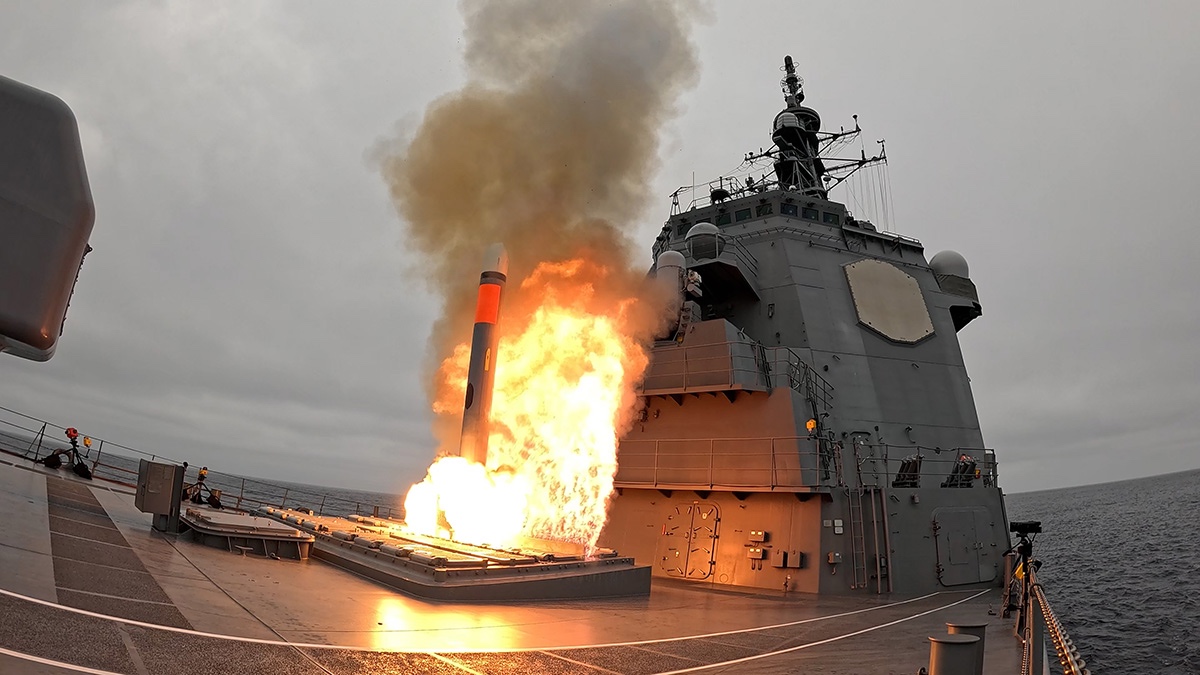
Meanwhile, Tokyo announced on July 30 that it had test-fired a Tomahawk land-attack cruise missile from one of its warships, the Aegis guided-missile destroyer JS Chokai (DDG-176), for the first time.
Additionally, Tokyo fielded the Type 25 Hyper Velocity Gliding Projectile, its first indigenous hypersonic boost-glide weapon, following successful California flight tests and domestic deployment drills that included loading launchers onto ships and aircraft.
In late July, an F-2 fighter conducted the first captive-carry flights of the air-launched Improved Type 12 (Type 25) long-range missile at Gifu Air Base, validating integration ahead of planned service in 2027.
Separately, a 100 kW-class shipboard laser system began sea trials aboard the test ship Asuka in late 2025, targeting drones and projectiles. Japan also conducted its first anti-ship missile live-fire on domestic soil in June 2025, firing a Type 88 from Hokkaido.
These developments highlight Tokyo’s push for stand-off strike and layered defenses amid regional tensions.
Mail us at: editor (at) eurasiantimes.com