The US Navy has awarded a historic $76.6 billion contract to build 14 new submarines, as Washington races to maintain its dominance over China in undersea warfare.
The deal includes the construction of five Columbia-class nuclear-powered ballistic missile submarines (SSBNs), awarded to General Dynamics Electric Boat (GDEB).
The contracts also provide for the construction of nine Virginia-class nuclear-powered attack submarines (SSNs) during fiscal years 2025–2029. The nine-ship contract was awarded to GDEB and HII-Newport News Shipbuilding (HII-NNS).
Together, these new awards represent a historic investment in maritime modernization and supremacy, with a combined total value of US$76.6B. The award will also strengthen the U.S.’s nuclear triad capacity.
“The awards drive the critical, once-in-a-generation recapitalization of the Navy’s undersea forces and the Nation’s nuclear triad,” according to the U.S. Department of the Navy.
“This historic investment underscores the Department’s continued commitment to undersea superiority and the recapitalization of our nuclear triad,” said Vice Adm. Robert Gaucher, Director, Submarine Programs.
The Columbia-class submarines will replace the Navy’s aging nuclear deterrent fleet, ensuring the continuity of the United States’ sea-based strategic nuclear deterrent.
$29.5B.
Five Columbia-class ballistic missile submarines.
Uncontested deterrence. pic.twitter.com/FdjVsk2B8G
— Acting Secretary of the Navy Hung Cao (@SECNAV) July 29, 2026
As the most survivable leg of the nuclear triad, the Columbia Class ballistic missile submarine represents a modern platform of national security and remains the Department of War’s number one acquisition priority, the U.S. Navy statement said.
Furthermore, these contract awards support the fielding of enhanced Virginia Class submarines, a platform engineered for unparalleled stealth, heavy payload strike capability, and multi-domain lethality.
The Virginia Class submarine is the premier tactical strike and multi-mission platform, ensuring continuous global undersea dominance, the US Navy said.
“By securing the continuous production of both the Columbia and Virginia classes, we ensure we will continue to deliver the world’s most lethal, survivable and resilient combat platform to our global Combatant Commanders, while providing long-term stability to our shipbuilding industrial base,” Vice Adm. Gaucher said.
The U.S. Navy now has seven Columbia-class submarines under contract, complementing a force of 26 operational Virginia-class submarines with 23 more slated to be built.
U.S. Navy Seeks Revolutionary Submarine-Launched Surface-to-Air Missile
Separately, the U.S. Navy is also seeking a new family of modular surface-to-air missiles, including a version that will arm future variants of the Virginia-class submarine.
The information was provided in a draft request for solutions contracting notice recently posted online.
“The United States Navy (USN) is seeking a new, modular interceptor to serve as the basis for the Naval Modular Missile (NMM) program, a next-generation initiative designed to revolutionize surface naval capabilities through multi-mission utility, enhanced capacity, and a modular open architecture,” according to the recent draft request.
Under this new NNM program, the U.S. Navy seeks to develop at least four distinct surface-to-air missile interceptors.
Though all four NNMs will fall in the broad category of Terminal Stage Interceptors (TSI), the four variants will differ substantially in their role and capabilities.
The four variants are: NNM Multi-Mission Long Range (LR), NMM Extended Range Submarine (ER-S), NMM Dual-Pack Extended Range (DP-ER), NMM Quad-Pack Medium Range (QP-MR).
The NMM ER-S is an extended-range interceptor intended to be launched from future versions of Virginia-class nuclear-powered attack submarines.
Notably, US submarines do not have an operational dedicated SAM system for engaging aircraft or other aerial threats.
Traditional weapons of US submarines are Tomahawk cruise missiles, Harpoon anti-ship missiles, Torpedoes, and Trident ballistic missiles.
Therefore, the development and operationalization of submarine-launched NMM ER-S would add a critical, all-new capability to the U.S. submarine fleet and would provide protection against airborne threats such as anti-submarine warfare (ASW) aircraft, while also contributing to broader fleet air defense.
This would give US submarines a true anti-aircraft capability for the first time, allowing them to engage planes or drones while remaining submerged or semi-submerged.
Furthermore, given that no country has operationalized a submarine-launched surface-to-air missile capability, this would give the U.S. submarine fleet a critical and exclusive defensive capability that will enhance its survivability in contested waters.
However, Germany is also developing its own submarine-launched SAM.
Germany’s IDAS (Interactive Defense and Attack System for Submarines), based on the IRIS-T missile, is designed for fully submerged launch from standard 533 mm torpedo tubes.
Traditionally, submarines were armed with man-portable air-defense systems (MANPADS), and submarines had to surface or expose the conning tower so a crew member could fire them manually. A tube-launched submarine-based SAM would be a revolutionary addition.
The addition of 14 new submarines (Five Columbia-class and nine Virginia-class) and SAM capability on future Virginia-class variants will boost the U.S. Navy’s capabilities as it races to maintain its edge over China in the critical domain of undersea warfare.
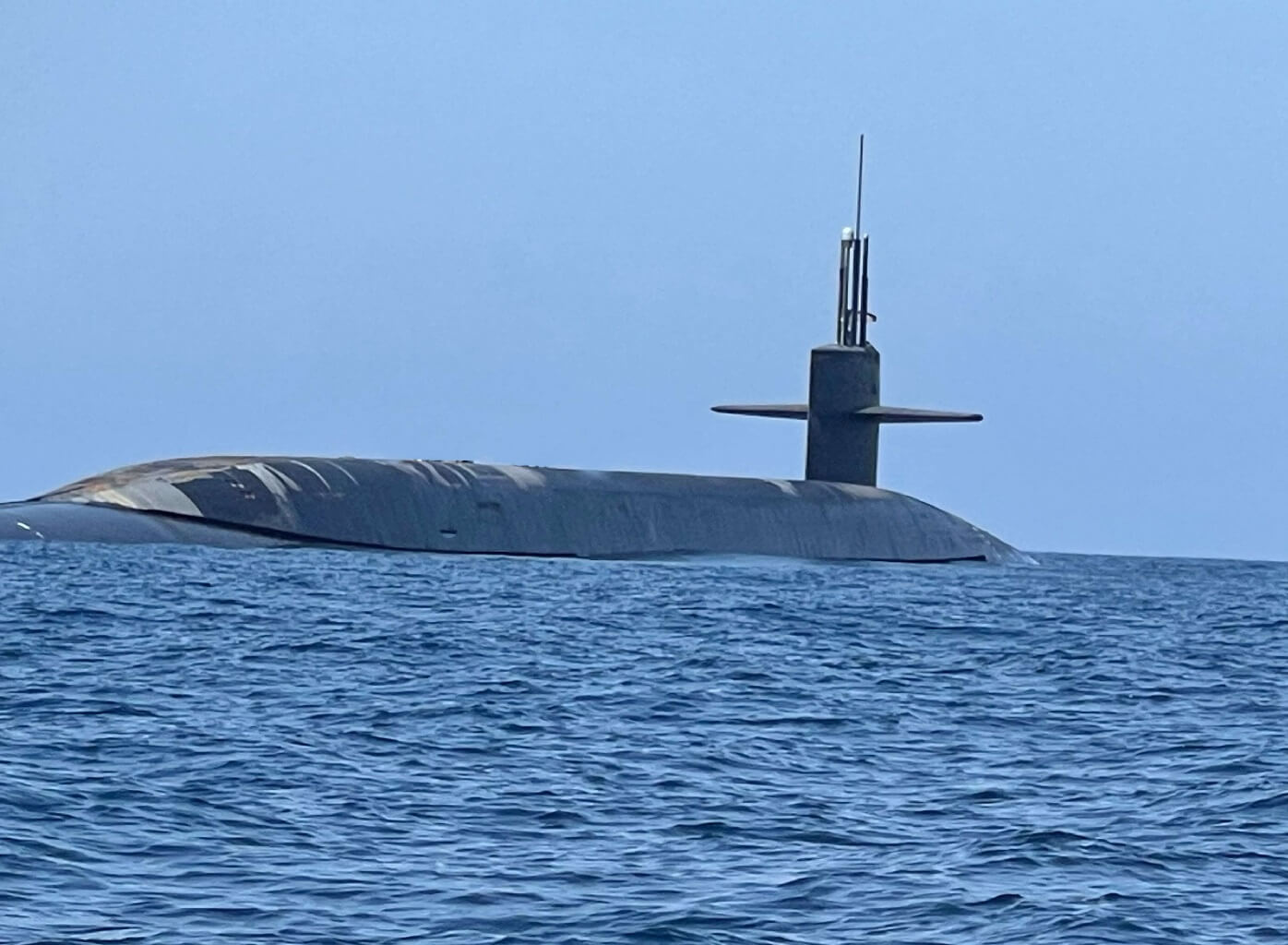
U.S. Vs China In Undersea Warfare
China already possesses the world’s largest maritime fighting force, with 234 warships compared to the U.S. Navy’s 219.
However, the U.S. still maintains an edge over China in undersea warfare.
But, according to a Pentagon report on the People’s Liberation Army (PLA), released in December last year, even in submarine fleet strength, Beijing is set to match U.S. capabilities by the end of this decade and might even surpass Washington’s submarine fleet by 2035.
According to the Nuclear Threat Initiative (NTI), the US Navy currently has 71 submarines, all nuclear-powered. However, some latest reports put the strength of the current U.S. submarine fleet at 66.
This list includes 14 Ballistic Missile Submarines (SSBNs), 53 Nuclear-Powered attack submarines (SSNs), and four Guided Missile Submarines (SSGNs).
Similarly, according to the NTI, China has 60 submarines, of which only 12 are nuclear-powered.
China has six Ballistic Missile Submarines (SSBNs), six Nuclear-powered attack submarines (SSNs), and 48 Diesel-electric attack submarines (SSKs). Of the 48 SSKs, 12 submarines feature Air-independent propulsion (AIP), a technology that makes them quieter and allows them to stay submerged longer.
While China has not yet operationalized a nuclear-powered aircraft carrier, Beijing has nearly half a century of experience with nuclear-powered submarines.
China’s first nuclear-powered submarine, which was a loud and slow vessel, entered service in 1974. Since then, Beijing has made considerable progress in improving its nuclear-powered subs. They are now larger, quieter, and faster.
In recent years, China has made particular strides in nuclear-powered submarines, whose greater speed, range, and endurance give its Navy greater reach.
New models under development include the Type 095, which analysts expect to feature vertical launch tubes capable of accommodating cruise missiles.
According to the Institute for National Defense and Security Research, the capabilities of China’s two new nuclear submarines – the Type 095 and Type 096 – match those used by the US and Russia.
Additionally, China is set to add more submarines each year than the US, meaning it will have far greater submarine strength than the US in the future.
According to the US Navy’s long-range shipbuilding and fleet inventory plan 2025, the US submarine strength will drop to 47 by the end of this decade, before hovering in the mid-50s for many years. The fleet isn’t projected to hit 66 until 2054.
On the other hand, China’s submarine strength will rise in the coming years. A 2023 US Department of Defense (DoD) report anticipates that China will grow its submarine force to 80 units by 2035. Nearly 20 of these subs could be nuclear-powered.
According to a 2024 CSIS report, China’s submarine technology is rapidly improving, and its submarine production capacity is growing.
China has added between seven and eight Type 093B submarines in just the past three years, a production rate that exceeds the number of attack submarines China has constructed over the past three decades.
When including conventional submarines, such as the new Type 039C, China’s total submarine fleet launched over the past three years exceeds 15, underscoring China’s impressive submarine-building capacity.
These numbers suggest that in the next decade, China might have nearly 20 more submarines than the US.
However, in qualitative terms, Washington still might have an edge over China. As noted earlier, while all of the US submarines are nuclear-powered, China will have only around 20 nuclear-powered submarines.
The addition of 14 new submarines and a SAM capability are, therefore, key to Washington’s efforts to maintain parity with Beijing in undersea warfare.
- Nitin J Ticku holds a double master’s degree in Journalism and Business Management from the University of Glasgow. He has over 20 years of global experience in MARCOM, Journalism, and Digital Marketing, and has worked & traveled widely across Europe, the Americas, and Asia. Nitin is the Editor of the EurAsian Times.
- He can be reached at editor (at) eurasiantimes.com