HAL’s Su-30MKI upgrade pivots almost entirely around the Virupaksha AESA radar being developed by DRDO to replace the existing N011M Bars Passive Electronically Scanned Array (PESA) radar.
DRDO’s confidence in successfully developing the Virupaksha AESA on a tight timeline rests on its experience and technological strides in developing the Uttam AESA for the LCA Mk-1A.
However, is that confidence justified, keeping in mind that delays in developing the radar and performance shortfalls could result in serious IAF capability gaps?
Uttam AESA
Development of the Uttam radar started around 2012, when DRDO showcased a prototype. The radar has not yet been operationally inducted.
As of August 2026, HAL claims that the Uttam radar has been extensively flight-tested. More than 120 sorties had been flown on Tejas LSP-2/LSP-3 by mid-2025, and the program had reportedly completed the major flight-test phases and hardware qualification required for certification.
Back on February 20, 2015, LRDE officials told the author that rooftop trials of the radar were set to commence. (It had earlier been reported in the press that rooftop trials had already commenced.)
SK Sharma, Chairman and Managing Director of BEL, told reporters at Aero India 2015, “Our Active Array Radar is currently being developed in collaboration with DRDO, and would take 2 years to complete. The progress is going good and we hope Tejas could ultimately have homemade radars.”
During 2016–17, the AAAU (Active Antenna Array Unit) prototype was tested on the rooftop. Integration and testing of the engineered version on LSP-2 was in progress.
During Aero India 2019, ADA displayed LSP-2 fitted with the Uttam AESA radar. The radar was then being flight-tested on a Hawker-800 business jet.
In February 2021, DRDO chairman Sateesh Reddy told TOI, “We will have the Uttam radar from the 21st Tejas Mk-1A to be produced. Uttam has performed better than anticipated in the trials so far. We’ve already signed an MoU with HAL,” he added.
MQ-9B Sea Guardian — Military Experts Back India’s $203M Drone Lease From GA-ASI Despite High Costs
No Production Clearance Yet
The plan to introduce Uttam partway through the first 83-aircraft Mk-1A order has now effectively been abandoned. HAL’s management stated in May 2026 that Uttam would not be included in the 83-aircraft program because DRDO had not yet given production clearance. HAL now plans to integrate it into the 97-aircraft Mk-1A order.
In July 2026, Astra Microwave received a ₹2,205-crore HAL order for 122 AAAUs and 121 interface frames for the Uttam program, intended for the second tranche of Tejas Mk-1As.
It has been reported that aircraft-level integration, software/interface validation, weapons integration, environmental and electromagnetic testing, certification and acceptance by the IAF are not yet complete.
There can be no doubt that DRDO is close to wrapping up the Uttam project. After over 14 years of development, Uttam is no longer merely an experimental radar, but neither is it yet a production-standard, operationally inducted IAF radar.
A realistic target for Uttam to achieve full maturity and operational induction would be 2029–30.
Su-30MKI Upgrade Program
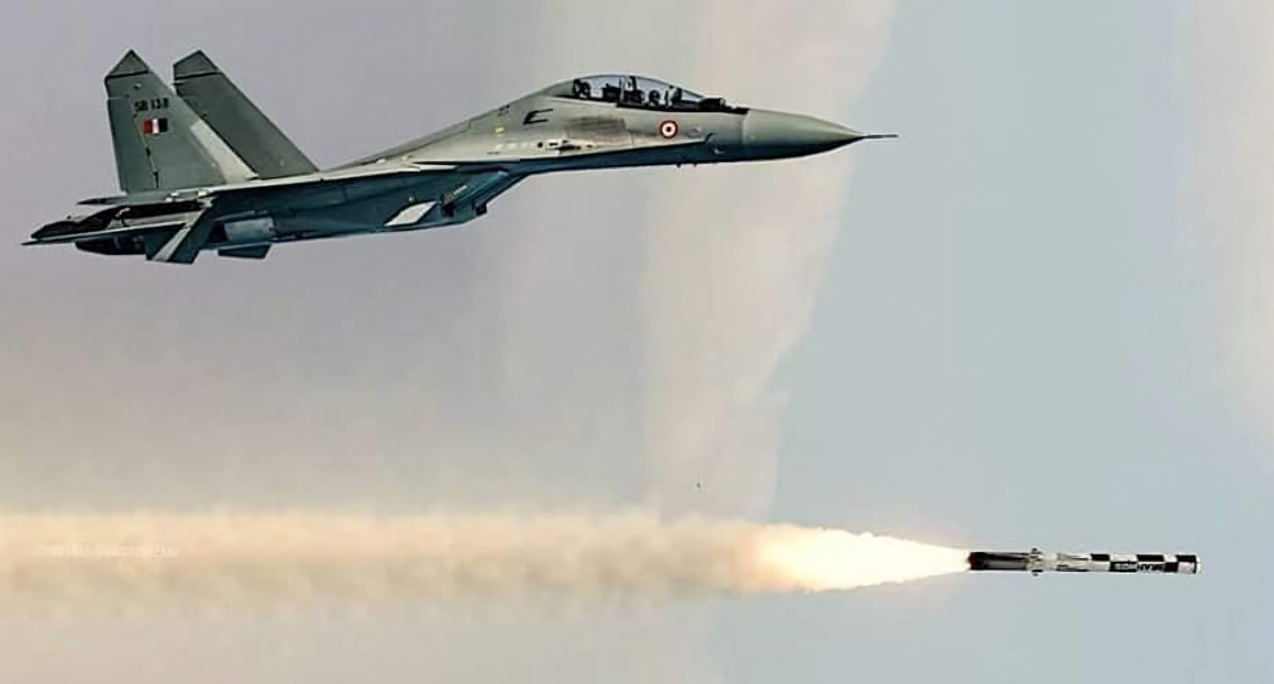
The Indian Air Force’s Su-30MKI fighters have been undergoing spiral upgrades for over a decade, with key milestones including the successful integration of the BrahMos supersonic cruise missile and Astra air-to-air missiles.
In 2022, the IAF outlined plans for a more comprehensive block upgrade. In October 2022, The Times of India quoted IAF Chief Air Chief Marshal V. R. Chaudhari as saying, “We have decided this upgrade will be done indigenously with a plethora of indigenously-designed weapons, electronic warfare systems and the like.”
By October 2023, reports in The Economic Times indicated that the proposed upgrade would touch every aspect of the fighter—except its airframe and engines.
On November 30, 2023, the Defense Acquisition Council (DAC) formally approved the block upgrade program. The project is expected to unfold in two phases: the first focused on installing advanced avionics and radar systems, and the second on enhancing the aircraft’s flight-control systems.
The DAC approved the indigenous Su-30MKI upgrade from HAL on November 30, 2023.
Among the most significant upgrades is the integration of the indigenously developed Virupaksha AESA radar, which will substantially improve detection, tracking, and engagement capabilities. Additionally, the Su-30MKIs will be fitted with a new indigenous Infrared Search and Track (IRST) system, enhancing both air-to-air and air-to-ground targeting. The upgrade will also introduce a new electronic warfare suite designed to detect, jam and neutralize enemy threats, significantly boosting survivability in contested airspace.
Together, these upgrades will not only extend the operational life of the Su-30MKI fleet but also transform it into a more lethal, survivable and networked combat platform for the future battlespace.
Considering the steady depletion in IAF fighter aircraft strength and the growing stealth and drone threats from our adversaries, the Su-30MKI upgrade is a welcome short-term move to plug IAF operational capability gaps.
Virupaksha AESA
However, making the Su-30MKI upgrade totally dependent on the still-under-development Virupaksha AESA introduces risks that should not be ignored.
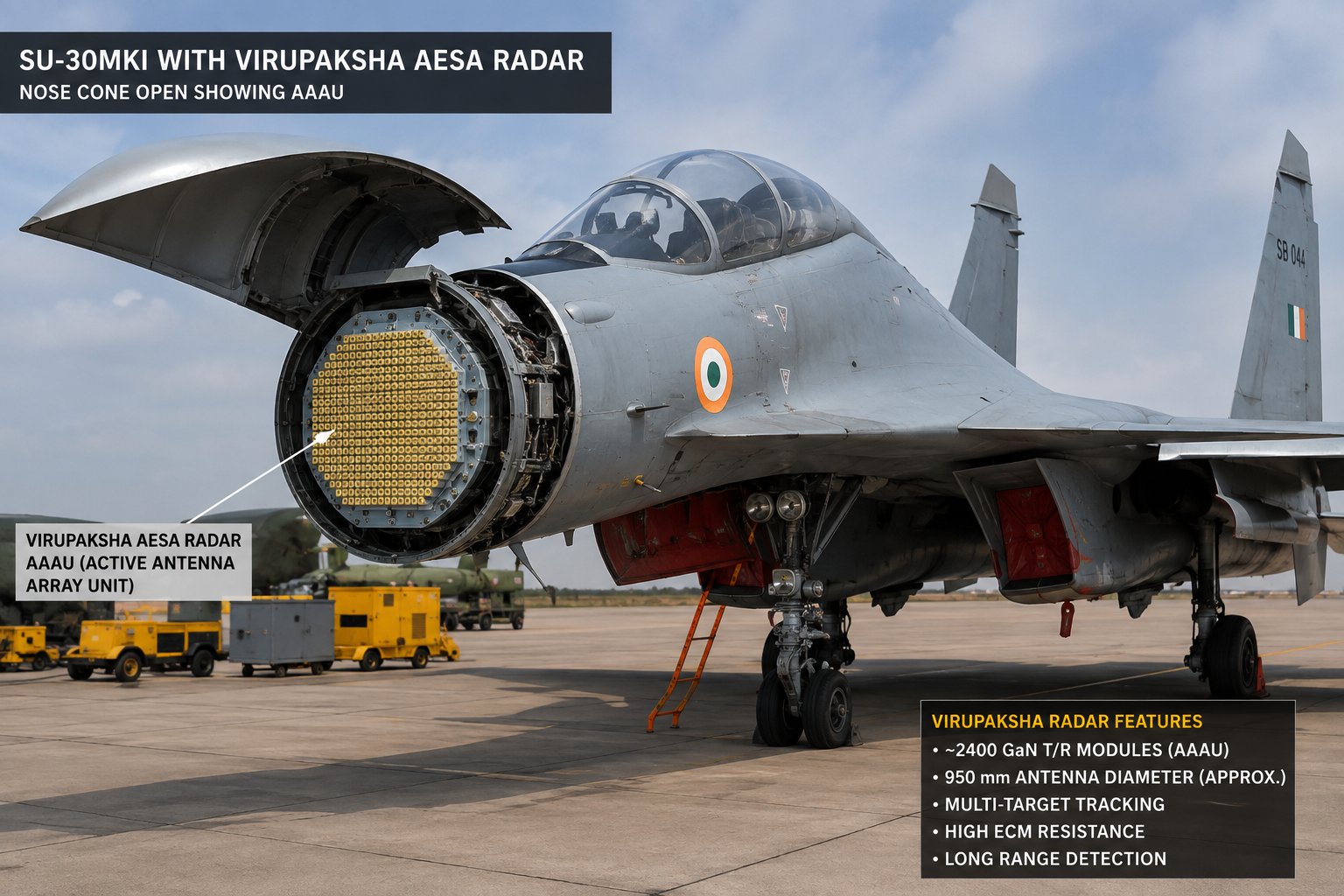
The Virupaksha is a next-generation Active Electronically Scanned Array (AESA) radar specifically tailored for the Su-30MKI upgrade program. The radar reportedly features around 2,400 Gallium Nitride (GaN)-based transmit/receive modules. Importantly, it is being developed as a plug-and-play system compatible with the Su-30MKI’s existing avionics architecture.
Development work is already underway.
While the Virupaksha AESA radar offers impressive capabilities, its development, integration, and validation are likely to be a multi-year process.
However, integrating such a sophisticated sensor onto a legacy platform like the Su-30MKI is a daunting challenge. Despite the system’s modularity, radar integration is complex and delicate, requiring seamless interfacing with flight-control, navigation, and weapons-management systems. As the primary onboard sensor, the radar must operate flawlessly under real-time combat conditions, making integration and testing both technically demanding and time-consuming.
Upgrade Timeline
DRDO has not officially committed to a Virupaksha development timeline.
In October 2022, the then IAF chief, Air Chief Marshal V. R. Chaudhari, told TOI that the design and development phase would take four to five years, after which the major upgrade would begin.
In February 2024, The ET reported that the Air Force was set to begin integrating the new systems within the year, with approximately 90 fighters slated for upgrade in the initial phase.
In February 2025, DRDO, which displayed a model of the radar with a 950-mm antenna and about 2,400 GaN T/R modules, claimed that development of the Virupaksha radar was progressing as planned. DRDO subsequently told Janes that it had finalized the radar’s design architecture.
Developmental trials using a Hawker-800 are reportedly planned for 2027, with Su-30MKI integration planned for 2028.
Su-30MKI integration would need to be coordinated with the integration of new mission/radar computers and displays, as well as the aircraft’s weapons and EW systems.
India may have tied up with Russia for help integrating the Virupaksha radar, including integrating the RVV-BD (R-37M) long-range missile onto existing Su-30MKIs equipped with the N011M Bars radar.
Raksha Mantri Shri Rajnath Singh met with Russian Defense Minister Mr. Andrey Belousov on the sidelines of the Shanghai Cooperation Organization (SCO) Defense Ministers’ Meeting held in Qingdao, China, on June 26, 2025.
The official press release described the meeting as “one of the most important recent meetings between the leaders of the two nations,” citing the context of Operation Sindoor and the emerging need to bolster defense production—particularly in critical domains such as air defense, air-to-air missiles, modern capabilities, and upgrades of air platforms.
America Is Losing the Space War — Top U.S. General Demands Weapons to Outdo Russia & China in Orbit
Realistic Upgrade Timeline
Even ignoring imponderable delays inherent in technology development, in 2028, when integration of Virupaksha with the Su-30MKI commences, Virupaksha would be at roughly the same development stage as Uttam was in 2019.
Under the circumstances, a realistic goal for the start of serial upgrades of the Su-30MKI would be 2035.
The need for developing Virupaksha cannot be questioned. However, subordinating the Su-30MKI upgrade to the successful development of Virupaksha is clearly not a near-term solution to the widening gap in the IAF’s operational capabilities and the threat perspective. Even as a long-term solution, it appears underwhelming considering the need for MUM-T (Manned, Unmanned Teaming).
- Vijainder K Thakur is a retired IAF Jaguar pilot, author, software architect, entrepreneur, and military analyst. Views Personal of the Author
- Follow the author @vkthakur