

How and why are four-decade-old F-16 fighter jets still defining air power in the age of fifth-generation stealth F-22/F-35 and sixth-generation F-47?
This question matters because the fourth-generation aircraft was in the news last week when Taiwan received three F-16Vs on November 8, marking the start of deliveries under a long-delayed $8 billion order. It had earlier received two Viper jets in October.
After all, Taiwan is not the only nation that uses the F-16.
Lockheed Martin’s latest available data shows that 2800 F-16s are operating in 29 countries, and its Block 70/72 program (often associated with the F-16V Viper configuration) has a backlog of 111 aircraft for global customers.
What adds weight to the above question, really, are the reports that, apart from spending billions of dollars to modernize hundreds of existing F-16s, the US Air Force is even considering buying new F-16s in 2028, after more than 20 years, to address its fighter-force shortages.
The renewed American interest in buying new F-16s is perhaps the most revealing endorsement of the aircraft.
Reportedly, the new aircraft would incorporate capabilities beyond even the present Block 70 configuration. In that sense, the F-16 appears to be reinventing itself.
The new-build F-16s, potentially dubbed “F-16G” to reflect upgrades from existing F-16C and D models, will likely be on the agenda when Air Force mandarins gather shortly, it is said.
Apparently, the US Air Force, in a written response to “Air & Space Forces” Magazine, said it is examining its options as it looks to the future. “The Department of the Air Force is in the initial phases of analyzing options for the next Future Years Defense Program,” an Air Force spokesperson said.
Lockheed Martin currently produces F-16C and F-16D models—single- and dual-seat variants, respectively—in the Block 70/72 configuration. Often associated with the F-16V Viper upgrade package, the Block 70/72 is a substantially upgraded aircraft.
Its important features include the APG-83 AESA radar, which is developed by Northrop Grumman. It offers much faster target detection, multi-target tracking, and improved performance in demanding environments. It shares substantial hardware and software commonality with the F-35 and F-22 radar systems.
At the same time, the aircraft’s new Integrated Viper Electronic Warfare Suite (IVEWS) is designed to detect, identify, locate, and jam hostile radar threats. In addition, integrating infrared search-and-track equipment provides another way to identify and track hostile aircraft.
The Viper configuration features modern cockpits with high-resolution displays, improved mission computers, digital maps, and better integration of targeting information to reduce pilot workload.
The modernized aircraft can employ sophisticated air-to-air and air-to-ground weapons, including AIM-120 variants and precision-guided munitions, and features conformal fuel tanks and structural improvements to enhance operational flexibility.
For safety and longevity, an automatic Ground Collision Avoidance System (Auto GCAS) helps prevent fatal ground collisions. The Block 70/72 airframe is designed for a 12,000-hour service life.
These changes are not cosmetic. They are said to change the aircraft’s operational range and capabilities.
As part of the US Air Force’s Post Block Integration Team program, more than 600 older F-16s are undergoing a broad package of 22 major upgrades and modifications to bridge capacity shortfalls and offset F-35 delivery delays. The program is estimated at approximately $6.3 billion.
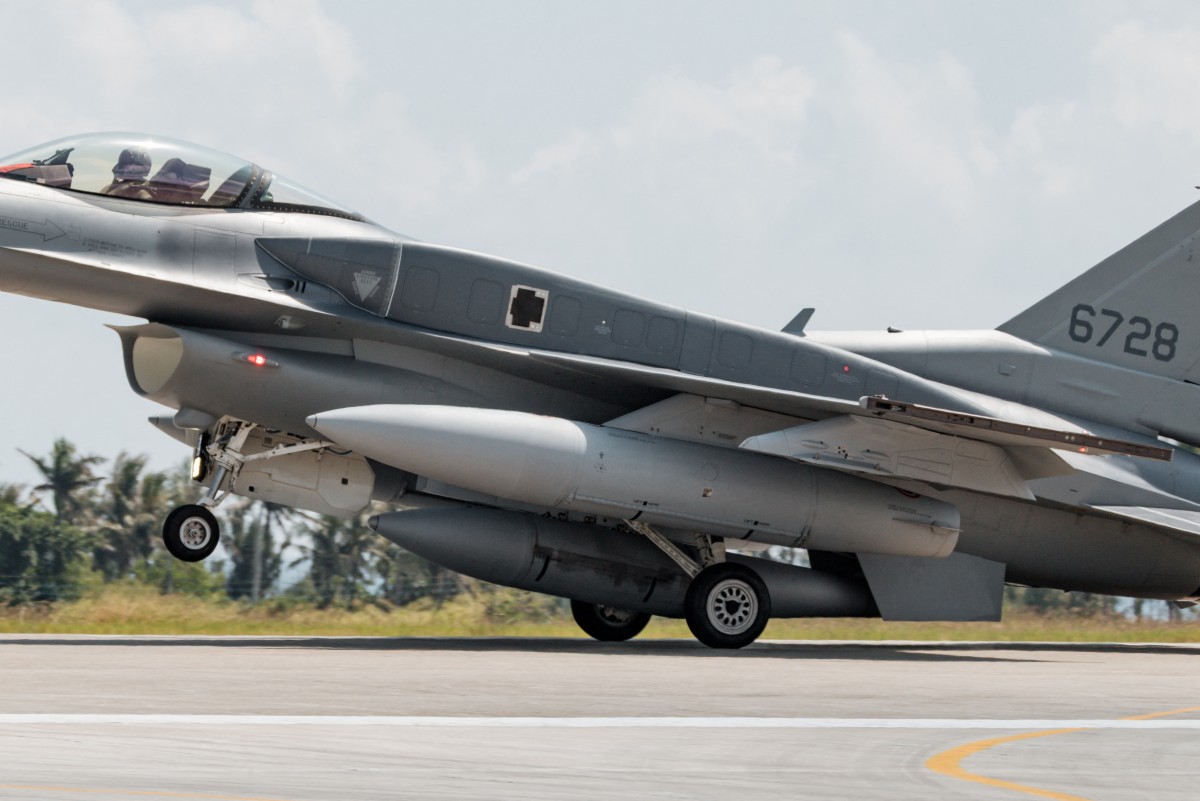
Incidentally, the US Air Force’s faith in the F-16 has grown stronger because of its recent performance in the Middle East. A report by Rebecca Grant on November 10 in “RealClearDefense” suggests that America’s wars against Iran and its proxies have reinvented the F-16.
In Operation Epic Fury and in the long shadow war with Iran’s proxies like Houthis, the F-16 became America’s workhorse. Three points are noteworthy in this context.
First, it proved to be a “drone killer”.
The Houthi attack on USS Abraham Lincoln in November 2024, and the endless drone waves since, exposed a brutal arithmetic that one cannot shoot a $20,000 drone with a $2 million missile forever. And it is precisely here that the F-16 answered with the AGR-20F APKWS — a laser-guided rocket, cheap, precise, carried in pods of 42. In the new Standard Conventional Load, it carries those rockets and four AIM-9X missiles. It has become a flying magazine for cheap kills.
Grant writes: “CENTCOM showcased the latest anti-drone configuration in an August 25, 2026 photo of the F-16 on a twilight mission laden with extra fuel tanks, wingtip missiles, a targeting pod and two dispensers for small rockets carried on an underwing hardpoint. This was the result of almost two years of intensive work. For example, F-16s have been armed to take on drones with weapons like the AGR-20F Advanced Precision Kill Weapon System (APKWS), a precision-guided rocket specially modified in 2024 to enhance the F-16 anti-drone mission.
“F-16s jumped in during a complex attack in November 2024 as the Houthis fired ballistic missiles, suicide drones, and land-attack missiles toward the USS Abraham Lincoln and her strike group operating in the Red Sea. F-16s shot down multiple suicide drones heading for the Navy ship and, under the tactical guidance of USS Spruance, also shot down a land-attack missile”.
Second, equipped with the Integrated Viper Electronic Warfare Suite (IVEWS), the upgraded F-16 provided “a near fifth-generation quality of detection and targeting capabilities while inside a jamming environment.”
This internal EW (electronic Warfare) system is interoperable with the F-16’s AN/APG-83 active electronically scanned array radar and is designed to the Open Mission Systems Tier I standard.
These advanced capabilities enable the F-16 to use its AESA radar to track multiple targets at once, and to jam an active threat while targeting it for destruction.
Thus, in what proved to be a fifth-generation targeting capability aboard a fourth-generation fighter, the F-16 proved very potent and dangerous.
Third, it proved to be a “surge fighter”. When an Iranian ballistic missile damaged eight F-15Es and an A-10 in Jordan, commanders did not ask for more F-35s. They asked for more F-16s. Because numbers matter when bases are hit.
Overall, the Iran experience with the F-16s illustrated that the aircraft is no longer confined to conventional air-to-air combat. It was employed in air-defense patrols, anti-drone missions, aerial refueling operations, and suppression of enemy air defenses.
The F-16 is now said to be the only Western fighter that offers three things together: AESA radar (APG-83), modern weapons, and a moderate price and maintenance bill. It is not only one of the cheapest fighter planes, but it is also one of the cheapest to operate per hour.
The estimated cost to fly an F-16 is between $20,000 and $27,000 per flight hour. In comparison, the F-35 is around $34,000 at the low end and over $40,000 per flight hour depending on configuration and conditions.
Besides, an air force purchasing the F-16 does not have to build an entirely new maintenance, training, logistics, and weapons-support infrastructure. It can benefit from decades of accumulated operational experience and cooperation with other F-16 operators. This is particularly important for countries, including the United States, whose defense budgets are coming under increasing strain.
American experts are arguing that the F-16’s value is that it can complement more sophisticated aircraft like the F-35 and F-47, not replace them. This will likely be the case in the Indo-Pacific if the US fights a future war with China.
As Rebecca Grant writes, “Pacific scenarios will plunge the F-16 into an intense electronic warfare environment. The F-16s will be active in hunting and killing Chinese aircraft and air defenses on land and at sea aboard China’s People’s Liberation Army Navy ships. Every tail needs to be ready to fight in a peer environment.
“The F-16 is also a testbed for the Family of Affordable Mass Munitions, or FAMM – a new, affordable standoff cruise missile family first designed as a munition for palletized launch from large aircraft. In March, the test team at Eglin AFB completed a round of tests for a ‘lugged’ munition, including loading, fit and function, high-risk envelope expansion, and live fire from an F-16.
Anduril, CoAspire, and Zone 5 are all listed as vendors, and the Air Force plans to buy as many as 27,000 of the missiles over the next five years. ‘When you have a lot of them,’ Air Force Chief Gen. Kenneth Wilsbach said of FAMM while testifying before Congress in June, ‘then adversaries will end up using their exquisite defenses to shoot those weapons down, and eventually we’re going to get some through.’
In other words, experts say that because a conflict in the Indo-Pacific would demand enormous numbers of combat aircraft, long-range weapons, surveillance platforms, and supporting assets, the US Air Force cannot depend exclusively on a relatively limited number of expensive stealth fighters like the F-35. Here, the F-16 can provide additional combat mass, air defense, escort, weapons delivery, and other missions, particularly after hostile air defenses have been degraded.
Thus, there will be a division of labor between the F-35 and the F-16 in future American military planning. The F-16 is not a competitor to the F-35 or F-47; its role will be to serve as a great force multiplier.
Its value is that it can complement these more sophisticated aircraft, not replace them. This division of labor is likely to become increasingly important in future American military planning.
In sum, the F-16 Fighting Falcon has evolved over the past five decades. When it entered service in the late 1970s, it was designed as a nimble, lightweight dogfighter meant to wrest air superiority from enemy fighters at the very front of a conflict.
Today, as fifth-generation stealth aircraft like the F-22 Raptor and F-35 Lightning II take over the “tip of the spear” role in heavily defended airspace, the F-16 has transitioned into the indispensable backbone of the US Air Force, even though it looks “less glamorous”.
- Author and veteran journalist Prakash Nanda is Chairman of the Editorial Board of the EurAsian Times and has been commenting on politics, foreign policy, and strategic affairs for nearly three decades. He is a former National Fellow of the Indian Council for Historical Research and a recipient of the Seoul Peace Prize Scholarship.
- The author can be reached at prakash.nanda (at) hotmail.com