China and Russia currently lead the United States in operational hypersonic weapons. Washington has now identified another key area, i.e., anti-satellite capabilities, where it needs to catch up.
Alongside the Golden Dome missile-defense initiative and efforts to accelerate production of 14 key munitions, the U.S. has elevated “integrated space fires” to one of its top warfighting priorities.
Speaking at the annual Space & Missile Defense (SMD) Symposium in Huntsville, Alabama, U.S. Space Force Gen. Stephen Whiting explicitly called for new “integrated space fires” capabilities, including both non-kinetic and kinetic options, underlining the need for “credible, acknowledged” means of damaging and even destroying enemy space assets if a war breaks out in orbit.
“From the broadest perspective, maybe the most critical characteristic of the responsive and adaptive national security space architecture called for in the President’s Ensuring American Space Superiority executive order is that survivability matters at least as much as performance,” Whiting said.
“In space, there is no safe harbor. You can’t dig a trench or build a shield. Our satellites are consistently or predictably in an opponent’s weapons engagement zone. And we can build the most high-performing, exquisite satellites in human history, but if they depend on fragile, targetable supporting infrastructure, their performance will drop to zero on the first day of the next war,” he added.
While Whiting underlined the vulnerability of U.S. space assets, he also highlighted China’s rising capabilities in this domain.
China has direct-ascent ASAT (Anti-Satellite) missiles, ground-based lasers, jammers, and maneuverable, dual-use satellites, he said.
“These developments intend to degrade our current space superiority and would potentially give China a maneuver and logistics advantage in space – something we would not accept on the land, at sea, or in the air,” Whiting said.
He noted that offensive capabilities in space are an absolute must in today’s era.
“Space survivability isn’t just good to have or nice to have. It is need to have,” he said.
He also highlighted the five priority areas that the U.S. Space Command (SPACECOM) should focus on from 2029 to 2033 to maintain its edge in orbit.
“This isn’t just a wishlist. It’s a clear demand signal to several audiences describing the warfighting capabilities we need to meet our mission,” he said.
These five priority areas are:
(1) Integrated space fires: By this, SPACECOM means both kinetic and non-kinetic offensive capabilities to “deter orbiting threats.”
“We’re a combatant command, and we fight to win wars,” he said. “To win, we need credible, acknowledged, kinetic and non-kinetic fires. They are a key component of how we establish space superiority and restore credible deterrence.”
(2) Counter-pLEO tech: pLEO refers to proliferated low Earth orbit. There are thousands of satellites in this orbit, including nearly 10,000 SpaceX satellites.
Gradually, China and Russia are also launching hundreds of satellites in low Earth orbit (LEO). In the future, most of the countries will have their largest satellite constellations in this orbit. The large number of satellites in this orbit also necessitates protecting these assets and countering your adversary’s satellites.
“I don’t want any U.S. force to be put at risk because somebody else might have a proliferated low-Earth-orbit constellation that could find, fix, track, and target them,” Whiting said
(3) Joint, integrated space command and control: The ability to oversee, organize, and order complex space operations.
“We must enhance machine-to-machine connectivity to support decision-making and battle management of this global space fight on tactically relevant timelines,” Whiting said.
(4) Dedicated space domain awareness: Better situational awareness in space is key to successful defensive and offensive operations. Space domain awareness needs to expand and evolve across a whole range of space operations, not just one segment, Whiting said.
“We must adopt a ‘target-quality track’ mindset to everything we do in space, just like the missile defense community has done for decades,” he said.
(5) Sustained space maneuver: The ability to refuel and maneuver satellites in orbit. These functions could be used for routine maintenance and offensive purposes. In March, a Chinese commercial satellite used a flexible robotic arm to “to demonstrate on-orbit servicing, refueling, and debris removal,” according to the Space Force.
“Today, our satellites are limited by the fuel they launch with, which leads to a psychology of scarcity. Husbanding that fuel often overrides desired warfighting maneuvers,” Whiting said. “That must change. We must be able to actively avoid threats and maneuver to gain a position of advantage on our adversaries.”
“We’re a combatant command, and we fight to win wars,” Whiting declared. “To win, we need credible, acknowledged, kinetic, and non-kinetic fires. They are a key component of how we establish space superiority and restore credible deterrence.”
“Our space assets need to shoot, move, and communicate just like the rest of the joint force, so that our space assets can enable the joint force to shoot, move, and communicate,” Whiting said. “In short, space needs to fight like the joint force to empower the joint forces’ ability to fight and undermine our adversaries’ ability to do so.”
Whiting did not elaborate on what kind of kinetic and non-kinetic space-fire options he had in mind.
However, both the US and its near-peer adversaries, such as Russia and China, have developed a range of such anti-satellite offensive capabilities.
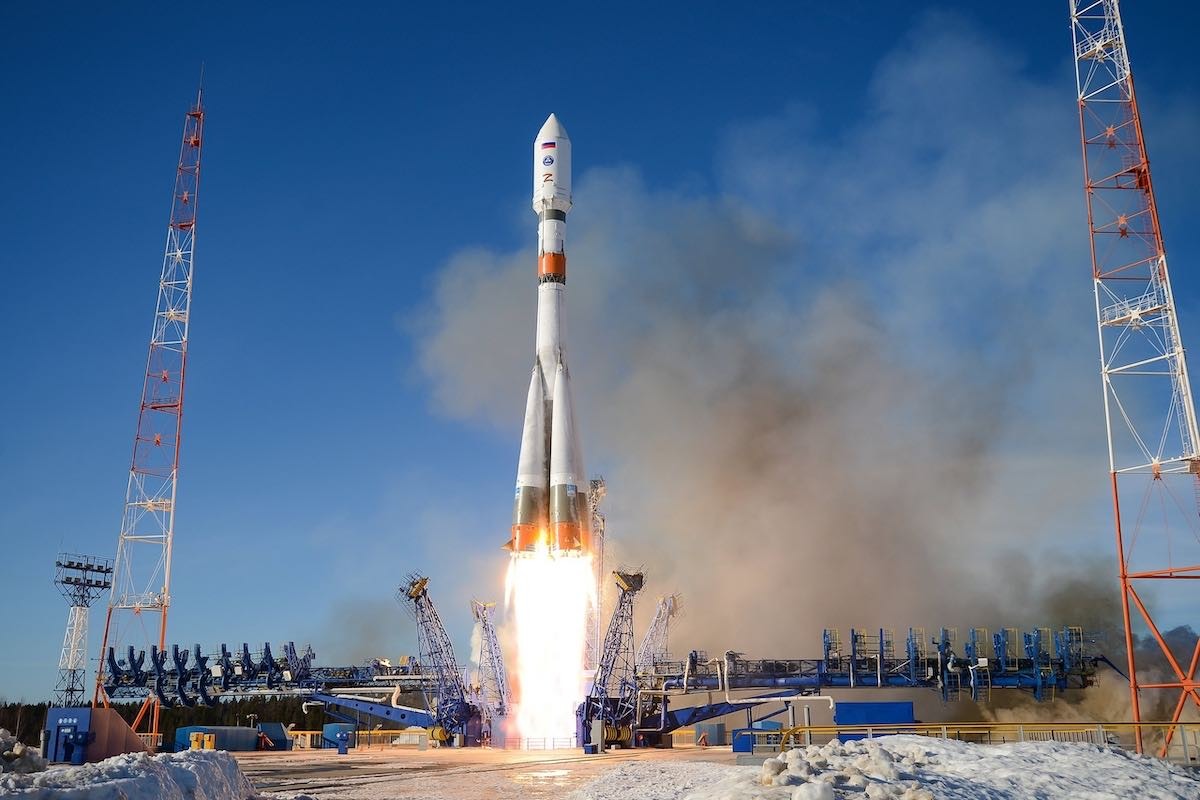
The Anti-Satellite Offensive Capabilities of Russia, China, and the U.S.
Anti-satellite missiles are the primary kinetic options for space warfare. However, in the non-kinetic realm, options include directed-energy weapons, lasers, cyber attacks, electronic warfare, and satellites with robotic arms that could tow other satellites.
Especially in the kinetic domain, Russia and China have a clear lead over the US.
In 2007, China conducted its first direct ascent anti-satellite (DA-ASAT) missile test. A kinetic-kill vehicle launched on a ballistic missile destroyed an inactive Chinese weather satellite, FengYun-1C, at an altitude of about 530 miles (865 kilometers) in low Earth orbit.
Since then, China has conducted multiple DA-ASAT tests.
Chinese DA-ASAT capability against LEO targets is likely mature and potentially operationally fielded on mobile launchers. Chinese DA-ASAT capability against deep-space targets (MEO and GEO) is likely still in the experimental or development phase, and there is insufficient evidence to determine whether it will become operational in the near future.
SC-19 is China’s most well-known DA-ASAT missile. It has a range of around 1,000 to 1,500 kilometers in altitude, making it potentially effective against most LEO satellites. China has tested the SC-19 system multiple times.
China has also launched satellites capable of “dogfight” or physically pulling other satellites out of orbit.
Besides, China has also developed several non-kinetic anti-satellite offensive capabilities, such as ground-based lasers, jammers, cyber capabilities, and possible high-power microwave (HPM) weapons.
Last year, the Chief of U.S. Space Operations Gen. Chance Saltzman warned that China is rapidly building out its arsenal of counterspace weapons: everything from ground-based lasers to satellites that can grab other satellites, all of which pose a “grave threat” to the US.
“Aside from missiles, the PLA has fielded multiple ground-based laser weapons able to disrupt, degrade, or damage satellite sensors. By the mid-to-late 2020s, we expect them to deploy systems high enough in power that they can physically damage satellite structures,” he said.
Similarly, Russia has tested Nudol (PL-19) DA-ASAT multiple times, including a successful destructive intercept of a LEO satellite in 2021. Russia has also deployed “nesting doll” designs that have shadowed high-value US satellites. Moscow is also investing in electronic weapons systems, ground-based lasers, directed-energy weapons, and cyber attack capabilities.
However, the US has only acknowledged the Counter Communications System (CCS), a ground-based electronic warfare (EW) system for uplink jamming of GEO communications satellites.
The US may also have other anti-satellite capabilities that remain classified. In 2022, then-US President Joe Biden’s administration announced a self-imposed moratorium on destructive direct-ascent ASAT weapons testing.
Some argue that the US should publicly demonstrate its anti-satellite capabilities to deter adversaries.
However, U.S. Space Command’s elevation of integrated space fires, covering both kinetic and non-kinetic anti-satellite options, to one of its highest warfighting priorities signals that the United States will actively expand its offensive space warfare capabilities in the coming years.
- Sumit Ahlawat has over a decade of experience in news media. He has worked with Press Trust of India, Times Now, Zee News, Economic Times, and Microsoft News. He holds a Master’s Degree in International Media and Modern History from the University of Sheffield, UK.
- He can be reached at ahlawat.sumit85 (at) gmail.com