Over the years, China has reportedly been working on technologies to detect, track, and even shoot down stealth jets, primarily aimed at the USA. More recently, however, the People’s Liberation Army has started testing a simpler method: combining man-portable air-defense systems (MANPADS) with regular air-defense missiles to hunt stealth fighters.
The US operates several stealth aircraft, including the F-22 Raptor, F-35 Lightning II, B-2 Spirit, and the incoming B-21 Raider.
Chinese state media claimed that PLA soldiers demonstrated the coordinated use of Man-Portable Air Defense Systems (MANPADS) to engage stealth fighters in footage aired by China’s state-owned broadcaster CCTV on August 8, 2026.
During this live-fire test, teams reportedly used MANPADS and HQ-16 air-defense missiles in coordinated fire. While most of the inbound targets were engaged by the HQ-16 during the exercise, the MANPADS were tasked to hunt the stealth targets.
The CCTV video explained that most air-defense systems are radar-guided, but radar generally struggles to detect stealth aircraft, allowing them to operate with near impunity over contested airspace. In contrast, MANPADS employ infrared guidance that catches heat sources, making detection more likely.
Official video shows how #PLA soldiers, through coordinated teamwork, can use portable air defense #missiles to shoot down #stealthfighters, detailing the training and the principles behind it. The demonstration reflects the PLA's mature capability in this area, though it is only… pic.twitter.com/17okbpjdPN
— Global Times (@globaltimesnews) August 9, 2026
Interestingly, the report also drew attention to the alleged use of infrared detection technology by Iran’s military to score a hit on an American F-35 stealth fighter during the war earlier this year, which apparently challenged its near-invincibility. The Chinese report did not share any more information on the F-35 or Iranian strikes.
CCTV emphasized that downing a stealth fighter with infrared-guided MANPADS is no easy task: operators must swiftly relocate to sites where the stealth fighter is likely to emerge and launch missiles when the aircraft is closest, because their range is considerably shorter than that of long-range air defense missiles.
Furthermore, this kind of engagement necessitates a very high degree of synchronization between two MANPADS operators seeking to down the stealth aircraft. If the missiles are not fired simultaneously, the second missile may lock onto the first missile’s heat plume, taking it for the target.
Nonetheless, during the nighttime drills, the two operators fired their MANPADS almost simultaneously, and both missiles struck the target drone.
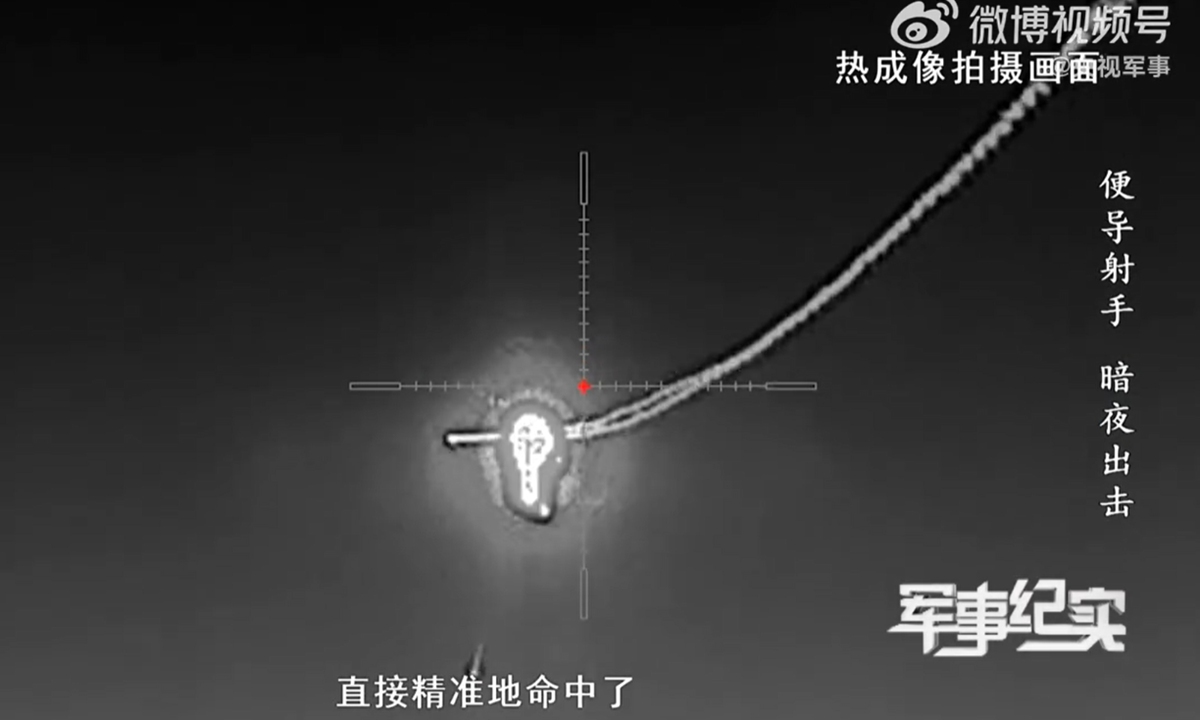
Notably, stealth aircraft predominantly rely on a reduced radar cross-section (RCS) to achieve invisibility. However, their infrared signature, driven by engine heat and airframe heating, is not fully eliminated. This is what the PLA might be looking to exploit.
However, when quizzed about this tactic and the drill by the EurAsian Times, Indian Air Force veteran and military commentator Air Marshal G.S. Bedi dismissed it as “hype” and a “typical copy-book scenario” that does not make much sense operationally.
Air Marshal Bedi questioned how the troops detected the stealth package, adding that the heat-seeking missiles catching stealth is no revolutionary tactic.
“Older stealth fighters, such as the F-117, did not have an afterburner to reduce the infrared signature, but the US Air Force later decided that more advanced jets like the F-22 could have an afterburner because that would add maneuverability and complicate continuous tracking, which is necessary for downing an aircraft. Therefore, this new PLA theory is not very nuanced.”
“These MANPADS have very short ranges, which means that the aircraft has to be very close for the operator to take aim, and if a stealth fighter is that close, I wouldn’t understand its philosophy of utilization. Frankly, this theory does not sit well operationally because all advanced air forces are shifting to standoff attacks using long-range missiles, so the utility of a MANPAD would be severely diminished, and it might be relegated to the last available option,” the expert added.
As for the notional stealth fighter, Air Marshal Bedi said, “A stealth fighter is not just supposed to beat the ground-based air defenses but also long-range air-to-air missiles, almost all of which are active missiles, not heat-seeking.”
“And, if stealth is so easily detectable and defeatable, why is China investing in production of so many J-20s, and now, the J-35s?” Air Marshal Bedi asserted emphatically.
Meanwhile, Chinese military experts emphasized that the exercise showed how low-cost equipment, properly integrated via data links and information fusion, can help counter high-value stealth targets. A Chinese military expert told the Global Times that an HQ-16 would need multiple detection units to conduct consistent, uninterrupted scanning in the same direction to detect stealth targets.
This deployment of multi-static arrays can exploit stealth flaws, such as the fact that stealth is not omnidirectional, thereby enhancing the likelihood of actually detecting a stealth target.
At the same time, the radar-guided system benefits greatly from portable missiles. The two can be teamed up to engage stealth targets, the expert explained. He also emphasized that this teamwork demonstrates the maturity of the PLA’s data link and information fusion systems, although it requires both excellent operational skills and a high level of cooperation.
More importantly, the expert stressed that the PLA’s anti-stealth strategy includes more than just using portable missiles against stealth jets, as the EurAsian Times has reported on multiple occasions.
China Prioritizing Anti-Stealth Capabilities
As the threat of a military confrontation between China and the US rises, Beijing has been working relentlessly to enhance its anti-stealth capabilities.
Last year, Chinese researchers claimed to have developed a dual-satellite (bistatic) space-borne radar system, based on the LT-1 constellation, that can detect and track stealth aircraft day and night in all weather conditions.
One satellite transmits radar pulses while the other receives the echoes. This reduces self-interference, better suppresses clutter, and can increase a stealth target’s apparent radar cross-section at certain angles.
The Chinese team noted that the simulations suggested it could pick up even slow, low-RCS objects at 50 kilometers/hour, with faster targets like fighter jets becoming easier to detect via Doppler shifts, as reported by the EurAsian Times at the time.
In May 2025, China showcased the JY-27V radar system, which it claimed was a next-generation meter-wave anti-stealth radar. It reportedly incorporates three advanced technologies: a low-frequency band, a high-power aperture, and sophisticated intelligent algorithms.
This is meant to enable the radar system to precisely detect stealth targets and guide an air defense system for a precision strike. However, observers noted that this radar failed to detect US stealth jets during “Operation Absolute Resolve” in January this year.
Similarly, in October 2024, Chinese experts claimed to have developed a new radar technology capable of tracking and identifying the F-22 Raptor, as previously reported by the EurAsian Times. At the time, the teams said the radar could use BeiDou signals to detect refraction patterns caused by stealth aircraft. These patterns create unique echoes, allowing scientists to estimate the aircraft type and location.
In 2022, China claimed to have developed an IRST system for its J-20 stealth aircraft that can reportedly detect the signatures of a US B-2 stealth bomber and the fifth-generation F-22 Raptor from 150 kilometers and 110 kilometers away, respectively.
An IRST looks for temperature differences caused by the thermal radiation of a high-speed aircraft against the colder ambient air. Moreover, it is entirely passive, meaning it does not reveal the location of the aircraft it is mounted on, unlike search radars, which emit radio waves when the pilot uses the radar in active mode to detect the enemy airplane.
None of these assertions could be independently confirmed. In fact, the military experts and skeptics EurAsian Times has spoken with have frequently voiced doubts about China’s theoretical and ambitious claims.
At the same time, though, experts have often bluntly stated that stealth is not absolute and that no aircraft is fully invincible or immune to detection.
Interestingly, China has claimed to have detected stealth fighters on multiple occasions in recent years. For example, on October 3, CCTV aired a documentary in which a PLA Air Force (PLAAF) pilot claimed he simultaneously locked onto two foreign stealth fighter jets while flying the domestically developed J-16 fighter jet, forcing both jets to withdraw. The incident reportedly occurred in 2024.
Every major air-defense power invests in complementary sensors: low-frequency radar, IRST, passive radio frequency, multistatic geometries, and networked cueing. As for China, the emphasis is rational in the face of growing US military capabilities and an omnipresent threat of a conflict in the Indo-Pacific, either over China’s invasion of Taiwan or a conflict between China and the Philippines in the South China Sea.
- Contact the author at sakshi.tiwari13 (at) outlook.com
- Follow EurAsian Times on Google News