

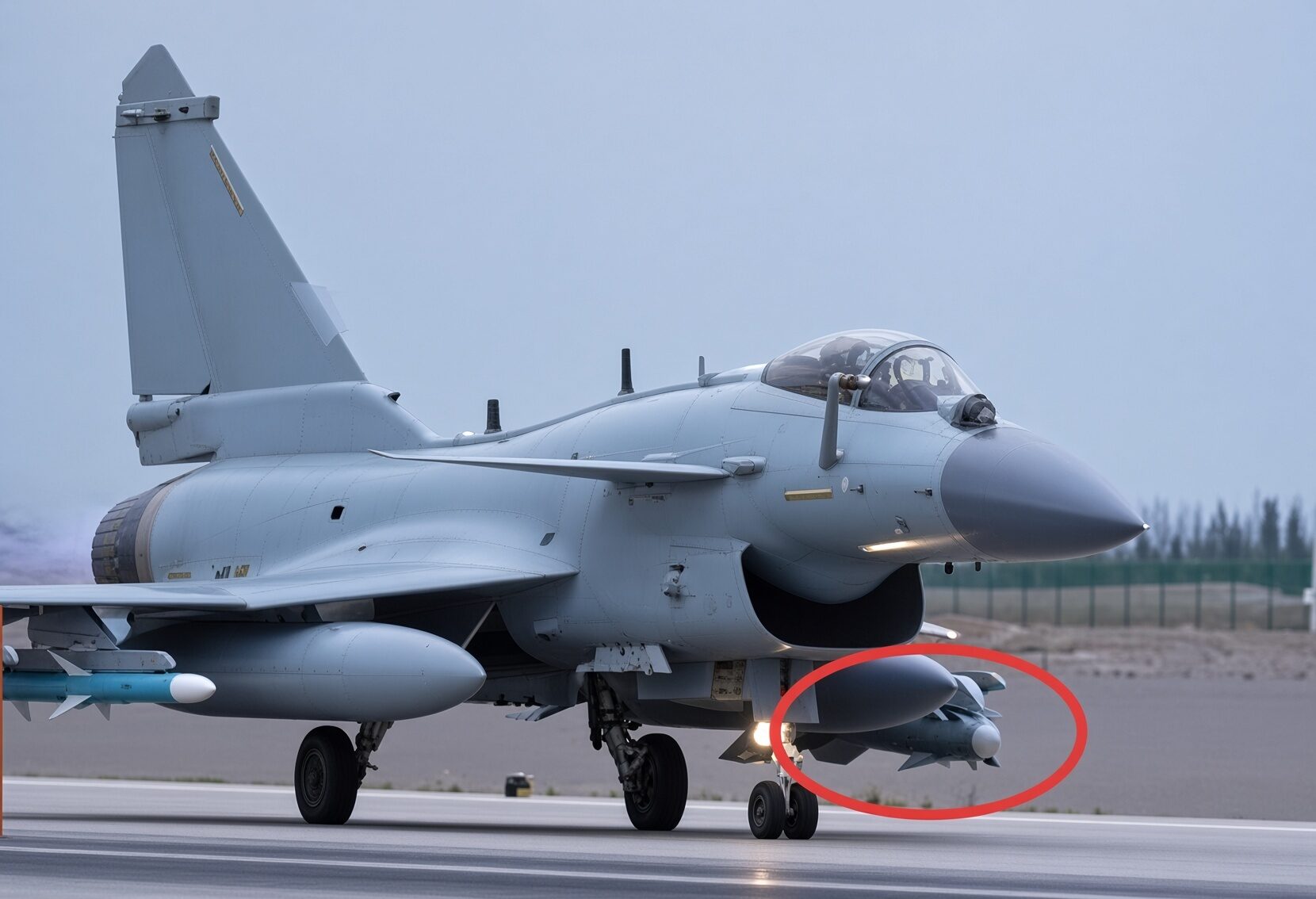
New footage released by state broadcaster CCTV appears to show China’s J-10C fighter jet carrying a Russian-origin Kh-29T air-to-surface missile. Why is China, now a defense powerhouse, integrating an older Russian missile into the PLAAF’s cutting-edge fighter fleet?
The Kh-29 entered service with the Soviet Air Force in 1980. It was designed as a heavy air-to-ground missile for attacking hardened and high-value targets.
The Kh-29T uses a television-guided seeker, allowing the missile to lock onto a target before launch and guide itself towards it. Depending on the variant, the missile has a maximum range of 30 kilometers.
Weighing approximately 685 kg, it is a heavy missile. Its warhead weighs about 320 kg and combines high-explosive and armor-piercing elements.
According to reports in Hong Kong-based SCMP, China imported around 2,000 Kh-29T missiles alongside Sukhoi Su-30MKK jets in the early 2000s. The missile later appeared on Chinese JH-7A fighter-bombers and, more recently, on J-16 fighters.
Chinese social media accounts suggest the missile may have been modified and now features an imaging-infrared seeker instead of the original television-guidance system. The footage appears to confirm that the J-10C has carried a Kh-29 variant, but it cannot be ascertained how, or whether, Beijing has modified the missile.
Old Missile, New Jet
The J-10C is part of the “Four Swordsmen” of China’s PLAAF (People’s Liberation Army Air Force), alongside the J-20, J-35A, and J-16. It features modern avionics and an AESA radar, and it is armed with the long-range PL-15 air-to-air missile, along with other munitions.
Its appearance with the Kh-29 raises an obvious question: why would China equip a cutting-edge combat jet with a missile developed more than four decades ago when it has the resources and capabilities to manufacture advanced weapons?
One possible explanation could be that the Kh-29 offers a capability different from the weapons already available to the aircraft.
The J-10C can carry the Chinese KD-88 air-to-surface missile, a longer-range stand-off weapon reportedly capable of striking targets more than 200 kilometers away. The Kh-29 serves a different purpose.
Its heavy warhead is designed for tactical attacks against relatively close, hardened targets. It could provide an additional option when jets operate near enemy airspace, especially when the air defenses have been neutralized.
A longer-range missile may be better suited to attacking targets from outside contested airspace, while a heavier, shorter-range weapon like the Kh-29 may be useful against nearby, hardened targets.
China already possesses stocks of Kh-29 missiles. If Beijing can refurbish, upgrade, and integrate these weapons with domestic aircraft, it may extract additional value from its existing inventory instead of manufacturing new missiles.
Chinese local media argues that the J-10 could be following the path of the American F-16 Fighting Falcon. They argue that both aircraft, the F-16 and the J-10C, were developed mainly for air combat but gradually evolved into multirole fighters with a greater focus on ground-attack capabilities.
The F-16 was designed as a lightweight, highly maneuverable fighter. However, as its radar, avionics, and weapons improved, it could take on a much wider range of missions, including BVR (beyond-visual-range) engagements and precision strikes. With newer versions, especially the F-16C/D, the aircraft’s ground-attack capabilities got a big boost.
Later variants, such as Israel’s F-16I and the UAE’s F-16E/F Block 60, added advanced targeting systems, more fuel capacity, and other components that made them ideal for long-range missions. They remain capable jets, but are now widely used for ground attack.
The J-10C could be undergoing a similar transformation. China is now operating new, advanced fighter jets, including the fifth-generation J-20, J-35A, and the heavier J-16 Flanker. These jets can perform challenging missions such as penetrating defended airspace, engaging enemy jets with BVR missiles, and carrying a large weapons payload to obliterate enemy ground defenses.
As the J-20 and other jets take center stage, the J-10C could serve as a flexible multirole platform. It can still perform air-defense and air-to-air missions, but its ability to carry different air-to-ground weapons could become increasingly consequential.
The apparent integration of the Russian-origin Kh-29 missile would give the J-10C another missile for attacking hardened ground targets. This does not mean the J-10C is becoming a dedicated ground-attack aircraft or that China is abandoning its air-to-air combat role. Rather, it suggests Beijing may be expanding the fighter’s mission profile.
China’s Su-30 MKK
Beijing originally acquired the Kh-29 missile as part of the weapons package for the Su-30MKK, a long-range heavy aircraft.
China and Russia agreed on the Su-30MKK deal in 1999, and the PLAAF received the first 10 aircraft in December 2000. China eventually received additional batches of jets, bringing its initial purchases to around 76 aircraft.
The Su-30MKK2, a maritime-strike variant developed for China’s navy, followed, with 24 delivered in 2004.
Russia’s Sukhoi developed the aircraft as a two-seat, long-range derivative of the Su-27 family. The designation MKK stands for Modernizirovannyi Kommercheskiy Kitayskiy, broadly translated as modernized commercial Chinese. It was tailored to PLAAF requirements, including long-range operations and a strong air-to-ground weapons capability.
When China acquired these jets, the Su-30MKK represented a major upgrade over its domestically produced fleet. Its two-seat configuration let one crew member fly while the other managed navigation, sensors, and weapons. Its long range and substantial weapons payload made it a valuable asset.
Crucially, the aircraft gave China access to a modern package of Russian precision-guided weapons. These included the Kh-29T television-guided missile, the Kh-59ME air-to-surface missile, Kh-31P anti-radiation missiles designed to attack radar systems, and guided bombs.
The Su-30MKK also helped China develop experience in operating a sophisticated multirole aircraft and integrating different types of guided weapons. Its importance therefore extended beyond the aircraft itself: it gave the PLA a platform to improve its strike tactics and build experience with modern precision warfare.
More than two decades later, the apparent appearance of a modified Kh-29 on the J-10C suggests that China is still finding ways to use weapons acquired during that earlier period.
Mail us at: editor (at) eurasiantimes.com