

When the US attacked Iran earlier this year, much was made of Tehran’s archaic Air Force, which still relied on more than four-decade-old American fighters, such as F-4 Phantoms, F-5 Tigers, and F-14 Tomcats, for its defense.
However, a country right on the US doorstep also relies on a very small number of F-5E/F Tiger jets for its defense.
Mexico bought 12 Northrop F-5E/F Tiger II jets in 1982 and hasn’t purchased any fighter jets since.
Now, after more than four decades, Mexico plans to modernize its Cold War-era vintage air force, and four very different fighter jets – Lockheed Martin’s F-16 Block 70/72, Swedish Saab Gripen E/F, South Korean KAI FA-50, and Italian Leonardo M-346FA are in the fray.
South Korea is aggressively pitching its light fighter jet FA-50, with President Lee Jae-myung visiting Mexico City in September 2026, the first Korean presidential visit in 16 years, to pitch the FA-50 to Mexico and sign aerospace cooperation agreements.
If Seoul wins the contract, it would mark South Korea’s entry into the American fighter aircraft market after successfully winning export orders for the FA-50 from Poland, Malaysia, the Philippines, Indonesia, Iraq, and Thailand.
Meanwhile, the Swedish Saab Gripen has already won export orders from Brazil and Colombia, and is actively pushing the fighter jet to Peru and Canada.
However, it is unclear which aircraft will win Mexico’s fighter jet contract, valued at approximately $1.2 billion, but the United States is likely to have the last laugh, even if it loses the contract.
Although the Mexican Air Force has expressed interest in acquiring 12 new fighters by 2028, the government has signaled that the replacement program is not a top priority. In June, Defense Secretary Gen. Ricardo Trevilla Trejo said Mexico would prioritize transport aircraft and helicopters, placing F-5 fleet replacement on the back burner.
Mexico’s Fighter Race: F-16 vs Gripen vs FA-50 vs M-346
In April, during the Tulum Air Show, General Román Carmona Landa, commander of the Mexican Air Force (FAM), said that the force was looking to procure 12 new fighters by 2028.
He said the service wanted an aircraft capable of air defense, reconnaissance, and ground attack, adding that it would be one of four fighters: F-16, Gripen, FA-50, or M-346.
“The F-5 constitutes Mexico’s highest capability, but it’s an older technology and we are planning their replacement in the short to medium term. We are considering different options such as the Lockheed Martin F-16 or Saab Gripen and even … [platforms] in the light combat aircraft category, with the KAI FA-50 from South Korea and the Leonardo M-346 from Italy,” he said.
However, no formal tender has been issued so far.
The Four Contenders
Lockheed Martin’s F-16 Block 70/72 is the heavyweight in the competition – a full-size frontline multirole fighter with a maximum take-off weight of around 48,000 lb and a top speed of about 1,500 mph, which is combat-tested in multiple theatres.
Buying F-16s will also help Mexico curry favor with US President Donald Trump and win somewhat favorable terms and conditions in the under-discussion US-Mexico trade talks.
Meanwhile, the Swedish Gripen has already won export orders from Brazil and Colombia.
Saab has also offered to set up a manufacturing base in Canada if Ottawa selects Gripen jets for its air force. The light fighter jet is easy to operate and maintain.
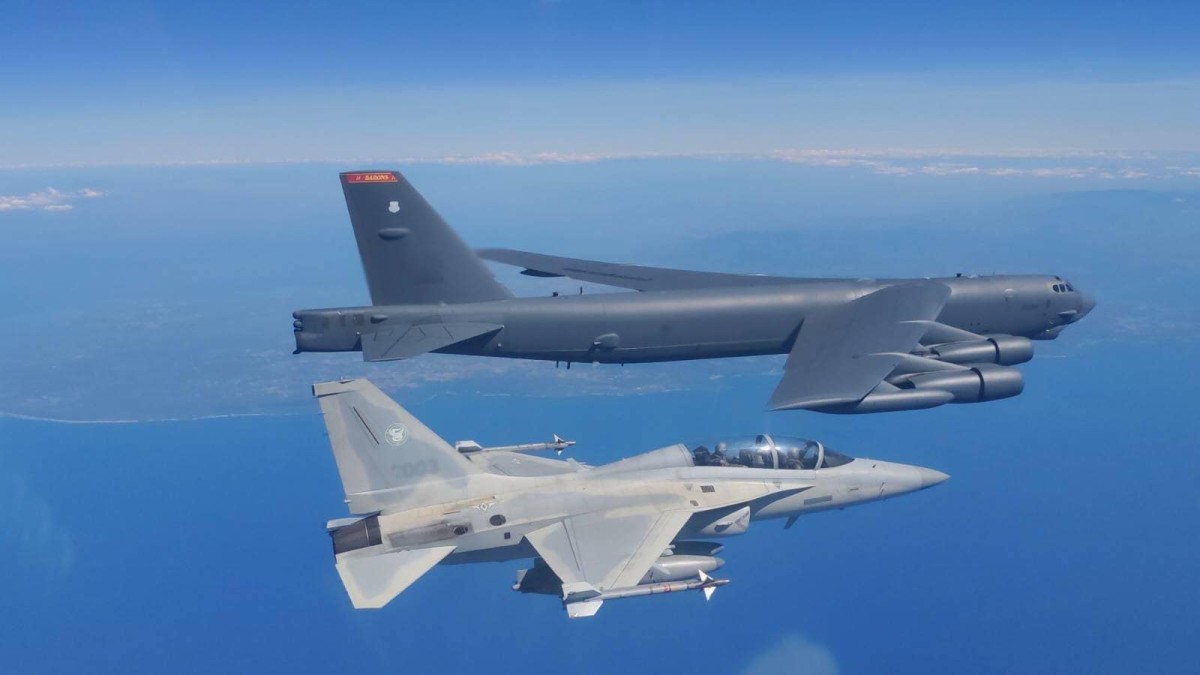
Meanwhile, South Korea is aggressively pushing its FA-50 fighter. At 26,929 lb, its takeoff weight is just over 50% of the F-16’s.
In theory, the FA-50 is no match for the F-16’s capabilities. However, diplomatic tensions between the United States and Mexico, along with Korea’s competitive pricing, could make its proposal attractive.
South Korean proposal gained political traction when President Lee Jae Myung promoted the FA-50 during South Korea’s first state visit to Mexico in 16 years.
Speaking to Mexican newspaper El Universal, Lee stated that, as part of a potential modernization of the Mexican Air Force’s combat fleet, “the Korean FA-50, given its capabilities and cost-effectiveness, could lay the groundwork for mutually beneficial cooperation.”
KAI, the FA-50’s manufacturer, also signed a memorandum on aerospace cooperation with Mexico’s aerospace industry federation, Femia, and Posco International, covering local production, supply chains, drones, satellites, and maintenance. Still, the agreement does not bind Mexico to buy fighter jets from South Korea.
The fourth contender is Leonardo’s M-346FA, the fighter-attack version of the twin-engine M-346 Master advanced trainer.
Why the US. Will Win Irrespective of Mexico’s Choice
Regardless of which company wins Mexico’s contract for 12 fighter jets, the US will benefit financially and strategically because all four aircraft rely on American-made jet engines and core subsystems.
For instance, Gripen E/F jets use General Electric (GE) F414 turbofan engines. The Swedish jet also uses Honeywell-supplied inertial navigation, air data sensors, and auxiliary power components, which keep the jet oriented, track flight dynamics, and supply onboard cooling.
U.S.-based Collins Aerospace supplies Heads-Up Displays (HUDs) and communication equipment. L3Harris supplies Pneumatic missile launchers (MELP5), data links, and electronic interface units.
In fact, roughly 30% to 35% of its components originate from US-based aerospace contractors, about 30% from the UK, and the remaining 30% is built in Sweden.
Rather than building every subsystem from scratch, Saab acts as a master systems integrator, pairing its own open-architecture mission software with proven hardware from major defense suppliers like Honeywell, Collins Aerospace, and L3Harris.
Last year, speaking in the UK’S House of Lords, Justin Bronk said, “Sweden has close to a sovereign capability, but about 30% of the Gripen is UK IP, and there is still US ITAR technology on the Gripen.”
The UK supplies the landing gear, Martin-Baker ejection seats, Raven ES-05 AESA radar (Leonardo UK), and many other subsystems.
In fact, both the UK and the US have an effective export veto over the jet, unlike the French Rafale.
Similarly, the South Korean FA-50 relies heavily on US defense technology, incorporating an American engine, flight-control architecture, navigation suites, radars, and weapons.
In fact, Korea Aerospace Industries (KAI) and Lockheed Martin co-developed the fighter jet.
Lockheed Martin funded 13% of the original T-50 program and provided critical aerodynamic, structural, and avionics engineering data based on the F-16.
The aircraft is powered by a single GE Aerospace F404-GE-102 afterburning turbofan engine.
While baseline FA-50s use an Israeli Elta EL/M-2032 pulse-Doppler radar, upgraded variants like the Block 20 and Block 70 integrate the American RTX Raytheon PhantomStrike Active Electronically Scanned Array (AESA) radar.
Honeywell supplies the Inertial Navigation System and Global Positioning System (EGI), paired with a U.S.-sourced radar altimeter.
The FA-50 also uses standard American ordnance, including the M61/M197 20mm rotary cannon, AIM-9 Sidewinder air-to-air missiles, AGM-65 Maverick air-to-surface missiles, and Boeing Joint Direct Attack Munitions (JDAM). Newer variants also integrate AIM-120 AMRAAM AAMs.
The Italian M-346FA also uses twin Honeywell F-124-GA-200 turbofan engines.
Due to these significant U.S.-supplied parts and technologies, all three aircraft – the Swedish Gripen E/F, South Korean FA-50, and Italian M-346FA – are subject to US International Traffic in Arms Regulations (ITAR) re-export approvals.
ITAR is a set of US government regulations that require any person or company manufacturing, exporting, or temporarily importing defense articles, technical data, or services listed on the United States Munitions List (USML) to first register and obtain a specific export license from the US government.
Therefore, no matter which aircraft Mexico selects, any deal will require US government export approval, giving Washington a veto over the contract.
And even if the US approves the sale, it will still get a significant chunk of the contract value because of the engines, avionics, navigation and communication systems, and weapons on these aircraft.
- Sumit Ahlawat has over a decade of experience in news media. He has worked with Press Trust of India, Times Now, Zee News, Economic Times, and Microsoft News. He holds a Master’s Degree in International Media and Modern History from the University of Sheffield, UK.
- He can be reached at ahlawat.sumit85 (at) gmail.com