

Even before the Iran war has reached its logical conclusion, U.S. President Donald Trump may already be eyeing his next target: Cuba.
In an interview last week, Trump did not mince words. He said he wants to “get Cuba done” before leaving office in 2029 and added that he would “certainly consider” military intervention in the communist-run island – a dream every U.S. president has held since the 1950s, when the Castro brothers seized power in Havana with their bearded guerrillas, including the famed Che Guevara.
Trump said his administration was monitoring the situation in Havana “very closely” and described Cuba as a “failed” state.
“I want to get Cuba done before I leave,” Trump said, giving a timeline to his Cuba plan.
He added that Secretary of State Marco Rubio, himself a descendant of Cuban migrants, would “love to do it” and would “certainly consider” a short military operation.
Facing threats from the Trump administration, Cuba has stepped up preparations for a possible military confrontation with the United States, activating wartime command structures and preparing its population for a potential U.S. attack.
Notably, the country is already teetering on the brink of economic collapse due to a strict oil and shipping blockade Washington has enforced since January this year. The blockade was imposed just days after the U.S. launched Operation Absolute Resolve in Venezuela, captured President Nicolás Maduro and his wife, Cilia Flores, and installed a friendly government in Caracas.
China, meanwhile, is not taking any chances. After the fall of Venezuela, Havana is Beijing’s last stronghold in the Americas, and China is determined to ensure that Cuba does not fold the way Venezuela did.
Last week, Liu Haixing, Minister of the International Department of the CPC Central Committee (IDCPC), visited Havana to meet his counterpart and express full solidarity with Cuba.
Cuba Activates Wartime Command Structure
President Miguel Díaz-Canel activated Cuba’s wartime structures in a meeting on November 13. He said the government had activated wartime structures even under peacetime conditions and was intensifying efforts to prepare civilians to defend the country under its “War of the Entire People” strategy.
“We have the determination to reject any foreign military aggression against our country, and we are preparing for that,” Miguel Díaz-Canel told the Cuban state newspaper Granma.
Cuba’s “War of the Entire People” strategy, ‘Guerra de Todo el Pueblo’ in Spanish, is the nation’s official total-defense military doctrine, established in the early 1980s by the Revolutionary Armed Forces (FAR).
Cuba recognizes that it cannot win a conventional military conflict against the UUS Therefore, the doctrine is designed as asymmetric deterrence. The core objective is to make any foreign military invasion so costly in blood, time, and urban-warfare attrition that an enemy deems the action unacceptable.
Under the doctrine, battles will not be fought at the borders, but rather near densely populated urban centers.
Furthermore, resistance will come not just from military units, but from the entire population.
Cuba has famously integrated its entire population into various army units, such as the Territorial Troops Militia (MTT), reserve units, civilian defense brigades, and local neighborhood committees, with specific tasks assigned to each unit, ranging from armed resistance and guerrilla ambushes to sabotage, logistics, and underground resistance.
“In the Cubans’ defensive strategy, the regular military is conceived of as only a “professional vanguard” of the mobilized citizenry, and any ensuing struggle would be waged by means of conventional warfare as well as unconventional or guerrilla warfare,” said Global Security in a research paper on the doctrine.
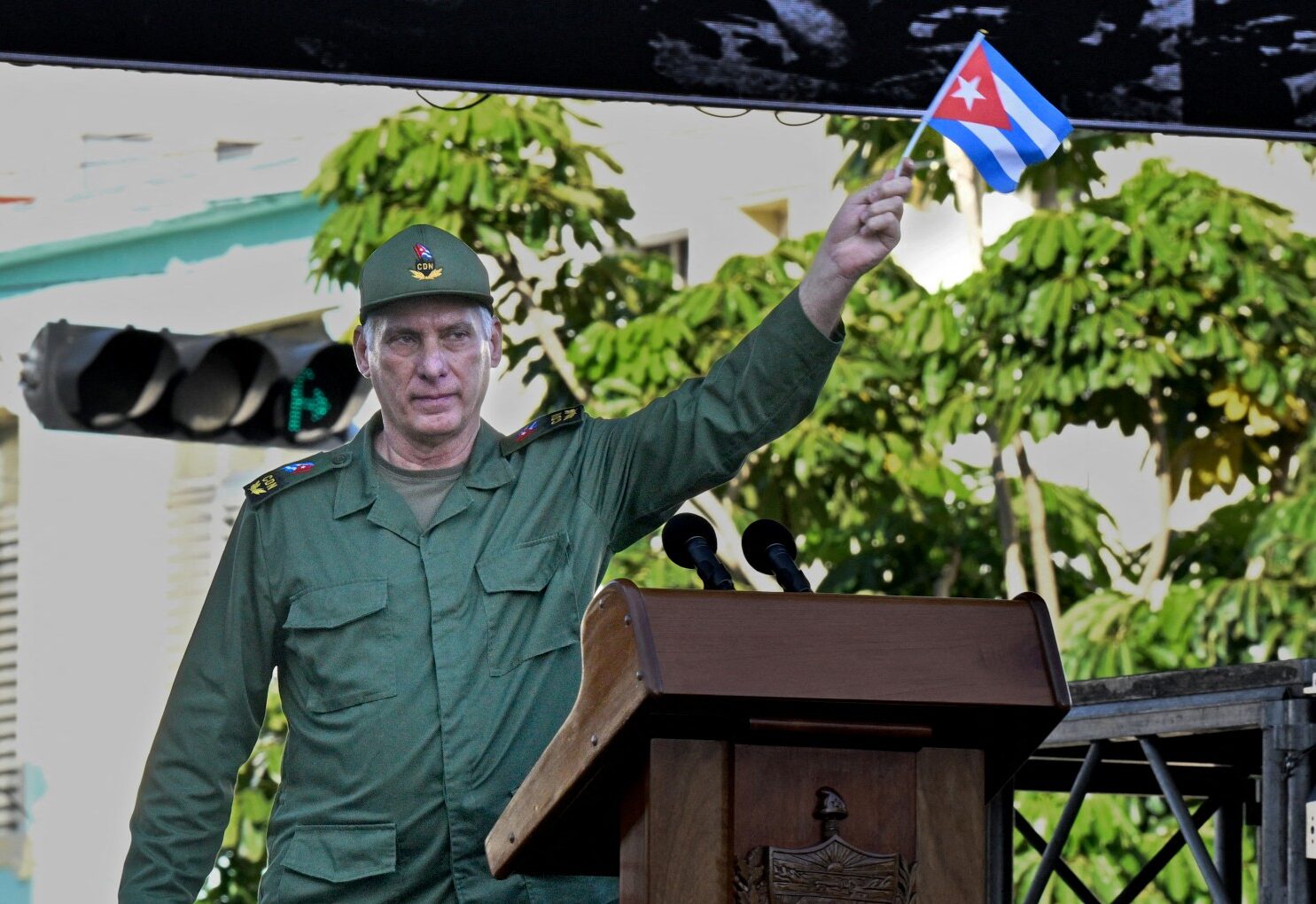
Cuba regularly tests and reinforces this doctrine through nationwide strategic exercises like Bastion and designated National Defense Days.
Notably, earlier this month, Cuba’s armed forces conducted large-scale military exercises called Moncada 2026. In addition to these drills, defense training activities are being held across the island every week.
Moncada 2026 was a nationwide strategic defense exercise conducted on November 4 and 5, culminating in a nationwide National Defense Day on November 6. The exercise mobilized the country’s entire military, government, economic, and civilian defense apparatus, putting into practice the country’s “War of All the People” doctrine.
Cuba’s Revolutionary Armed Forces (FAR), internal security forces, the National Defense Council, Provincial Defense Councils, and Municipal Defense Councils, militias, reservists, state enterprises, and the civilian population all participated in Moncada 2026.
The exercise ran simultaneously across all Cuban provinces, activating local defense structures down to the neighborhood level.
Cuban state outlet Prensa Latina described it as the “most advanced and complex form of training,” in which the country’s leadership left their offices and deployed to field command posts to simulate real wartime conditions.
“The objective of this exercise is to further enhance the level of preparedness and cohesion among leadership and command bodies, troops, the territorial defense system, and the economy at all levels, to confront any form of aggression,” the report added.
The exercise is “taking place against a complex backdrop for the Caribbean nation, marked by the tightening of the U.S.-imposed blockade and an ‘energy siege,’ compounded by threats and pressures from Washington,” it added.
The President said that in the defense zones the government is visiting week after week, we are seeing “the level of preparedness that our defense zone presidents and all those involved are acquiring.”
Criticizing the aggressive statements made by the Trump administration, President Díaz-Canel said that it is the rhetoric of military aggression from the U.S. that has led us “to activate wartime structures to work in peacetime, and to have an intense preparation of our population for defense, in the interest of guaranteeing the defensive strategy of the War of the Entire People.”
The U.S. has been enforcing an oil and shipping blockade of Cuba since January this year, which has contributed to a deepening energy and economic crisis in the country. The country has suffered repeated nationwide blackouts in recent months, along with fuel and food shortages.
Since Cuba is an island and right next to Florida, the U.S. could easily enforce a naval blockade of the country. This is in contrast to Iran, which shares thousands of miles of land borders with Iraq, Turkmenistan, Turkey, Armenia, Afghanistan, and Pakistan, and can bypass the U.S. naval blockade.
The oil crisis has deepened after the fall of Venezuela in January, as Caracas had supplied subsidized oil to Cuba for decades.
After taking office in 1999, Hugo Chavez provided Cuba with subsidized oil. This oil was key to running Cuba’s power industry.
After Maduro’s capture, Trump had warned that no more oil would reach Cuba.
“THERE WILL BE NO MORE OIL OR MONEY GOING TO CUBA – ZERO! I strongly suggest they make a deal, BEFORE IT IS TOO LATE,” Trump wrote on his Truth Social platform in January.
Meanwhile, Russia, another prominent backer of Cuba, is engaged in the Ukraine War.
Earlier this year, The Wall Street Journal had reported that the Trump administration is seeking a regime change in Cuba by the year’s end.
However, despite predictions of an imminent collapse, Cuba has survived till now, and it remains doubtful whether Washington could effect a regime change without a ground invasion, precisely the kind of scenario Trump wants to avoid.
Furthermore, Cuba is just 100 miles from Florida, and a possible military operation could lead to a massive humanitarian crisis, fueling large-scale immigration to the U.S., a scenario Trump may want to avoid.
Trump, however, has not ruled out the military option. In the interview last week with conservative radio host Hugh Hewitt, Trump said he would “certainly consider” military intervention in Cuba.
Trump realizes that his dream of remaking the Western Hemisphere as the U.S.’s backwater and its exclusive influence zone, his modern version of the 19th-century Monroe Doctrine, recast as Don-Roe by Trump, can not be fulfilled with a Communist Cuba next door, providing space to Washington’s adversaries, such as China and Russia.
A regime change in Cuba will not only fulfill the long-standing U.S. dream from the Cold War era, but it will also ensure that Trump’s name goes down in history as the President who finally ended the hostile Communist regime on the U.S. doorstep.
The question, however, is: after a costly and inconclusive war in Iran, will Trump gamble on another military conflict, especially when the country is working on the “War of the Entire People” strategy?
- Sumit Ahlawat has over a decade of experience in news media. He has worked with Press Trust of India, Times Now, Zee News, Economic Times, and Microsoft News. He holds a Master’s Degree in International Media and Modern History from the University of Sheffield, UK.
- He can be reached at ahlawat.sumit85 (at) gmail.com