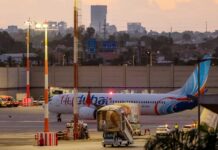
Iran has claimed that Qatar is holding its three pilots prisoners for nearly six months after Doha shot down two Iranian Su-24 fighter jets during a failed bombing run at Al Udeid military base.
Gen. Seyed Mohammad Bagherzadeh, commander of the Iranian armed forces’ missing persons search committee, made the accusation in a letter to the International Committee of the Red Cross, which Iranian media published.
He said the men were flying Su-24 fighter jets in an operation on March 2, days after the outbreak of the war, when their planes had been hit by “enemy defenses,” and the pilots ejected.
They survived but were captured by the Qatari authorities, according to General Bagherzadeh, who named the men as Javad Salehi, Abdolmajid Dashtian and Omran Behraveshian. A fourth pilot, Majid Kazemi, died, he added.
Qatar denied the allegations.
Doha said that its search and rescue teams had found the remains of one pilot after Iranian aircraft violated Qatari airspace in March and failed to respond to attempts to contact them.
“We categorically deny the claims circulating regarding the detention of Iranian pilots & are surprised by these misleading statements at this particular time, amid the ongoing diplomatic efforts & initiatives aimed at de-escalating tensions in the region,” Majed al-Ansari, a spokesman for Qatar’s foreign ministry, wrote on social media.
Qatar said that it found the remains of one Iranian pilot, which it offered to return to Tehran. The fate of three other pilots is not known, and they are presumed to have died in Qatari waters after being shot down by Qatari fighter jets.
On March 2, just three days after the Iran-US war started on February 3, two Iranian Su-24 entered Qatari airspace, flying as low as under 80 feet to evade radar detection.

Notably, just one day earlier, on March 1, three Iranian F-5 fighter jets successfully bombed the U.S. military base in Kuwait. This was the first time in over seven decades that U.S. ground troops were bombed by manned enemy fighter jets.
In the ensuing confusion, a Kuwaiti F/A-18 fighter jet shot down three US Air Force F-15 fighter jets, mistaking them for enemy jets.
According to Iranian Press TV, the three F-5 jets flew as low as under 50 feet to evade radar detection, and were able to penetrate Kuwaiti airspace, bomb a U.S. military base, and then escape unscathed.
The successful bombing run in Kuwait might have emboldened the Iranians. However, their strategy of shallow incursion failed in Qatar, as the Iranian Su-24 jets were detected, tracked, and shot down by Qatari F-15 fighter jets.
“Qatar Emiri Air Force successfully shot down two (SU24) aircraft coming from the Islamic Republic of Iran. They also successfully intercepted seven ballistic missiles through air defenses, and intercepted five drones by Qatar Emiri Air Force and Qatar Emiri Navy Forces, which targeted several areas in the state today,” the Qatari defense ministry said on March 2.
Notably, this was the first air-to-air kill for the Qatar Emiri Air Force.
Separately, Iran is also accusing Kuwait of withholding information about the fate of four Iranians held in Kuwait.
In May, Iran said the four were affiliated with the Revolutionary Guards and had been on a maritime patrol before entering Kuwaiti territorial waters due to a navigational disruption. Kuwait has said the four were suspected of planning hostile actions against the country.
Together, the two incidents can become further roadblocks in the fragile peace process in the Middle East.
According to analysts, Iranian attempts to raise the issue of its Su-24 pilots nearly six months after the incident and blaming Doha for holding its pilots in illegal detention might be a calculated attempt to flip the narrative and recast Tehran as the victim.
Alkhuzaie said Iran’s decision to drag a “neutral Gulf state,” which has largely acted as an ally for Tehran, into its war with the United States was a clear miscalculation, and that Doha had reacted to the attacks “as any sovereign nation would.”
“Its air defenses downed two Iranian Su-24s that violated its airspace. This was not aggression; it was self-defense,” he insisted. “The facts are clear: Jets were shot down, one pilot’s remains were recovered, and no evidence supports Iran’s claim of captured servicemen.”
“In the end, the narrative is simple. Iran struck Qatar, Qatar defended itself, and Iran is now trying to rewrite the story. The world should see this for what it is: a failed strategy dressed up as victimhood,” Alkhuzaie said.
Analysts suggested this might be ‘hostage diplomacy’ by Tehran to recast itself as a victim, and demand something in return from the Gulf states of Kuwait and Qatar.
Notably, Iran has a long history of using hostages as leverage to advance its diplomatic objectives.
Iran’s Long History of ‘Hostage Diplomacy’
Tehran’s history of using ‘hostages’ as leverage to advance its diplomatic objectives is as old as the Iranian Revolution itself.
On 4 November 1979, shortly after the Iranian Revolution overthrew the Shah, Iranian student militants stormed the U.S. Embassy in Tehran. They seized 66 Americans, mostly diplomats, staff, and Marine guards. While thirteen women and African-American hostages were released, 52 of them were held for 444 days.
Iranians demanded that Washington return the Shah, who was in the US for medical treatment. This kicked off one of the longest-running hostage crises of the 20th century and permanently damaged the US-Iran relationship.
The hostages were finally released on 20 January 1981, coinciding with Ronald Reagan’s inauguration.
Again, in 2004, Iranian forces captured eight British naval personnel in the waterway on the Iran–Iraq border while they were training Iraqi river patrols. Iran claimed they had strayed into Iranian waters. They were held for three days, appeared on Iranian TV, and were released on 24 June after diplomatic talks; their boats and equipment were not returned.
Three years later in 2007, 15 British Royal Navy personnel from HMS Cornwall were seized by Iran’s Islamic Revolutionary Guard Corps (IRGC) Navy. Britain insisted they were in Iraqi waters; Iran, however, claimed that they had entered Iranian waters.
They were held for 13 days, shown on Iranian television making statements, and released on 4 April 2007. President Mahmoud Ahmadinejad framed their return as a “gift.”
In 2016, two U.S. Navy riverine command boats, carrying 10 sailors, entered Iranian territorial waters near Farsi Island in the Persian Gulf due to navigational errors. IRGC Navy forces seized the boats and detained the crew for roughly 15 hours. They were released unharmed the next day, following rapid, high-level diplomatic contacts between Tehran and Washington.
Similarly, in 2009, Iranian border guards detained three Americans while they were hiking near the Iraq–Iran border in Iraqi Kurdistan. Iran accused them of illegal entry and espionage. While one hiker was released, the other two were convicted and only released in 2011 after diplomatic efforts and reported payments.
In fact, since 1979, Iran has repeatedly detained dozens of Americans, British, and other Western or dual nationals, including journalists, academics, businesspeople, aid workers, and tourists, often on charges of espionage, national-security offenses, or “propaganda against the state.”
Critics have often argued that these detentions are politically motivated and used by Tehran for leverage in negotiations, prisoner swaps, or to pressure foreign governments.
The latest Iranian accusations against Qatar, of holding three of its pilots prisoners for six months, might be ‘hostage diplomacy’ in reverse.
- Sumit Ahlawat has over a decade of experience in news media. He has worked with Press Trust of India, Times Now, Zee News, Economic Times, and Microsoft News. He holds a Master’s Degree in International Media and Modern History from the University of Sheffield, UK.
- He can be reached at ahlawat.sumit85 (at) gmail.com