India has announced it will lease two MQ-9B Sea Guardian drones as part of a plan to bolster surveillance over the Indian Ocean Region (IOR). The drones, leased at a whopping $203 million, are meant to serve as a bridge until the Indian Armed Forces begin receiving the Sea Guardian drones they ordered in 2024.
The Indian Ministry of Defense (MoD) signed a contract with General Atomics Aeronautical Systems, Inc. (GA-ASI) on August 17 to lease two MQ-9B Sea Guardian High-Altitude Long- Endurance (HALE) Remotely Piloted Aircraft Systems (RPAS) for the Indian Navy for 30 months for Rs 1,943 crore, or about $203 million.
“The MQ-9B Sea Guardian HALE RPAS, equipped with advanced systems, state-of-the- art sensors and sophisticated payloads, will significantly enhance the Indian Navy’s Maritime Domain Awareness capabilities. The systems will provide persistent Intelligence, Surveillance and Reconnaissance coverage over vast areas of the maritime domain, strengthening India’s ability to monitor and respond to developments across the Indian Ocean Region,” the MoD said in a press statement.
This will double the number of MQ-9 drones on lease.
The Navy first leased two MQ-9As in November 2020, and the lease has been officially extended multiple times. These drones have been used for maritime surveillance and intelligence, surveillance and reconnaissance (ISR) missions in the IOR, often complementing the Navy’s P-8I maritime surveillance aircraft to keep a vigilant eye on adversaries in the region.
Notably, India signed a $3.3 billion deal with the US in October 2024 to acquire 31 MQ-9B High-Altitude Long-Endurance UAVs. Of the 31 Sea Guardians purchased by the MoD, the Indian Navy will receive 15 drones, while the Indian Army and the Indian Air Force will each receive 8 to strengthen surveillance along the northern and western borders.
However, the first of these drones will arrive no sooner than January 2029.
Leasing Cost is High But Justified, Say Experts
The high cost has drawn criticism from some observers, who argue that India should prioritize indigenous ISR drones with endurance exceeding 30 hours. In contrast, veterans and prominent defense experts in the country have backed the move, emphasizing that it is meant to bolster the nation’s defense.
“1. Security costs money; 2. When are the 31 ordered drones coming?; 3. Will you accept maritime intrusion?; 4. Navy knows what it needs. The Government’s expertise on Maritime issues is at Naval Headquarters. Our feelings are meant to divert attention from reality. Security is never cheap,” Vice Admiral Shekhar Sinha, a veteran aviator of the Indian Navy, told the EurAsian Times.
The Sea Guardian drones are expected to boost ISR coverage in the region, especially as China steadily expands its military footprints in the IOR. They will act as force multipliers for the Indian Navy, covering large swathes of ocean, accelerating responses to any potential intrusions, and enhancing overall maritime security.
Air Marshal Anil Khosla (retd), former Vice Chief of the Air Staff, explained the cost structure to EurAsian Times: “The ₹1,943 crore price tag is not a basic rental fee for two airframes. General Atomics provides the entire ecosystem (possibly including Ground Control Stations, satellite communication bandwidth, continuous payload integration, spare parts and on-site engineering support).”
“In addition, the cost includes availability of a guaranteed number of operational flight hours. The manufacturer would bear the cost associated with airframe degradation, maintenance cycles, component failures and logistics overhead.”
Air Marshal Anil Khosla added that the lease also covers high-end, mission-specific sensor suites, including 360-degree maritime surface-search radars, synthetic aperture radars, electro-optical/infrared systems, and signals intelligence packages.
India has long used leasing as a flexible acquisition tool. In fact, it had previously leased nuclear-powered attack submarines of the Chakra class from the Soviet Union and later on, from Russia. Additionally, it leased MQ-9B Sea Guardians from the US and Heron TP drones from Israel.
The Defense Acquisition Procedure (DAP) unveiled by the MoD in 2020 stated that leasing was a “means to possess and operate (a military) asset without owning the asset” and asserted that the approach provides a useful way “to substitute huge initial capital outlays with periodical rental payments.”
New Delhi views this as a win-win scenario, as it allows them to bypass the protracted, slow-moving procurement procedures. For reference, India’s leasing of two MQ-9As in 2020 was finalized in roughly two months, whereas the first aircraft from the 2024 purchase will take about 53 months to arrive.
Additionally, they can use the critical platform without making a massive upfront financial commitment.
Earlier this year, the Indian MoD cleared a long-stalled deal for six additional Boeing P-8I long-range maritime surveillance aircraft to bolster its ISR and anti-submarine warfare capabilities with an eye on deterring China. However, a formal agreement to purchase these aircraft has yet to be signed.
Nevertheless, buying or leasing ISR drones is believed to be cheaper than operating P-8 Poseidons.
General Atomics has noted that the Sea Guardian burns roughly 90% less fuel per hour than a Poseidon and requires significantly fewer people to operate. This means that operating a leased drone may be more beneficial than purchasing or leasing a whole new P-8 aircraft.
Experts argue that leasing more MQ-9s could greatly enhance overall ISR and anti-submarine capabilities. The UAVs can take over a significant portion of ongoing “search and patrol” tasks, freeing up the more costly and capable manned aircraft for more complex or high-priority tasks, such as multi-crew decision-making or ASW tactics.
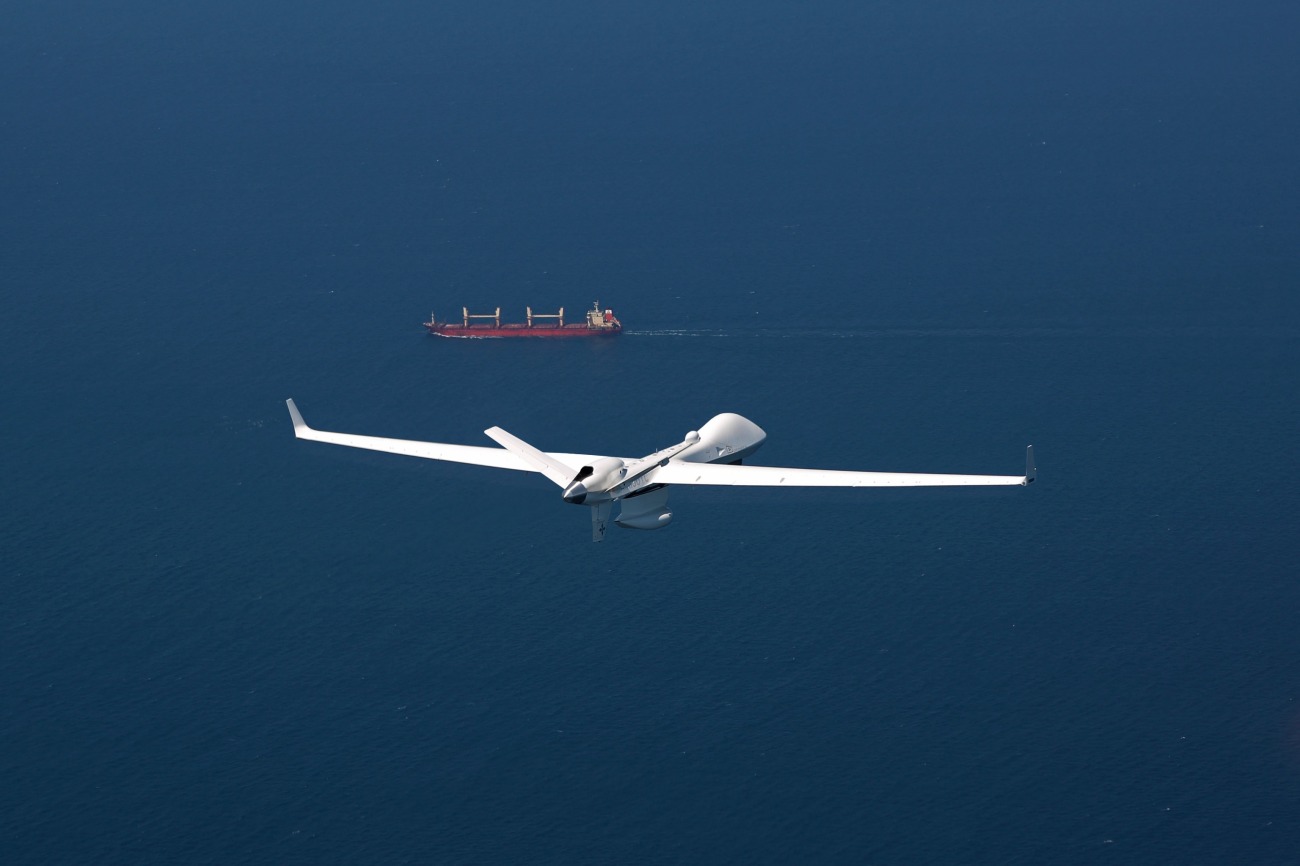
MQ-9B Drone To Boost Indian Defense
The MQ-9B is an evolved and more capable version of the earlier MQ-9 Reaper (Predator B) family. The SeaGuardian, for one, is specifically missionized for maritime operations with additional sensors and payloads tailored for over-water use.
With a 1,800-kilometer range and 36–40 hours of endurance, these drones can effectively cover the large swathes of seas, as well as the country’s western and eastern borders. MQ-9s can locate, fix, track, engage, and evaluate critical emerging targets, both moving and stationary, as previously explained by the EurAsian Times.
With anti-ice/de-ice systems, lightning protection, and autonomous takeoff and landing capabilities, it is built for all-weather operations and can carry a sizable payload—roughly 363 kilograms internally and up to 2,155 kilograms externally over nine hardpoints.
In addition to providing up-to-date information on enemy activity, force deployments, and modifications to border infrastructure, it can conduct intelligence, surveillance, and reconnaissance (ISR) missions. It could also be integrated with missiles, drones, and artillery to enable precision strikes during a military conflict.
Thus, the drone could play a critical role in the kill chain, enabling coordinated precision strikes and enhancing fighter jet survivability.
The MQ-9B Sea Guardian drone is equally significant to the Army and the Air Force as it is to the Navy, as demonstrated in the past.
The Indian Navy’s leased MQ-9A took off from its home station during the 2020 Indo-China border crisis and flew thousands of kilometers to give the Indian forces holding ground at those perilous heights a real-time battle picture.
At the Indian Army’s request, the Indian Navy conducted land missions along the Line of Actual Control (LAC) near China, solidifying the drone’s reputation and further driving its acquisition.
The drone’s biggest advantage is its ability to relay communications, extending the reach of naval communication networks. The MQ-9B’s sensors and communication capabilities can enable SAR (Search and Rescue) operations. The drone can follow survivors, identify distressed vessels, and give rescue crews vital information.
Moreover, the MQ9B can enable real-time targeting of submarine threats, integrate with MH-60R helicopters, and deploy sonobuoys.
“It can act as a bridge between ships, aircraft, and coastal stations, improving overall situational awareness,” an Indian official had previously told the EurAsian Times. Therefore, until the owned MQ-9B fleet begins to arrive, the new lease provides the Navy with continuous high-end ISR capability amid enhanced security threats from China and Pakistan.
- Contact the author at sakshi.tiwari13 (at) outlook.com
- Follow EurAsian Times on Google News