The cracks in the transatlantic relationship, triggered by US President Donald Trump’s sharp criticism of European allies, initially suggested that Europe’s leading military powers—France and Germany—would close ranks. It was, in fact, anticipated that they would accelerate defense cooperation while pushing for European strategic autonomy.
However, despite some alignment, such as joint efforts on nuclear deterrence issues and coordinated pushback against Trump’s calls regarding Greenland, the Franco-German relationship has remained sporadically tense.
Even though they continue to make concerted efforts to bolster cooperation, deep-seated differences undermine closer integration. France has grown uneasy with Germany’s increasing assertiveness and its emergence as Europe’s preeminent economic and, increasingly, military player, as detailed in an analysis by veteran journalist Prakash Nanda for EurAsian Times.
“They are constantly fighting against the mismatched temperaments of their leaders, their orthogonal domestic politics, and the irreconcilably diverging strategic cultures at the heart of their deep states,” Carnegie Europe’s Strategic Europe wrote in a blog last month.
A core divergence lies in strategic outlook: France consistently advocates for greater European strategic autonomy, while Germany remains more committed to robust transatlantic ties with the United States. Meanwhile, economic and trade policies add another layer of friction, with the two powers often diverging on EU-level decisions regarding fiscal rules, industrial strategy, and market access.
France and Germany have struggled to rein in their powerful defense companies, leaving three major European collaborative projects — the Eurodrone, the FCAS fighter program, and the MGCS tank program — in serious difficulty. One has already collapsed, while the other two are now at risk of failure.
Franco-German Defense Projects in Crisis as FCAS Collapses
Europe’s multinational Medium Altitude Long Endurance (MALE) drone program, the Eurodrone, involving France, Germany, Italy, and Spain, suffered a blow earlier this week. Speaking to the French Senate on July 1, 2026, Dassault CEO Éric Trappier said Airbus had tried to expel Dassault from the multinational Eurodrone project.
“For us, it is very simple. Airbus told us to get out,” CEO Eric Trappier told a French Senate committee, when probed about the project that remains marred with delays. “We don’t agree, and so we are in discussions on why we are excluded. I can’t tell you any more about where the programme is because relations are broken at a programme level.”
Designed as a European MALE remotely piloted system, the 11-metric-ton unmanned aircraft system (UAS) seeks to establish and maintain European UAS development capabilities amid increasing reliance by European governments on US and Israeli platforms. The work on the Eurodrone project commenced in 2022 after Airbus was awarded a contract by the procurement agency OCCAR.
Within the Eurodrone framework, Airbus Defence & Space is the overall prime contractor for components, airframe, final assembly, ground stations, and system integration, whereas Dassault Aviation is responsible for safe flight & landing systems, mission communications, and air and ground maintenance systems. Leonardo, on the other hand, is developing sensors, mission systems, and ground control stations. The program was initiated to reduce European reliance on US drones, such as the MQ-9 Reaper.
Notably, Dassault CEO Eric Trappier informed the Senate that the Eurodrone may no longer be relevant, emphasizing that it could become “a fairly easy target” in future conflict, as allied air superiority is no longer assured.
“A Eurodrone over the Sahel [region of North Africa] – it is true that it has long endurance and good surveillance capabilities, [and so] a drone like that must have some relevance. But in an armed conflict where air superiority isn’t absolute, or at least where the threat from the ground remains, it is likely a fairly easy target,” Trappier reportedly stated.

The testimony follows reports last month that Dassault was seeking compensation from Airbus over changes to the Eurodrone program.
Notably, as per previously agreed plans, the partners were to develop 20 systems, each comprising three aircraft and two ground control stations — Germany was to receive seven, Italy five, and France and Spain three each.
However, France’s 2024 – 2030 Military Programming Law (LPM) unveiled in April showed a major drop in the country’s orders through 2035. The funding cut and delays in French payment will result in the company receiving a proportionally smaller share of the work under the European system of defense contracting regulations.
This has reportedly prompted Dassault to demand reimbursement from Airbus.
The cut has been attributed to France’s reservations about the drone being too heavy, expensive, and poorly suited for high-intensity warfare. On its part, the French Air and Space Force has shown interest in smaller, cheaper, and more flexible alternatives. Meanwhile, Airbus reiterated CEO Guillaume Faury’s previous statement that the Eurodrone project was “very likely to move forward with a slightly different setup,” after the French defense ministry changed its mind.
While France remains committed to the Eurodrone despite the cuts, these troubles mirror the recent collapse of the more ambitious FCAS (Future Combat Air System) program.
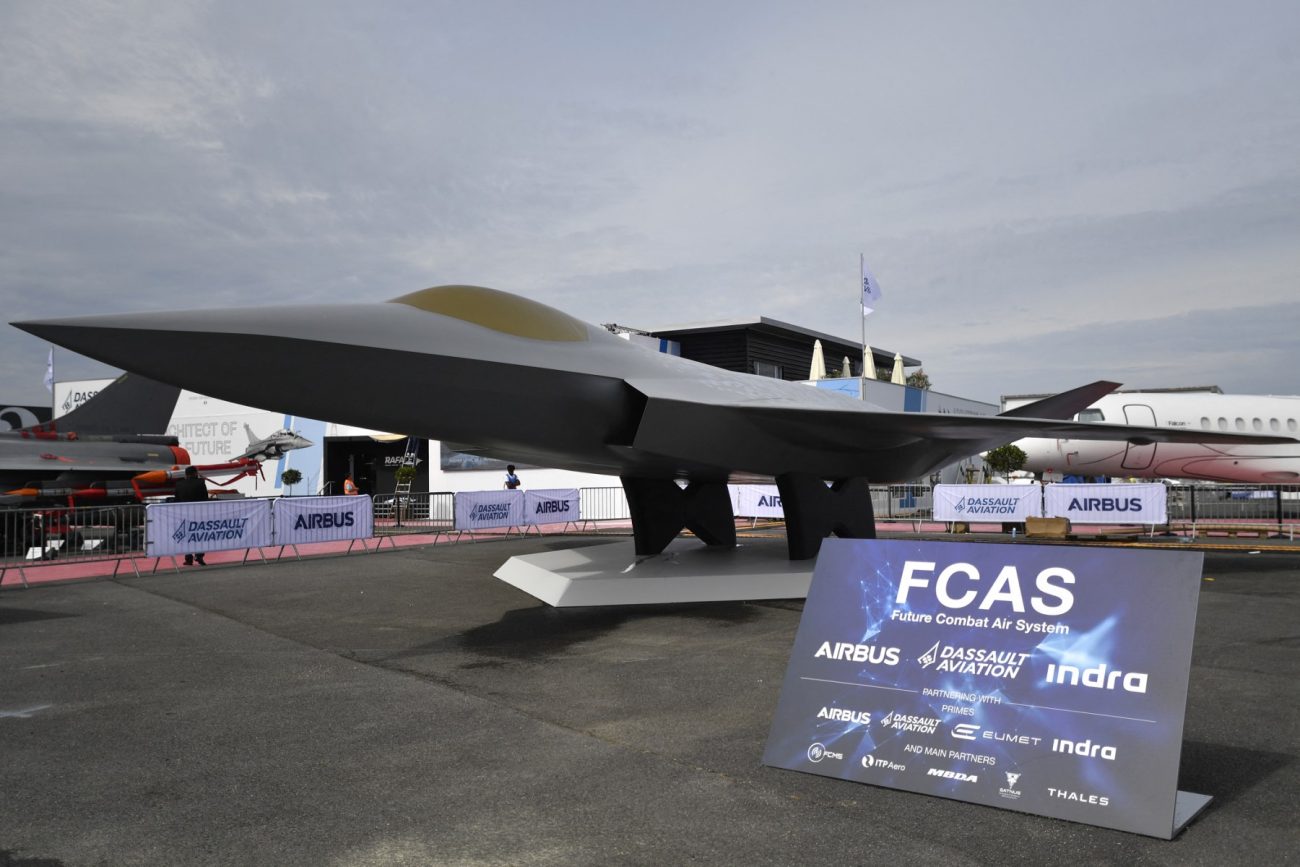
After months in a tailspin, the FCAS (Future Combat Air System) next-generation fighter program, pursued jointly by France, Germany, and Spain, collapsed in June 2026 as Berlin and Paris failed to break the deadlock between industry partners Dassault Aviation (representing France) and Airbus Defense and Space (representing Germany and Spain).
First announced in 2017, the FCAS was intended to be a €100 billion “system of systems” with a next-generation fighter (NGF) at its core, an adjunct aircraft, and a combat cloud for cross-platform information sharing.
As previously explained by the EurAsian Times, the program got off to a smooth start with Dassault taking charge of the next-generation fighter, Airbus developing the “loyal wingman” remote-carrier drone design, new cloud capabilities, and stealth technologies, Spain-based Indra taking on the task of building sensor systems, and Safran developing a new jet engine for the fighter.
However, the program eventually ran into difficulties due to a standoff between Airbus and Dassault over issues such as work-sharing, supplier selection, and design philosophy.
The Dassault CEO insisted that a collaboration focused on work sharing could yield a less-than-ideal technological solution, stressing that Dassault has the expertise and decades of experience to produce the entire fighter on its own. Meanwhile, Airbus demanded an equal share of work, claiming that Dassault’s desired 80% would leave nothing for the German and Spanish industry.
Despite several attempts by French President Emmanuel Macron and German Chancellor Friedrich Merz over the past two years to break the logjam, the program collapsed when the German leader recommended pulling the plug on the NGF last month. According to reports, both countries now have plans to develop their own sixth-generation fighters.
Main Ground Combat System (MGCS)
Launched jointly by France and Germany in 2017, the Main Ground Combat System (MGCS) aims to develop a next-generation combat tank to replace France’s Leclerc and Germany’s Leopard 2 tanks. It is a “system of systems” project that includes a main battle tank and a network of other combat systems, such as artificial intelligence (AI) for decision-making, advanced sensors, robotics, and onboard unmanned aerial vehicles.
The CEO of Rheinmetall recently warned that there are indications France may pull out of the MGCS project.
“There is always a risk, but nothing has been decided yet,” Armin Papperger told Welt am Sonntag last month, adding that the French government is planning to drastically cut funding for the project.
A German government spokesperson later openly questioned the MGCS, stating that it was uncertain whether a joint tank would be built at all and that the project would likely focus on “platform-independent” technologies.

Meanwhile, Jean-Paul Alary, CEO of KNDS, the Franco-German company developing the tank, said at the Eurosatory show in France that, although he could not comment on the MGCS’s current state because it is a political matter, it would be “very bad news” for Europe if the project failed.
The MGCS has remained marred in troubles and beset by delays, much like the now-abandoned FCAS. Disagreements over the tank’s design, technology, and industrial responsibilities have caused serious problems for the MGCS for many years.
Put succinctly, Berlin wants to build a stronger, better-armed tank suitable for a potential battle with Russia, while Paris prefers a lighter tank for worldwide deployment. Moreover, there are also political and budgetary tensions over which country’s industry should take the lead.
The project was initially intended to be led by the Franco-German joint venture KNDS, comprising Germany’s Krauss-Maffei Wegmann and France’s Nexter. However, Germany allegedly exploited its considerable political support to urge Rheinmetall’s involvement. There have since been tensions between the KNDS and Rheinmetall over leadership of program “pillars,” production shares, and contracts.
From a French perspective, Rheinmetall’s involvement has altered the project’s delicate power dynamics, creating discontent and increasing frustration.
Moreover, the project has reportedly been starved of funding. As Rheinmetall CEO Papperger recently noted, the shareholding companies have received only €25 million ($29 million) since the project’s inception.
All three projects have been marred by competing national industrial champions, mismatched operational requirements, disputes over workshare, and divergent political priorities. With the FCAS now history, it remains to be seen whether Berlin and Paris can save the remaining two pillars of European cooperation.
- Contact the author at sakshi.tiwari13 (at) outlook.com
- Follow EurAsian Times on Google News