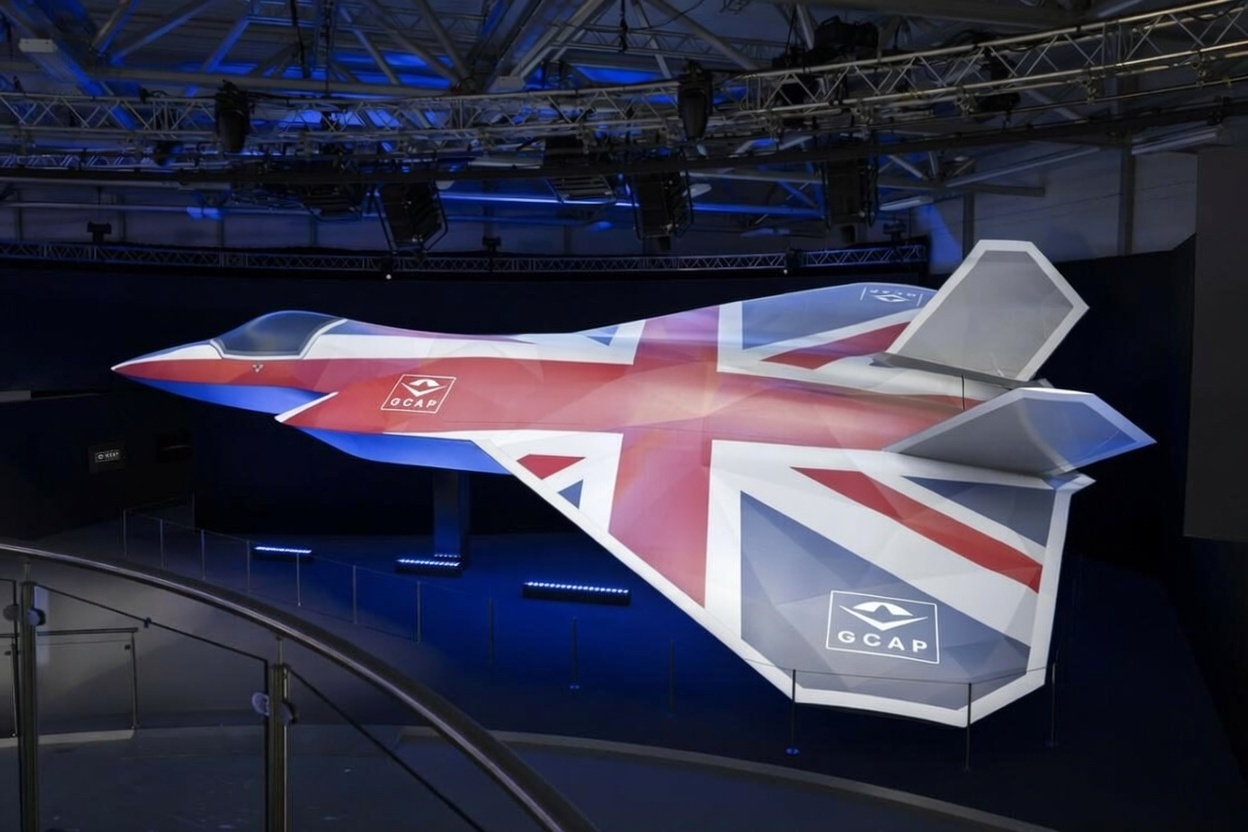
Japan, Italy, and the UK have awarded a $6.1 billion contract to Edgewing to build the 6th-gen GCAP fighter jet, the British government said on Friday.
The move comes just days after the UK committed £8.6 billion over four years to GCAP as part of its long-delayed Defense Investment Plan. That funding unlocked the project’s momentum after months of uncertainty about UK defense spending, which had threatened to stall the ambitious 6th-gen Project.
Edgewing is the trinational industrial joint venture established to lead the design, development, and delivery of the GCAP. Officially launched on 20 June 2025, Edgewing was created by BAE Systems (UK), Leonardo (Italy), and Japan Aircraft Industrial Enhancement Co. Ltd. (JAIEC, Japan).
Each partner holds an equal 33.3% shareholding in the company. Headquartered in the United Kingdom with operations and integrated teams across all three nations, Edgewing serves as the single prime contractor and design authority for the entire GCAP aircraft program.
It will retain this responsibility for the life of the platform, expected to extend well beyond 2070. The JV marks a considerable evolution in how the three countries collaborate on major defense projects. Rather than managing work through separate national contracts, Edgewing coordinates industrial activity as a fully integrated international program.
It subcontracts manufacturing and final assembly to parent companies and the broader supply chains in each nation, while retaining overall design authority, systems integration, and program leadership.
Edgewing’s formation and subsequent contract awards, including the £4.6 billion development contract, have positioned it at the center of efforts to deliver a next-generation combat aircraft with advanced stealth, artificial intelligence, and networked capabilities.
Canada Eyes GCAP
Canada has expressed interest in the Global Combat Air Program (GCAP), a sixth-generation fighter jet initiative pursued by the trilateral grouping of the UK, Japan, and Italy.
Canadian Defense Minister David McGuinty told his Japanese counterpart, Shinjiro Koizumi, in a meeting last week that Canada is “interested in learning more about” the GCAP.
Subsequently, McGuinty told Reuters that he discussed the advanced fighter jet program with his Japanese counterpart, calling it “promising.” “We are interested in learning more about it. I’ll take it back to my team and see what it looks like,” McGuinty told the publication in an interview after the meeting.
This may be the first time a high-ranking Canadian official has directly hinted that the country is interested in joining the GCAP.
Although the Canadian Defense Minister did not elaborate on the scope of the potential role in the program, Japanese publication Asahi Shimbun reported in March that Ottawa wanted to join GCAP as an observer. “Canada will decide after (joining as an observer),” the publication had cited a Japanese government official at the time.
Canada’s interest in this program comes as it is reviewing its F-35 purchase, which Prime Minister Mark Carney put on hold in March 2025 amid escalating tensions with the United States.
Although the F-35 review was expected to be published by the end of summer 2025, it has been indefinitely delayed, with no clarity on when a decision will be made. However, experts surmise that Ottawa has no choice but to complete the purchase, as it has no alternatives to a fifth-generation stealth aircraft and needs interoperability with the US within the NORAD (North American Aerospace Defense Command) framework, as well as with NATO partners within the security alliance.
In addition to the GCAP, Ottawa has also been flirting with the idea of acquiring up to 72 Gripen-E/F jets from Saab in a package deal that includes GlobalEye surveillance aircraft and local manufacturing of the 4.5th-generation jets, in a bid to diversify its arms purchases.
What Does Canada Get Out Of Its Observer Status?
Canada’s observer position does not automatically translate into a partnership. Instead, it allows the observer access to confidential information about the technologies and paves the way for a potential acquisition of the system.
Earlier, Sweden held observer status in the GCAP before withdrawing from the initiative in 2023, citing a mismatch in requirements and high costs. Similarly, Belgium joined the now-defunct FCAS (Future Combat Air System) grouping as an observer in April 2024.
Typically, an observer member in a multinational weapon development program could gain limited but valuable access and insights without the full commitments, costs, or decision-making power of full members or participating states. As an observer member in the GCAP grouping, Canada would gain controlled access to classified or confidential data on the next-generation fighter’s design, technologies, performance, and development process.
This could be very useful for evaluating the system, planning potential future integration into the Royal Canadian Air Force (RCAF), or informing domestic defense strategies.
Becoming an observer means Canada can join the GCAP on a low-commitment basis and, if it so wishes, eventually become a developer. However, that is not guaranteed.
Moreover, observer members typically place orders for the final system, giving them a unique “try before full commitment” option.
Entering the program as an observer will likely allow Canada to explore collaboration with GCAP’s industry partners. This could benefit Canadian aerospace firms through potential subcontracting, knowledge transfer, or later roles in the supply chain. It will also help the Canadian government enhance defense ties with the UK, Italy, and Japan and diversify its security relationships beyond the United States.
Both the United Kingdom and Italy have shown an inclination to expand the program to welcome new members. The UK said last year that it was open to welcoming Canada, whereas Italian Defense Minister Guido Crosetto recently said that more members could join the program, emphasizing that its expansion would help share development costs.
“The country most interested at the moment seems to be Canada as an observer; we are fully open to it,” Crosetto told reporters.
Japan, on the other hand, has been blunt about its reservations about opening the GCAP to new members amid concerns of delays. In the past, it had tried to block Saudi Arabia’s entry into the grouping and had offered only the finished product to potential customers.
The GCAP grouping has set a very ambitious target: to fly its first demonstrator by 2027 and field the next-generation aircraft by 2035.
- Contact the author at sakshi.tiwari13 (at) outlook.com
- Follow EurAsian Times on Google News