The United States’ efforts to field operational hypersonic weapons have faced new setbacks, with the US Army’s Long-Range Hypersonic Weapon (LRHW) program and the US Air Force’s Hypersonic Attack Cruise Missile (HACM) both falling further behind schedule.
A new Government Accountability Office (GAO) report published on July 2, 2026, states that the US Department of Defense is unable to meet weapons-delivery timetables despite repeated assurances.
The watchdog noted that the average time required to field a major defense capability has now exceeded 12 years, while several programs have delayed critical milestones or have yet to establish revised delivery schedules.
“The overall average time frame to deliver a capability increased this year to over 12 years,” the report stated. “Further, several MDAPs [major defense acquisition programs] have not set new delivery dates or are delaying critical interim milestones.”
Notably, the report covers dozens of initiatives and associated delays, including the much-delayed hypersonic weapon programs.
Hypersonic weapons travel faster than Mach 5, or five times the speed of sound, and are highly maneuverable, making it extremely difficult to intercept them.
While the US is yet to operationally field a hypersonic weapon, its competitors like China, Russia, and even sanctioned countries like Iran and North Korea have purportedly fielded hypersonic weapons.
China, for one, has amassed a massive inventory of weapons that travel at five times or more the speed of sound and are very hard to intercept due to unpredictable trajectories—ranging from the DF-17, the YJ-21 anti-ship missile, and the long-range DF-27 hypersonic weapon, to name a few. Russia, on the other hand, has Kinzhal, Zircon, Avangard, and Oreshnik—it has used all of these in combat against Ukraine, except the Avangard.
Additionally, even the Islamic Republic of Iran, which has been restrained by heavy international sanctions, appears to have produced two different hypersonic weapons: the Fattah-1 and the Fattah-2 missiles.
Dark Eagle Delivery Delayed
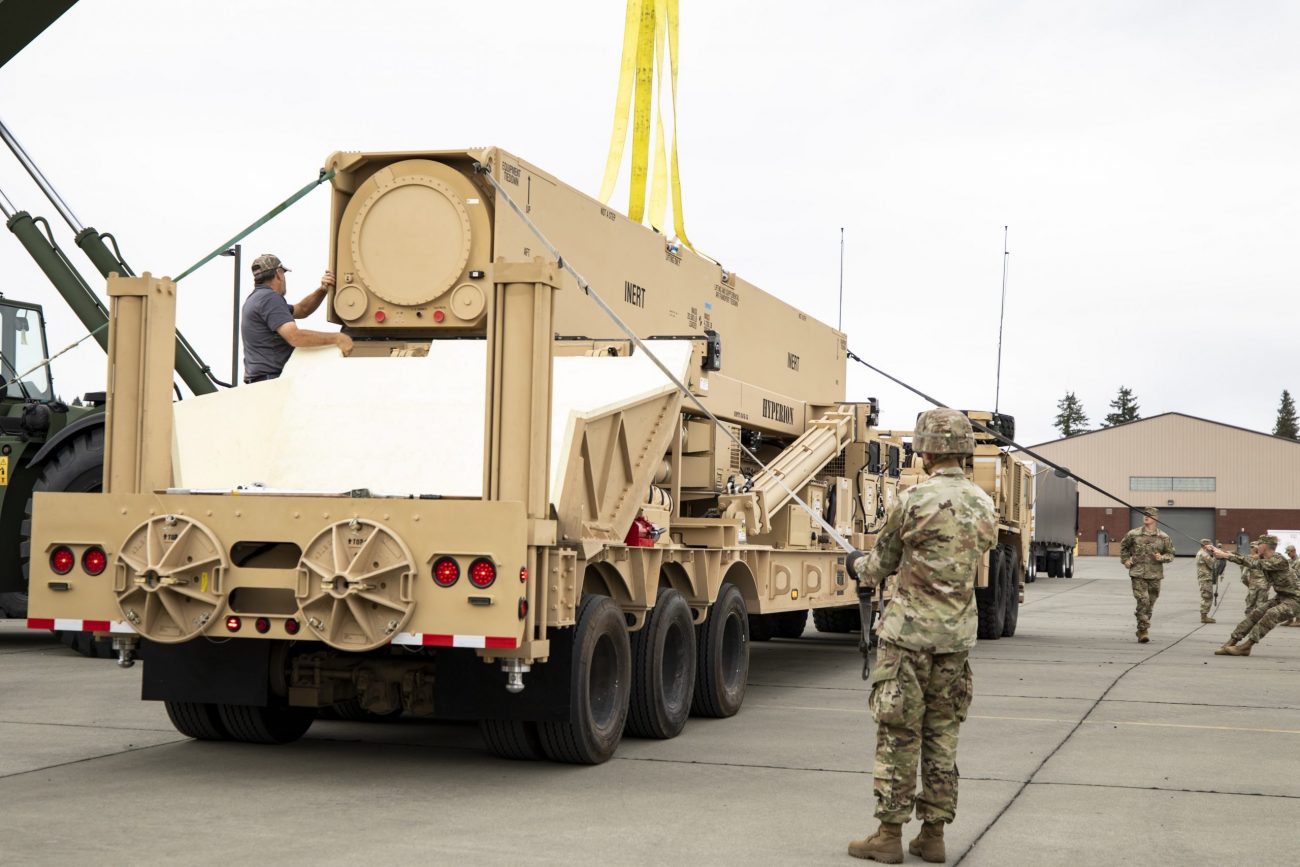
The US Army’s Long-Range Hypersonic Weapon (LRHW), popularly known as Dark Eagle, was expected to become America’s first operational hypersonic weapon system. However, after already slipping by more than two years, the program is facing further delays due to unresolved production issues.
Dark Eagle is a ground-launched missile system previously reported to have a range of 2,776 kilometers. In December 2025, however, Lt. Gen. Francisco Lozano, Director of Hypersonic, Directed Energy, Space, and Rapid Acquisition, informed Defense Secretary Pete Hegseth that the missile’s range is approximately 3,500 kilometers. You can read a detailed EurAsian Times report on the missile’s features here.
The GAO report found that the Army’s hypersonic program comprises two major efforts: an initial prototype battery consisting of four launchers, eight missiles, and associated support equipment; and a separate Middle Tier Acquisition (MTA) rapid-fielding effort to deliver two additional batteries.
The GAO found that the first battery will not be fielded until at least the second quarter of fiscal year 2026, more than two years later than originally planned.
Interestingly, the US Army officials stated in March 2026 that the unit would receive its first operational missiles “soon,” suggesting that the service was in the final stages of fielding and beginning procurement of its first eight missiles. However, the service has not officially notified whether the battery has been operationalized with missiles.
The GAO report further states that the second battery has slipped by at least six months due to “missing, inconsistent, and unclear work standards for missile production.” Furthermore, it states that the second battery includes a modified missile variant that has not yet undergone flight testing.
Initially scheduled for delivery in the fourth quarter of fiscal year 2027, the battery is now expected no earlier than fiscal year 2028. The GAO warned that this is likely to create a cascading effect, delaying the delivery of the third battery as well.
The US Army has already sent the Dark Eagle system to Australia’s Northern Territory for the Talisman Sabre 2025 global military exercise, even though it has not yet attained Initial Operational Capability (IOC). Meanwhile, the US Central Command (CENTCOM) allegedly sought the weapon for possible deployment to the Middle East amid increased regional tensions, as previously reported by the EurAsian Times.
USAF’s HACM Faces Delays
The GAO report also raised concerns about the US Air Force’s Hypersonic Attack Cruise Missile (HACM) program.
The HACM is being developed by Raytheon as an air-breathing, air-launched hypersonic cruise missile designed to strike high-value targets from fighters and bombers operating in contested environments. The project is being advanced in collaboration with Australia, as previously discussed in detail by the EurAsian Times.
The Air Force originally structured the HACM program around a compressed five-year rapid-prototyping phase, planning to transition to production if testing proved successful. It initially scheduled 13 flight tests between October 2024 and March 2027 before moving toward a production decision.
Eventually, the test plan was tightened as design delays pushed the program behind schedule, and the campaign was cut back to seven flights. However, the plan was revised again in 2025 as reports indicated the USAF was considering reducing the campaign from seven end-to-end demonstrations to five due to delays in finalizing the weapon’s hardware design.
Notably, HACM was to conduct its first flight test during the second quarter of fiscal year 2026. However, the latest report states that program project managers state that “there is effectively zero margin left in the schedule for the rapid prototyping effort,” despite the USAF cutting the test program from seven to five planned test flights.
“If a significant flight test failure occurs, it is likely that the program will not be able to complete all five tests within the 5-year rapid prototyping timeframe,” the watchdog notes in the expansive report. “According to the program, completing at least the first three flight tests is critical for informing the Air Force’s decision to initiate a rapid fielding effort and procure HACM in fiscal year 2027.”
HACM has struggled with delays since its early development. Initially, the delay was primarily due to the program needing more time to finalize the hardware design, which pushed the preliminary design review back by about 6 months. This delay shortened the test schedule, reducing the planned flight tests during the rapid prototyping phase.
These continued delays have fueled speculation that the Air Force may be reconsidering the AGM-183A Air-Launched Rapid Response Weapon (ARRW), which was shelved in 2023, even as HACM development continues.
The delays in both programs have effectively put the US’s aspirations to become a hypersonic-armed nation on hold, at least for now.
- Contact the author at sakshi.tiwari13 (at) outlook.com
- Follow EurAsian Times on Google News