Iran has warned of “unforeseen” consequences after Ukraine’s attack on an Iranian vessel in the Caspian Sea.
“This action by Ukraine was an absolutely illegal and unjustified act, contrary to the Charter of the United Nations, as well as a dangerous act of adventurism that will certainly not go unanswered by us,” the ministry’s spokesman Esmaeil Baqaei said in a weekly press briefing, adding that the consequences of Ukraine’s action “will certainly be unforeseen”.
Earlier, Iran’s Foreign Minister Abbas Araghchi warned that Tehran would respond to a deadly attack by Ukraine on an Iranian ship.
It came after Ukrainian President Volodymyr Zelensky said Kyiv had carried out long-range strikes in the Caspian Sea against vessels transporting military cargo involving Iran, underscoring the increasingly international dimensions of Russia’s war in Ukraine.”
Zelenskyy has attacked an Iranian commercial vessel, killing a sailor,” Araghchi said on X, describing it as “a blatant UN Charter violation done at Israel’s behest to drag Europe into its war”.He added that, during calls with the European Union’s Kaja Kallas and Russian top diplomat Sergei Lavrov, he “made clear that what the freeloader in Kyiv did CANNOT GO UNANSWERED”.
Iran’s foreign ministry said the attack caused the ship “to explode, killing one sailor and injuring several others”.The Islamic republic “has never intervened in the conflict between Russia and Ukraine”, the ministry said in a statement.
Ukrainian President Volodymyr Zelensky said on social media that armed forces had achieved “very strong results with long‑range strikes in the Caspian Sea — including vessels used in military cargo shipments involving Iran, as well as a warship”.
Ukraine’s intelligence services reported on Telegram that drone attacks had been carried out against “cargo vessels under international sanctions that were used to transport military cargo between Iran and Russia”.According to Iranian state television, the foreign ministry summoned the Ukrainian charge d’affaires in Tehran to protest this “hostile and criminal act”.
Ukraine Punches Hole in the “Caspian Highway”
As EurAsian Times reported earlier, it is Russia that is sending components for attack drones to Iran via the Caspian Sea, helping Tehran restock its arsenal.
It is said that many vessels operating between Russian ports like Astrakhan and Makhachkala and Iranian ports such as Bandar Anzali in the Caspian Sea function as a “dark” or shadow fleet. The merchant vessels of the two countries are said to be turning off their automatic identification system transponders in the Caspian Sea, allowing them to transport goods undetected by satellite surveillance.
According to a report in the New York Times, Iranian officials have said that efforts to open alternative trade routes are progressing rapidly, with four Iranian ports (Amirabad, Bandar Anzali, Nowshahr, and Caspian port) along the Caspian working around the clock to bring in wheat, corn, animal feed, sunflower oil, and other supplies.
Similarly, Russian trade officials have been quoted as saying there has been a swift increase in Caspian shipping in recent months. Two million tons of Russian wheat that used to be shipped annually to Iran through the Black Sea — now under threat of Ukrainian attacks — is now going via the Caspian.
Apparently, between July and February, Iran imported nearly 6 million tons of grain from Russia, double year-ago levels. Four Iranian Caspian ports now run 24/7 to process surges in wheat, corn, animal feed, and sunflower oil rerouted from blocked southern routes.
America’s New Headache: How Iran’s Kheibar Shekan Missiles Are Challenging U.S. Air Defense Systems
Russia is said to operate three grain-exporting ports on the Caspian: two in Astrakhan and one in Makhachkala, with a combined capacity of at least 3 million tons. A new 1.5-million-ton terminal in Makhachkala is expected to be completed by 2028.
In other words, the landlocked Caspian Sea, the largest lake in the world, has been proven to be a safe passageway for overt and covert trade between Russia and Iran. By rebuilding Iran’s offensive capabilities, this is helping Tehran persist as an adversary of the US despite overwhelming American military superiority.
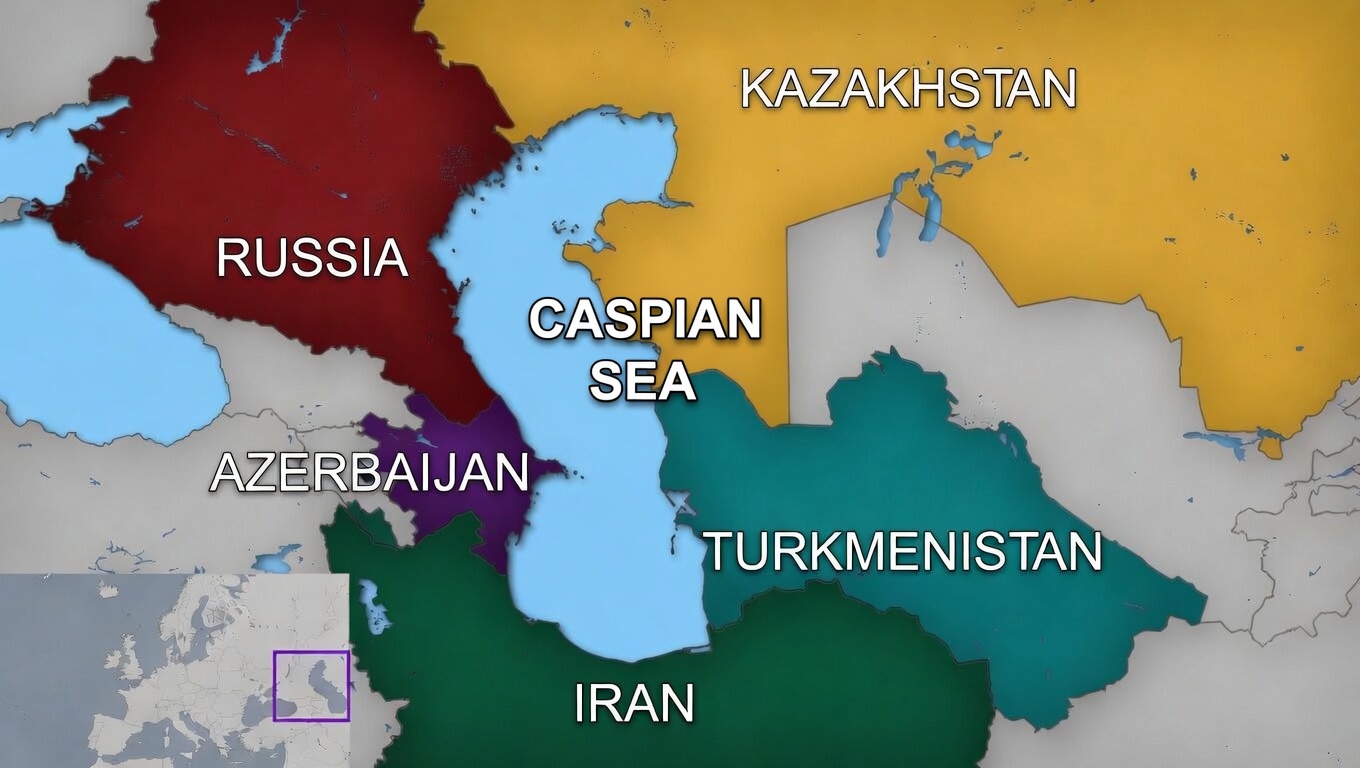
Unlike the Persian Gulf, the United States cannot interdict ships on the Caspian because only the five bordering nations have access. And that is because, under the 2018 Convention on the Legal Status of the Caspian Sea, only the five bordering nations—Russia, Iran, Azerbaijan, Kazakhstan, and Turkmenistan—have exclusive jurisdiction over it.
Third-party militaries are strictly prohibited. Only the five littoral states can maintain military forces there. The US Navy, or, for that matter, any NATO member, has no legal right or physical ability to enter, patrol, or intercept ships here.
Containing vast reserves of oil and gas, the Caspian Sea has, of late, assumed many strategic dimensions. First is its geography – sitting at the crossroads of Europe, Asia, the Middle East, and Central Asia, it acts as a buffer zone and transit corridor between competing spheres of influence.
Multimodal (rail, road, maritime) arteries such as the Trans-Caspian International Transport Route (connecting China through Central Asian states, the Caspian Sea, the South Caucasus, and Turkey to the European Union) and the North-South transport links involving Russia, Iran, and India. These bypass traditional oceanic chokepoints and are vital for regional integration.
Important pipeline systems linked to the Caspian region help transport energy to Europe and global markets while bypassing Russia or Iran in some cases. This makes the region central to European energy security, global oil supply diversification, and geopolitical influence over energy corridors.
Secondly, and this is particularly significant in the context of Iran, Moscow and Tehran signed a strategic partnership treaty in 2025 and have pledged to enhance military cooperation, including regular naval exercises in the Caspian.
In 2020, Iran and Russia started their first joint strategic naval exercises in the Caspian Sea. Since then, Russia’s Caspian Flotilla has been regularly hosting Iranian Navy and IRGC Navy vessels. Mutual port calls and what are called “PASSEX” drills, which focus on, among others, air defense and anti-ship missile launches, have become more frequent or routine.
Apparently, these exercises allow Iran to test Russian-provided air-defense radars and electronic warfare systems that are harder to deploy in the Persian Gulf due to US monitoring.
It may be noted that in March, Israel had targeted the 4th Artesh Naval District Headquarters at Bandar Anzali, destroying several naval assets, including missile boats (likely Sina-class) and the Hamzeh corvette. This reportedly wiped out roughly half of Iran’s warships and patrol vessels in the Caspian, affecting the supply chains, particularly relating to Russian-supplied drone components, ammunition, and other military hardware.
Israel called it “one of the most significant” strikes conducted during combat operations, as this “shattered the illusion that the Caspian Sea was a secure and closed corridor for Moscow and Tehran to bypass blockades in the Persian Gulf”.
Israel’s Qatar Ultimatum: Ex-PM Pledges to Declare Qatar an Enemy State Despite Its Strong U.S. Ties
After Israeli strikes hit Iran’s Caspian naval command, Russia is reported to have increased joint drills with Iran to keep the country as a militarily viable partner against Western pressure, giving, in the process, the Caspian Flotilla a combat-relevant mission beyond coastal patrol.
By attacking an Iranian ship in the Caspian Sea, Ukraine did more than hit one vessel. It struck at a key supply route that links Russia and Iran.
Iran still calls this route commercial, but it has become a two-way military channel: Iranian drones and parts go north to help Russia fight Ukraine, while Russian parts and technology go south to help Iran rebuild its weapons.
- Author and veteran journalist Prakash Nanda is Chairman of the Editorial Board of the EurAsian Times and has been commenting on politics, foreign policy, and strategic affairs for nearly three decades. He is a former National Fellow of the Indian Council for Historical Research and a recipient of the Seoul Peace Prize Scholarship.
- CONTACT: prakash.nanda (at) hotmail.com