For the first time, a Royal Air Force (RAF) Eurofighter Typhoon flew alongside the French nuclear-capable Rafale during a simulated nuclear-strike mission, showcasing rare coordination between Europe’s two most advanced fighter jets.
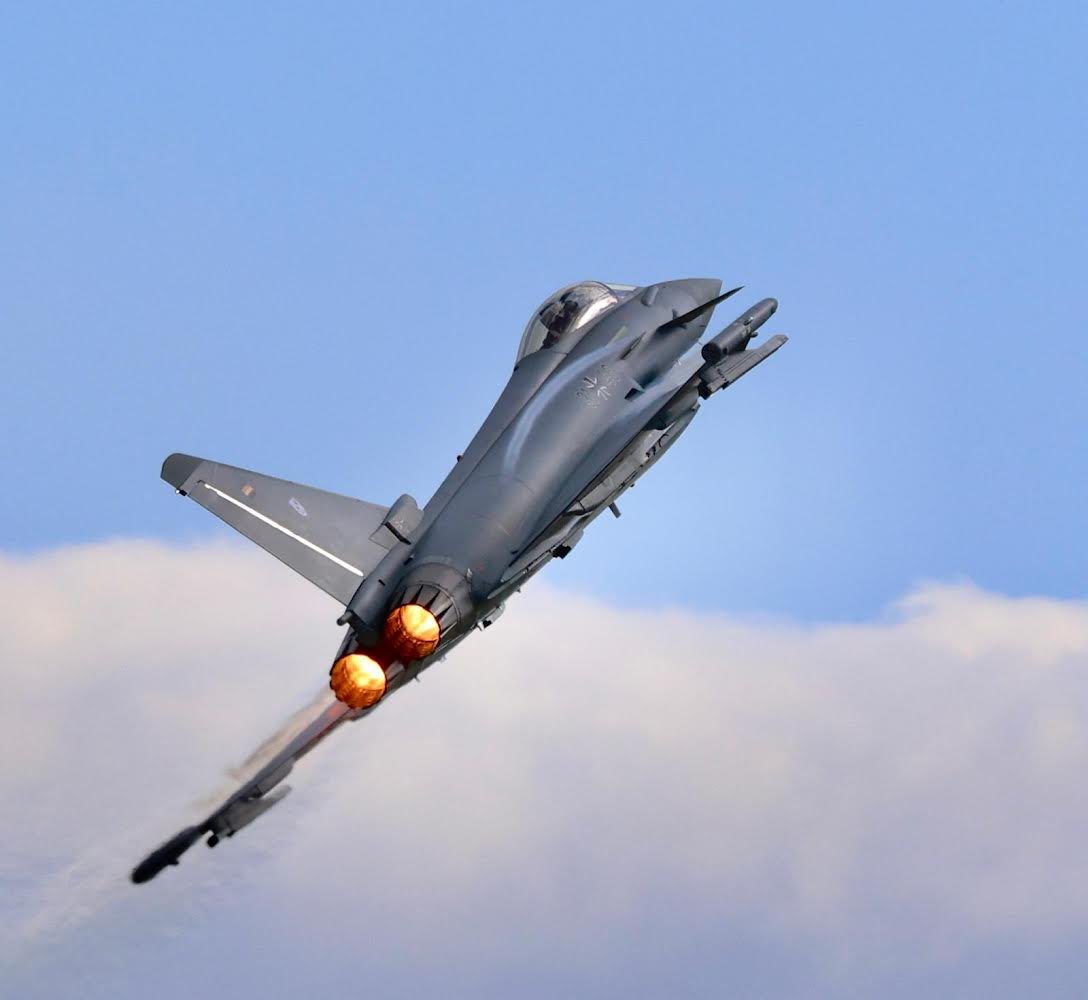
The UK deployed a small contingent of Eurofighter Typhoon FGR4s to France’s Saint-Dizier air base—a key facility in northeastern France that hosts Rafale squadrons of the deterrence force—for Exercise Rummy held over two days on October 20 and 21, 2026.
The exercise took place over France and the Mediterranean, with the Typhoons serving as a defensive counter-air (DCA) escort for the mock nuclear-armed Rafales during a simulated long-range nuclear strike sortie. The A330 MRTT refueling tankers supported the package.
“Taking off from the nuclear-capable air base at Saint-Dizier, the French and British crews demonstrated a very high level of interoperability and an ability to coordinate. The French and British nuclear forces remain independent,” the French Chief of the Defense Staff, General Fabien Mandon, said in a post on X.
Notably, the exercise did not involve any real nuclear warheads, although images published by French officials and Armed Forces Minister Catherine Vautrin show French Rafales armed with ASMP (an air-launched land-attack cruise missile that can carry a nuclear payload) and Mica air-to-air missiles. Meanwhile, the Eurofighters were seen equipped with the short-range ASRAAM air-to-air missiles and fuel tanks.
“Conducted under robust safety and security arrangements, the exercise did not involve nuclear weapons. The exercise focused on improving how our forces work together, ensuring that if the UK faces a serious threat, our military can respond quickly and effectively alongside our closest European ally,” the UK Ministry of Defense said in an official statement on October 23, 2026.
Under the Conventional Support for Nuclear Operations (CSNO) concept, which is an established approach of NATO, the conventionally armed Eurofighter Typhoons could provide conventional escort and protection for the nuclear-capable Rafales without carrying, controlling, or deciding on the use of nuclear weapons.
As the nuclear-armed aircraft’s main air defense, the Typhoons would have unrestricted movement around the Rafales’ perimeter to identify and, if required, neutralize any radar contacts.
Optimized for high-altitude, high-speed air superiority and carrying weapons for both short- and long-range combat, the Eurofighter Typhoons can detect, intercept, and engage enemy fighters that threaten the strike package during a nuclear mission.

In a real mission, the Typhoon’s high-altitude intercept capability and the Rafale’s low-observable, terrain-following performance would lower overall mission risk and improve the chances of the strike aircraft reaching the launch point.
Nuclear Cooperation Without Sharing Nukes
Both the UK and France are nuclear powers, although Britain stopped using air-launched nuclear weapons in 1998 following the Strategic Defense Review (SDR), and currently only possesses the Trident submarine-launched missiles for nuclear weapons. France, by contrast, has both sea- and air-based nuclear launch capability.
France, in turn, retains exclusive political and operational control over its nuclear forces. Therefore, Exercise Rummy does not create a shared European nuclear force; it shows only that two independent deterrents can practice the tactical and procedural interface of a nuclear mission, including communications, escort, tanker support, and deconfliction, without combining their weapons, targeting, or the final decision to fire.
That said, France and Britain signed the Northwood Declaration to strengthen cooperation on their respective nuclear arsenals during French President Emmanuel Macron’s three-day visit to Britain in July 2025.
“This morning, we signed the Northwood Declaration, confirming for the first time that we are coordinating our independent nuclear deterrence,” the former British PM Keir Starmer said at the time. ”From today, our adversaries will know that any extreme threat to this continent would prompt a response from our two nations. There is no greater demonstration of the importance of this relationship.”
Later that year, the newly formed Nuclear Steering Group met for the first time in Paris, and British officials observed Exercise Poker, a regular nuclear deterrence exercise conducted by French Air and Space Forces, marking the first time foreign officials had been given that access. Notably, the UK went from mere observer to participant, providing conventional support in a nuclear deterrence drill, in 10 months.
“Having independent nuclear forces doesn’t exclude coordination. By coordinating, our nuclear forces demonstrate that they can contribute even more significantly to the overall security of the alliance and the peace and stability of the Euro-Atlantic zone,” French Armed Forces Minister Catherine Vautrin stated.
Meanwhile, British Defense Secretary Wes Streeting said, “As Europe’s nuclear powers, we have a shared responsibility to contribute to the security and stability of the Euro-Atlantic region. This exercise demonstrates the depth of our partnership, the credibility of our deterrents and our determination to stand together in the face of emerging threats.”
France has been collaborating with several European partners on the idea of “forward deterrence” amid uncertainties about US security guarantees for Europe and escalating security threats from Russia. Earlier this year, German Eurofighter Typhoons flew alongside French nuclear-capable Rafales in a joint “forward deterrence” exercise earlier this year.
In July 2026, two Luftwaffe Eurofighter Typhoons from Taktisches Luftwaffengeschwader 31 “Boelcke” at Nörvenich and two French Air and Space Force Dassault Rafale Bs from the Forces Aériennes Stratégiques at Saint-Dizier conducted their first joint air activity.
In March this year, French President Macron announced some changes in the country’s nuclear policy, including increasing the size of the country’s nuclear arsenal and extending the deterrent to cover other European countries.
“The next 50 years will be an era of nuclear weapons,” he exclaimed. The President noted that the UK, Germany, Poland, the Netherlands, Belgium, Greece, Sweden, and Denmark had all agreed to participate in the new “advanced deterrence” plan. He emphasized that the eight European nations could host air bases where France’s nuclear bombers could be based as well as participate in exercises of France’s air-launched nuclear capability.
This would allow France’s Strategic Air Forces (FAS) to “spread out across the depth of the European continent… and thus complicate the calculations of our adversaries”, the president said at the time. This hinted that the country was eager to spearhead the continent’s nuclear posture amid rising security threats from Russia and a strained transatlantic relationship that has heightened insecurity among European states.
That said, Exercise Rummy does not create a shared European nuclear force, nor does it amount to a French nuclear umbrella in the classic extended-deterrence sense. Instead, it shows France systematically testing how far it can bring conventional partners–including Europe’s only other nuclear power–into the operational orbit of its airborne nuclear forces while retaining full control over the nukes in line with the larger “forward deterrence.”
- Contact the author at sakshi.tiwari13 (at) outlook.com
- Follow EurAsian Times on Google News