

Four of China’s new KJ-3000 airborne early warning aircraft have been spotted at the Xi’an Aircraft Company complex, suggesting the type may have entered low-rate or serial production just 22 months after its first flight.
Satellite images captured around October 4, 2026, by Vantor and posted to social media show four KJ-3000 early warning aircraft at the Xi’an Aircraft Company (XAC) complex in Yanliang. Three were spotted near the Y-20 production facilities, and the fourth was seen at the adjacent China Flight Test Establishment (CFTE).
Senior Fellow J. Michael Dahm of the Mitchell Institute for Aerospace Studies analyzed all available images in depth and assessed that the presence of four aircraft at Xi’an’s Y-20 production facility indicates the KJ-3000 has entered serial production.
However, Chinese military aviation specialist Andreas Rupprecht seemed to agree with Dahm’s assessment, though he noted that the images could instead signal that the aircraft have entered low-rate production.
“Consequently, this could indeed be a sign that production or LRIP has begun; however, it could also be that all 4 previously known prototypes are in place. What we therefore need are clear photographs of the aircraft, their serial numbers, and, at best, showing them in PLAAF grey,” he argued, adding just the amount of caution required vis-à-vis Chinese platforms.
The KJ-3000, expected to be China’s most advanced early warning aircraft, first broke cover in December 2024, right after the sixth-generation prototypes, the J-36 and the J-50, were seen flying for the first time.
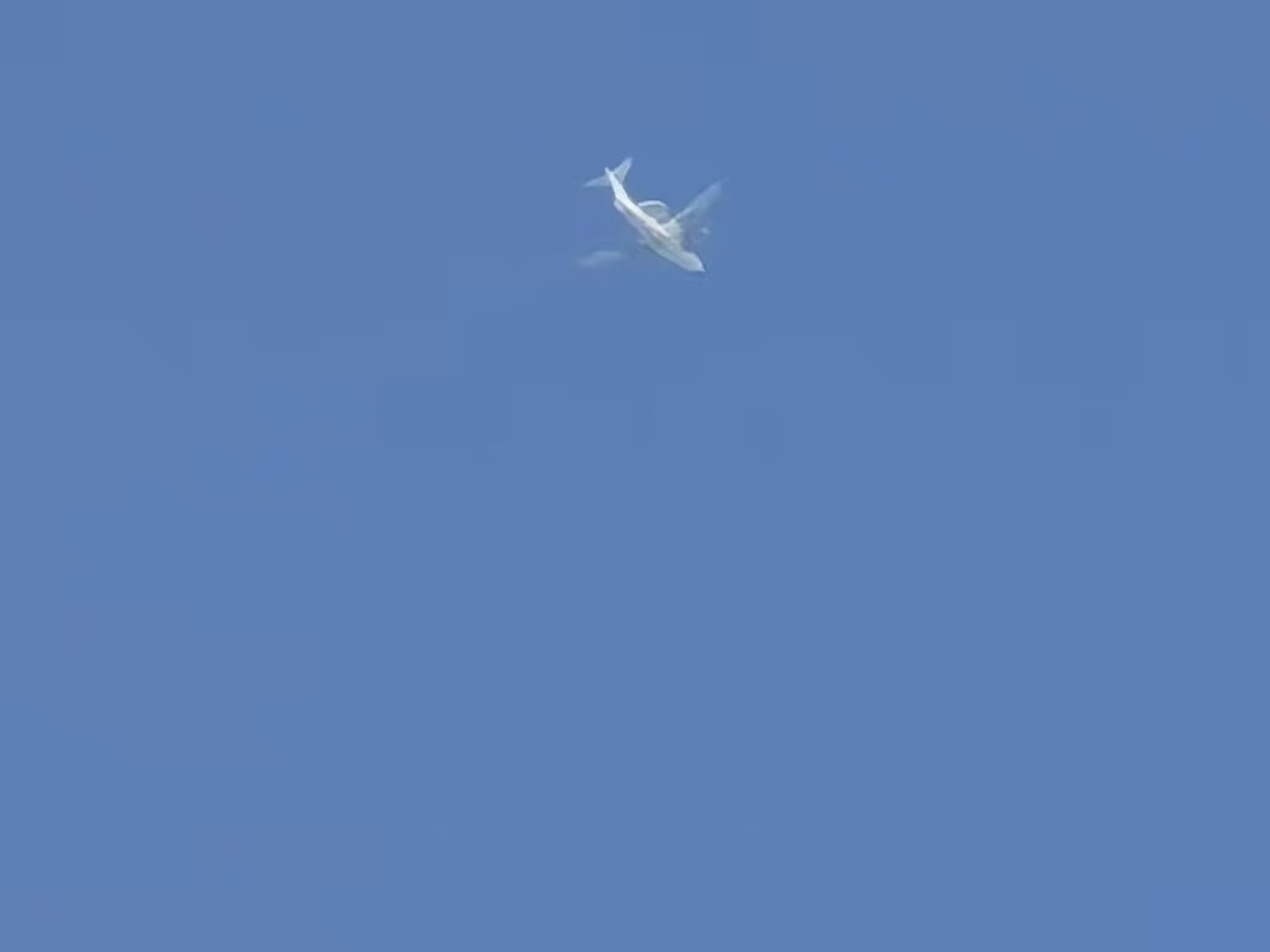
A pixelated image of the KJ-3000 in flight was posted to social media, as the EurAsian Times had reported at the time. Another highly pixelated image of a primer-painted aircraft bearing serial number 7821 surfaced in May 2025.

Notably, AEW&C aircraft serve as “eyes in the sky,” providing real-time surveillance and command and control over large areas. They are crucial force multipliers that coordinate air operations, guide fighters, and integrate data from multiple sources, including satellites, other aircraft, and ground-based sensors, serving as airborne command centers. Thus, playing a vital role in complex, dynamic battlefields where rapid decision-making is key.
Although details about the KJ-3000 are scarce, it is based on the Y-20B transport aircraft and powered by a WS-20 high-bypass turbofan engine.
The aircraft has a noticeable set of antennae on the forward fuselage and a large circular radome positioned over the rear fuselage. It also features a prominent intake at the base of the tailfin, likely to supply cooling air for its numerous onboard electronics. Additionally, it has an aerial refueling probe above the cockpit.
The aircraft is expected to have a detection range of 360 to 500 kilometers, although some estimates put it at 600 to 1,000 kilometers. These conjectures couldn’t be verified.
The massive early warning radar aircraft is likely intended to replace the KJ-2000, China’s only large jet-powered AEW&C platform to date. The People’s Liberation Army Air Force (PLAAF) had a limited fleet of about four KJ-2000 aircraft, converted from Russian Ilyushin Il-76MD transports in the early 2000s, as the program stalled due to limited access to suitable Il-76 airframes and reliance on Russian engines and spares.
The KJ-3000 is believed to be a massive improvement over the KJ-2000. It can reportedly carry up to 66 tons of payload (16 tons more than the KJ-2000), and the WS-20 engines provide more thrust (about 31,000 pounds) and fuel efficiency, enabling longer flights.
The KJ-3000 would serve as a high-end airborne command, control, and surveillance node, significantly enhancing China’s ability to detect, track, and coordinate forces across the vast distances of the Indo-Pacific in a potential conflict with the United States.
Its large AESA radar—mounted on a high-flying, long-endurance Y-20B platform—provides a much greater radar horizon than ground-based radars or existing smaller Chinese AEW&C aircraft.
Operating at higher altitudes and with aerial refueling will allow the KJ-3000 to provide persistent coverage over key maritime approaches, the Taiwan Strait, the Philippine Sea, or the South China Sea.
The aircraft could detect aircraft, ships, and potentially low-observable or low-flying threats (such as drones and bombers) farther away, giving Chinese forces earlier warning and more time to decide on a fast-moving battlefield.
The KJ-3000 is designed as a “sky command center.” It can track multiple targets at once and direct Chinese fighters, such as the J-20 stealth aircraft, as well as long-range air-to-air missiles, surface-to-air missiles, anti-ship missiles, and drones.
Furthermore, the KJ-3000 detects and tracks carrier strike groups, airborne tankers, AWACS, and strike packages at longer ranges, feeding targeting data to ballistic and cruise missiles and aircraft, and helping Beijing’s painstakingly built Anti-Access/Area-Denial structure.
A Mismatch Between Chinese & US Capability
Interestingly, China’s expanding early warning capabilities contrast sharply with those of the United States Air Force, which continues to grapple with the transition of its own heavy advanced early warning from the E-3 to the more advanced E-7 Wedgetail.
The E-3 Sentry fleet is aging, and its airframe and radar limitations are becoming more acute with every passing day. The planned replacement, the Boeing 737-based E-7 Wedgetail, already in service with allies such as Australia, South Korea, Turkey, and soon the United Kingdom, was originally planned for the USAF at 26 aircraft. However, budget uncertainty and shifting priorities have repeatedly delayed procurement.
Last year, for instance, the previous US Air Force plan to acquire 26 Boeing E-7 Wedgetail aircraft remained under review during the fiscal 2026 budget process under the current Trump administration, as the EurAsian Times reported at the time.
However, Congress pushed back against potential cuts and cancellation of the program.

In March 2026, the USAF changed strategy and awarded contract modifications to continue development and procure additional engineering-and-manufacturing-development (EMD) aircraft, bringing the contracted total to about seven. Later, in May 2026, the Secretary of War Pete Hegseth stated the department’s “mindset” had changed and that the E-7 “has a future” and a place on the battlefield.
Finally, reports in June 2026 noted that the Pentagon was seeking diversion of money from the US Navy’s E-2D Hawkeye and classified Air Force accounts to fund a $1.55 billion spending plan for its revived E-7 Wedgetail program in fiscal 2027. However, it has not yet committed to the large production run of the originally planned 26 aircraft.
The continued delay has raised concerns about a potential gap in airborne battle management amid rising security threats, especially since the E-3 is becoming outdated and the US has only about 15 of these aircraft (after one loss in the Iran war).
By contrast, China is not only improving its early warning capabilities but also expanding its AEW&CS fleet—something that could trouble the US and its allies in an Indo-Pacific conflict.
China is Amassing Early Warning Aircraft
Early warning platforms are among an air force’s most strategic assets, especially since a single high-end platform can cover hundreds of thousands of square kilometers and track multiple targets during combat. However, no air force can rely on a handful of expensive, slow-moving, vulnerable early-warning aircraft alone.
So, China appears to have created somewhat of a layered AEW&C force structure.
Under this strategy, instead of fielding one type of aircraft, Beijing is working on deploying complementary tiers of platforms optimized for different roles, ranges, basing options, and threat environments. This is intended to create persistent, resilient, multi-domain surveillance that adversaries find harder to suppress.
China has developed newer early-warning aircraft based on existing designs, including the KJ-500, which forms the backbone of the PLAAF’s early-warning capability and is based on the Shaanxi Y-9 turboprop, and the KJ-200, a legacy aircraft based on the older Y-8.
The KJ-200 and KJ-500 are smaller than the high-end KJ-3000. They are considered ideal for regional operations, including in volatile areas like the Taiwan Strait and the South China Sea, and would play a major role in a potential contingency in these flashpoint areas.
The KJ-200s, for one, provide supplementary coverage and experience while the PLAAF expands and simultaneously upgrades its KJ-500 fleet.

China has also developed the KJ-700, a next-generation Y-9-derived design intended as a more capable complement to the KJ-500. It features improved sensors and enhanced networking and is designed to handle denser, more complex threat environments, including low-observable aircraft and large numbers of drones. It is likely designed for missions anticipated in a future conflict with the United States.
China has also developed the KJ-600 for carrier-based operations, giving the PLA Navy massive reach and the ability to detect incoming threats from farther away, allowing it to project power far from its coast. With a twin-turboprop design, folding wings, and a large AESA rotodome, the KJ-600 entered operational service on the CATOBAR carrier Fujian in 2025 and has been observed on the ski-jump carrier Shandong.
The KJ-200 could be classified as a low-tier legacy aircraft, while the KJ-500 and KJ-700 could be clubbed as medium-tier and advanced medium-tier aircraft, respectively.
Meanwhile, the KJ-600 is a specialized carrier aircraft. The larger, more capable KJ-3000 falls into the high-tier category, and its serial production would let China field multiple aircraft for continuous coverage, attrition resilience, or simultaneous operations.
- Contact the author at sakshi.tiwari13 (at) outlook.com
- Follow EurAsian Times on Google News