After the collapse of the next-generation Future Combat Air System (FCAS) earlier this week, France announced that it is advancing work on a nuclear-capable ASN4G hypersonic missile for the Rafale F5 fighter jet.
France’s defense procurement agency, the Direction Générale de l’Armement (DGA), notified MBDA on June 2, 2026, about the framework agreement for the implementation and development contract for the ASN4G (Air-Sol Nucléaire de 4ème Génération), the country’s fourth-generation nuclear-armed hypersonic cruise missile.
The DGA has set a target of 2035 for the missile’s induction, adding that it will be carried by the Rafale F5 and integrated into both the French Air and Space Force’s Strategic Air Forces (FAS) and the Navy’s Nuclear Air Force component, according to an official press statement.
“The performance of the ASN4G, and in particular its hyper-speed, will maintain the credibility of airborne deterrence in the face of changing threats,” the agency stated.
Although details about the missile remain shrouded in secrecy for operational reasons, we know that the ASN4G will replace the ASMP (Air-Sol Moyenne Portée), the supersonic nuclear stand-off missile currently carried by the French Air Force and Navy Rafales, which make up the aerial leg of France’s current nuclear force.
The ASN4G will be scramjet-powered, capable of reaching hypersonic speeds (more than Mach 5), and has a longer range than the ASMP and its upgraded variant, the ASMPA-R. Additionally, some reports suggest that the futuristic ASN4G will have a range of about 1,000 kilometers, and a new TNA4G (Tête Nucléaire Aéroportée 4G) thermonuclear warhead designed to withstand hypersonic stresses.
Notably, the contract award was announced a year after Dassault Aviation’s chief, Eric Trappier, confirmed that the Rafale F5, currently under development, would carry the nuclear-armed ASN4G missile.
With the induction of ASN4G, France will officially enter the elite clique of countries with hypersonic capability. Currently, only Russia and China have air-launched hypersonic weapons in their arsenal, with the US playing catch-up with its HACM (Hypersonic Attack Cruise Missile) and AGM-183 ARRW (Air-Launched Rapid Response Weapon) programs.

The formal green light for the ASN4G program reinforces French strategic autonomy, independent nuclear deterrence, and aspirations to expand nuclear coverage.
Earlier this year, French President Emmanuel Macron unveiled the “forward deterrence” nuclear doctrine, proposing to expand France’s independent nuclear deterrent umbrella across Europe. Against that backdrop, integrating a next-generation nuclear-armed hypersonic missile with the Rafale F5 will likely give Paris some leverage in ongoing talks with several European countries.
After the collapse of the FCAS due to irreconcilable differences between Dassault and Airbus, France will have to double down on upgrading its proven Rafale platform—particularly the Rafale F5— as an interim solution. The integration of the nuclear-armed ASN4G will make the platform more lethal than ever, and ever-prepared to counter advanced Anti-Access/Area Denial (A2/AD) fielded by adversaries like Russia and China.
The ASN4G is designed to counter rapidly evolving threats, including advanced integrated air defense systems (IADS), layered missile defenses, and emerging enemy hypersonic capabilities. By combining exceptional speed, high maneuverability, extended range, and advanced stealth features, the missile will ensure high survivability, deep penetration, and credible nuclear deterrence.
Notably, the French Defense Minister Catherine Vautrin recently told the Parliament that the country will keep working on a next-generation fighter (NGF) jet through 2040, citing “eight years of commitment, 2.5 billion in investment.”
Within the FCAS framework, Germany and Spain disagreed with France on the need for the sixth-generation fighter to carry nuclear weapons and support naval operations. Therefore, the failure of the program would, thus, allow Dassault to pursue an independent evolutionary path for Rafale, its successors, and associated systems (including nuclear arms and configuration for compatibility), without compromising nuclear command and control and core technologies that a joint program might impose.
France Is Developing Rafale F5
The concept of the Rafale F-5 first received media attention in 2021. For example, Frédéric Parisot, Vice Chief of the French Air and Space Force, was quoted as saying: “Dassault Aviation is set to bring an F5 standard of the existing aircraft, endowed with an impressive number of capabilities.”
“At the start of the 2030s, the F5 standard will allow us to further improve the Rafale’s first entry capacity, with new sensors and armaments, but also capacities to communicate, collaborate and be interoperable,” the report had added.
Xi Calls The U.S. “Fading Giant”, “Declining Power” — But Data Shows China May Never Surpass America
Nonetheless, the F5 program gained fresh momentum as the FCAS stalled amid disagreements over work-sharing between Dassault and Airbus.
The Rafale F5 upgrade, long viewed as a technological precursor to the New Generation Fighter within the FCAS program, is now being developed by France as a bridge solution. It will sustain and enhance French airpower through the 2030s and 2040s until a sixth-generation fighter enters service.
The Rafale F5 variant, also called the ‘Super Rafale,’ will have more powerful engines, improved survivability and data links, and will be accompanied by an unmanned combat air vehicle (UCAV) weighing more than 10t,” as earlier noted by Dassault chief Eric Trappier.
The Rafale F5 has reportedly been envisioned as an aircraft that will fly alongside a loyal wingman drone in a manned-unmanned teaming configuration.
The new loyal wingman is likely to benefit from the nEUROn program, which demonstrated Europe’s first stealth UCAV, but it will likely be more than twice the size of the nEUROn, Trappier had revealed. “We will go to more than double that to carry weapons and get a certain range. It’s going to be a big one,” Trappier had said last year.
Among other cutting-edge features, the stealthy loyal Wingman drone will feature autonomous control (with man-in-the-loop capability) and internal cargo capacity. Earlier, the French Ministry of Armed Forces said that the combat drone “will allow it to act with discretion as an extension of the Rafale F5 to produce decisive network effects” and that “with these characteristics,” this device “should be a cornerstone of processing modern medium and long-range anti-aircraft systems.”
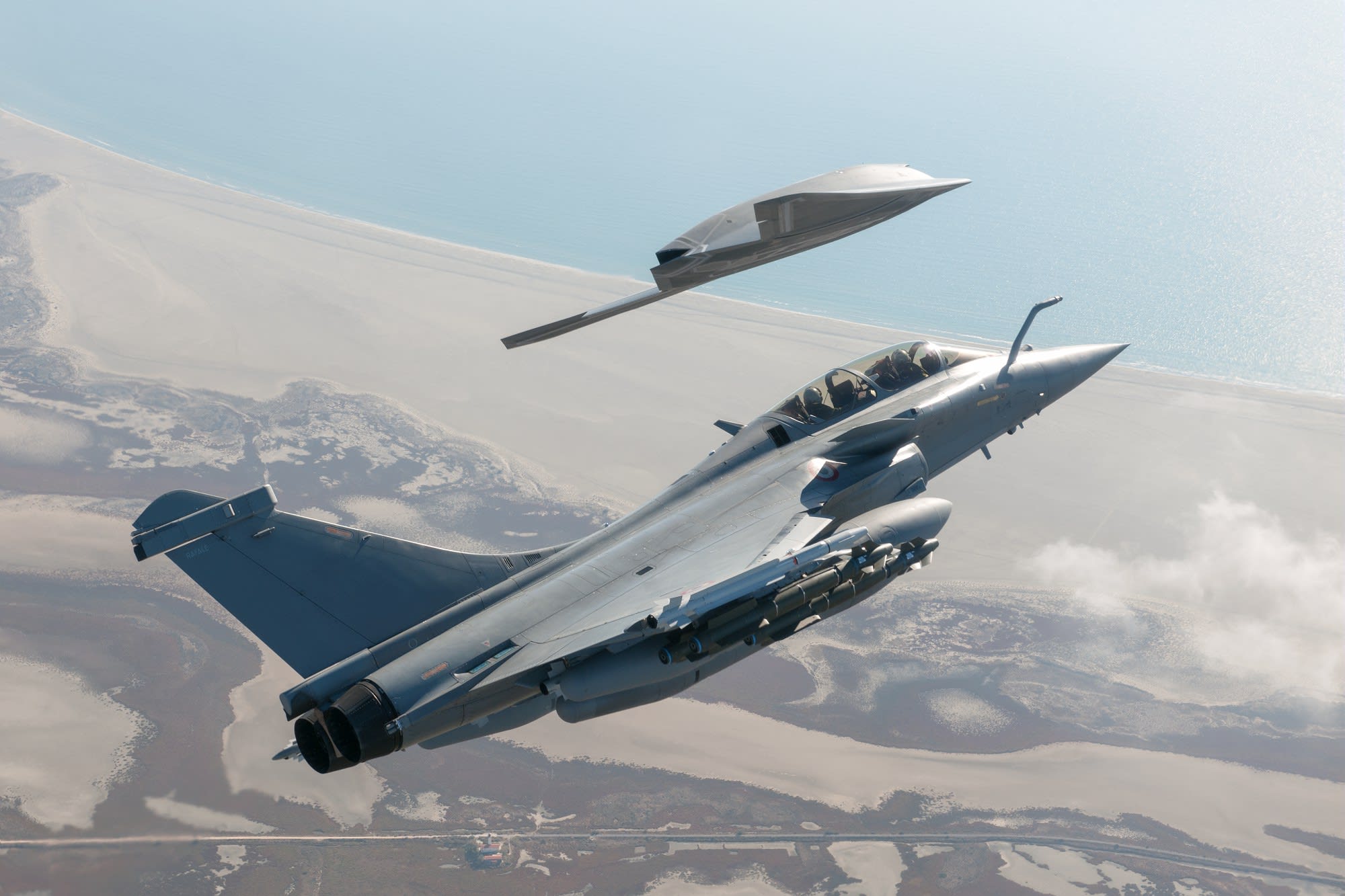
Interestingly, the DGA issued a Request for Information (RFI) on June 4 for a future “Collaborative Combat UAV System”, initiating an official market research phase. According to details released by the agency, this loyal-wingman drone would be carrier-capable.
Safran Aircraft Engines has launched a development program to increase the thrust of the M88 power plant, which propels the Rafale. Improvements to the engine’s hot section, known as Project T-Rex, will allow thrust to be raised above the current maximum of 11,240 lb (50 kN) without necessitating a larger engine. Trappier states that the thrust required is “a little bit more than we had in mind before,” although he did not disclose the exact amount.
It is important to note that maintaining the engine’s current size will eliminate the need to modify the Rafale’s basic design. “It is possible to increase the size of the Rafale a little bit, but it is not the way we are looking at today,” Trappier had stated.
The F5 variant of the combat-proven Rafale will include new sensors, armaments, and a faster, more secure means of communication and collaboration. The aircraft will have a much more advanced electronic warfare (EW) suite than existing platforms, with capabilities for Suppression or Destruction of Enemy Defenses (SEAD/DEAD), including the latest jamming systems and anti-radiation weapons, as EurAsian Times had reported. Additionally, the Rafale F5 will introduce fiber-optic wiring.
The EW suite of the F5 aircraft is anticipated to be more advanced than the current SPECTRA EW and jamming system, which includes radar jamming, ECCM, infrared, and radar decoys. It will also be surrounded by a defensive bubble.
All of these will greatly boost penetration in a combat scenario.
The aircraft will essentially serve as a sensor truck and a tactical airborne command post, thanks to its data fusion and processing capabilities, and bridge the gap between fifth and sixth-generation capabilities. This is perhaps why Dassault calls the F5 an Air Combat System within a system, rather than just a fighter jet, as the current Rafale F4 variant is.
The integration of a nuclear-armed hypersonic missile will make the Rafale F5 a force to reckon with and the most powerful aircraft the country has ever seen.
- Contact the author at sakshi.tiwari13 (at) outlook.com
- Follow EurAsian Times on Google News