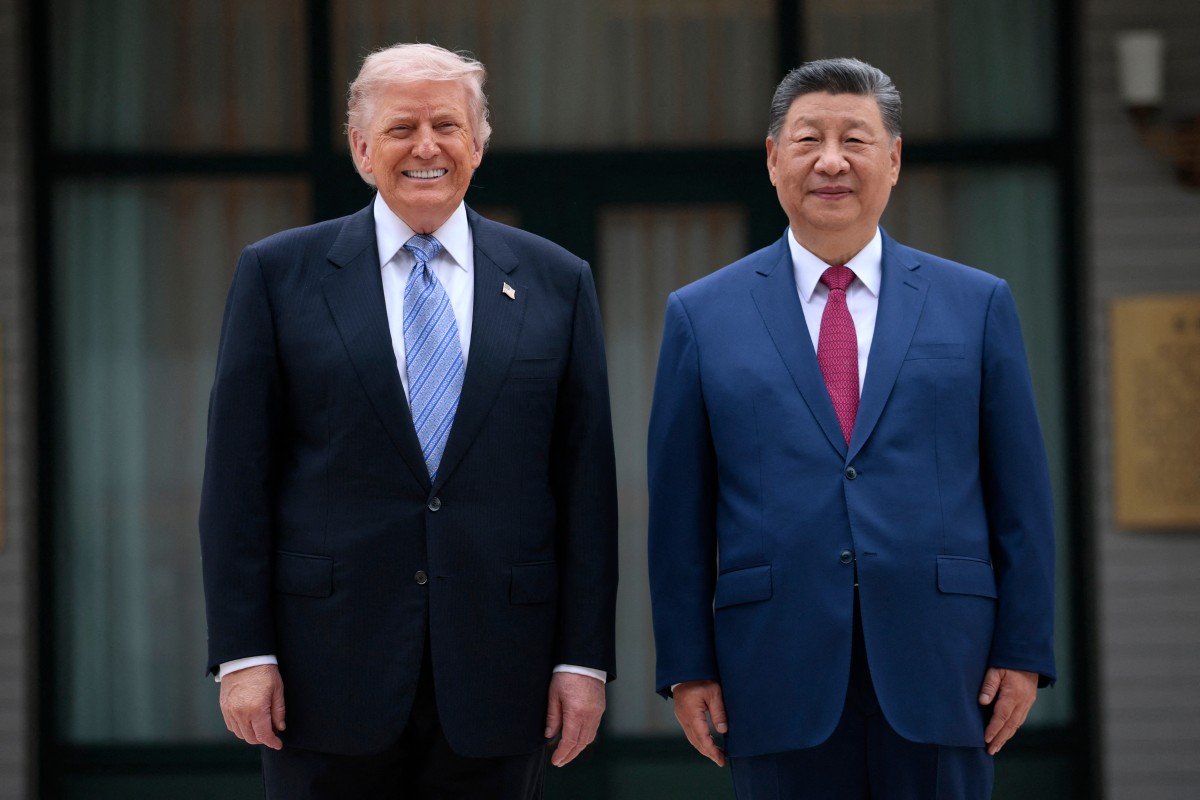
In his bilateral meeting with President Donald Trump, Chinese President Xi Jinping called the US “a declining power”.
Interestingly, this is not the first time that Xi Jinping has called the US a declining power. In recent years, President Xi Jinping has repeatedly framed the US as a “declining power” and a “fading giant,” invoking narratives of Eastern ascent and Western sunset.
However, is the US really a ‘declining power,’ or are narratives of imminent American decline overblown?
A clear-eyed analysis of the key power metrics, economic size, military capacity, technological edge, alliances, currency dominance, and soft power paints a starkly different picture.
These data points show that not only is the US not in decline, but it will remain the world’s dominant superpower for at least four to five more decades.
US Economy Still Far Ahead of China
When assessing national power, economic size remains one of the most important parameters.
For instance, Australia’s Lowy Institute releases an annual Asia Power Index to measure the relative power of 27 countries in the Indo-Pacific region.
This report gives roughly 33% weightage to economics while measuring national power, 17.5% to economic capability, and 15% to a country’s economic relationships.
In economic heft, the US is far ahead of China.
Nominal GDP, not purchasing-power-parity (PPP) figures, best reflects a nation’s ability to project power globally through trade, investment, and sanctions.
According to IMF projections for 2026, the US economy stands at approximately US$32.38 trillion, while China’s hovers around US$20.85 trillion, making America roughly 1.54 times larger on an exchange-rate basis. China is ahead of the US in Purchasing Power Parity (PPP) terms; however, this matters less for international transactions priced in dollars.
However, more worrisome is the fact that China will not overtake the US economy anytime soon.
In fact, a decade ago, many economists and think tanks were predicting that the Chinese economy would overtake the US economy by 2030.
For instance, the Center for Economics and Business Research’s (CEBR) 2021 paper explicitly predicted that China would overtake the US as the world’s largest economy in 2030.
“Faster growth in the US means that China is now forecast to overtake the US and become the world’s largest economy in 2030 rather than 2028 as we had forecast last year,” the CEBR paper predicted in 2021.
Similarly, Justin Yifu Lin, former World Bank Chief Economist and Peking University professor, predicted that China would surpass the US in nominal GDP by 2030.
Earlier in 2011, PwC predicted that China would overtake the US by 2030 and dominate global trade.
Those predictions have now been shattered by reality.
Today, many economists predict that China will overtake the US economy only by 2060.
Worse, many think tanks predict that China might never overtake the US in terms of economic size.
According to London-based Capital Economics, slowing productivity growth and a shrinking workforce “prevent China from ever passing the US.”
“China’s economic clout will not increase steadily relative to the U.S. through time, due in part to its workforce declining by more than 0.5 percent a year by 2030. Meanwhile, the U.S. workforce will expand over the next 30 years, supported by higher fertility than in China and immigration,” consultancy firm Capital Economics said in its report.
The OECD has similarly pushed timelines toward 2070 or beyond, while some models show the gap widening.
Similarly, according to Kishore Mahbubani, former president of the UN Security Council and a former top diplomat from Singapore, the gross domestic product disparity between the world’s two largest economies may become more pronounced, and anyone who believes the US is weakening “ought to have his head examined”.
“[The gap] has actually grown. In 2020, US GDP was US$21 trillion, China’s was US$15 trillion – a US$6 trillion gap,” he explained. “In 2030, US GDP is expected to reach US$37.6 trillion and China US$26 trillion – the gap will go from 6 trillion to 11 trillion.”
Even Chinese economist Justin Yifu Lin, once a vocal optimist, has revised his timeline to 2045, which also assumes an average Chinese growth rate of 4.5% versus 1.6% for the US.
The earlier assumption that China would surpass the US economy by 2030 was based on extrapolated double-digit growth that no longer exists and is unlikely to return.
China Has Likely Peaked: Demographics, Aging, and Stagnation Tell the Story
Beneath China’s inability to overtake the US economy lie some hard facts that Beijing will likely be unable to reverse.
The country’s population has declined for four straight years, with births plunging to historic lows.
To reverse the trend, the Communist Party has ended the decades-old one-child policy; however, it has failed to reverse the trend of falling birth rate in China.
Government data showed that the country’s birth rate fell to 5.63 per 1,000 people – a record low since the Communist Party took power in 1949 – while its death rate rose to 8.04 per 1,000 people, the highest since 1968.
China’s population fell by 3.39 million to 1.4 billion by the end of 2025, marking a faster decline than the previous year.
China has one of the lowest fertility rates in the world, at around one birth per woman, below the replacement rate of 2.1.
Experts at the United Nations believe China’s population will continue to decline, estimating that the nation will lose more than half of its current population by 2100.
A shrinking population has economic and social implications for the world’s second-largest economy: exacerbating an already declining workforce and weak consumer sentiment.
Demographers warn China is “getting old before it gets rich,” a reversal of the demographic dividend that powered its earlier double-digit growth boom in the 1980s and the 1990s.
Economists warn that China has already peaked and, going forward, faces a Japan-like situation of a declining population, a shrinking workforce, and stagnant growth, but without Japan’s high per capita income.
On the other hand, the US population will continue to rise due to healthier birth rates and immigration.
According to the US-based Cooper Center, the US population will rise from 331 million in 2020 to 349 million in 2030 and 371 million in 2050.
This rising population in the US will ensure the country remains on a growth trajectory.
The Dollar Still Rules—And the World Trusts It Far More Than the Yuan
Currency dominance also cements American power. The US dollar accounts for roughly 57% of global foreign-exchange reserves and over 50% of international payments via SWIFT as of early 2026. Whereas the yuan languishes at around 2% of reserves and 3% of payments.
According to the latest IMF data, “The share of US dollar holdings decreased to 56.77 percent in 2025Q4, from 56.93 percent in 2025Q3. The share of euro holdings decreased to 20.25 percent in 2025Q4, from 20.36 percent in 2025Q3. The share of Chinese renminbi holdings increased to 1.95 percent in 2025Q4 from 1.92 percent in the previous quarter.”
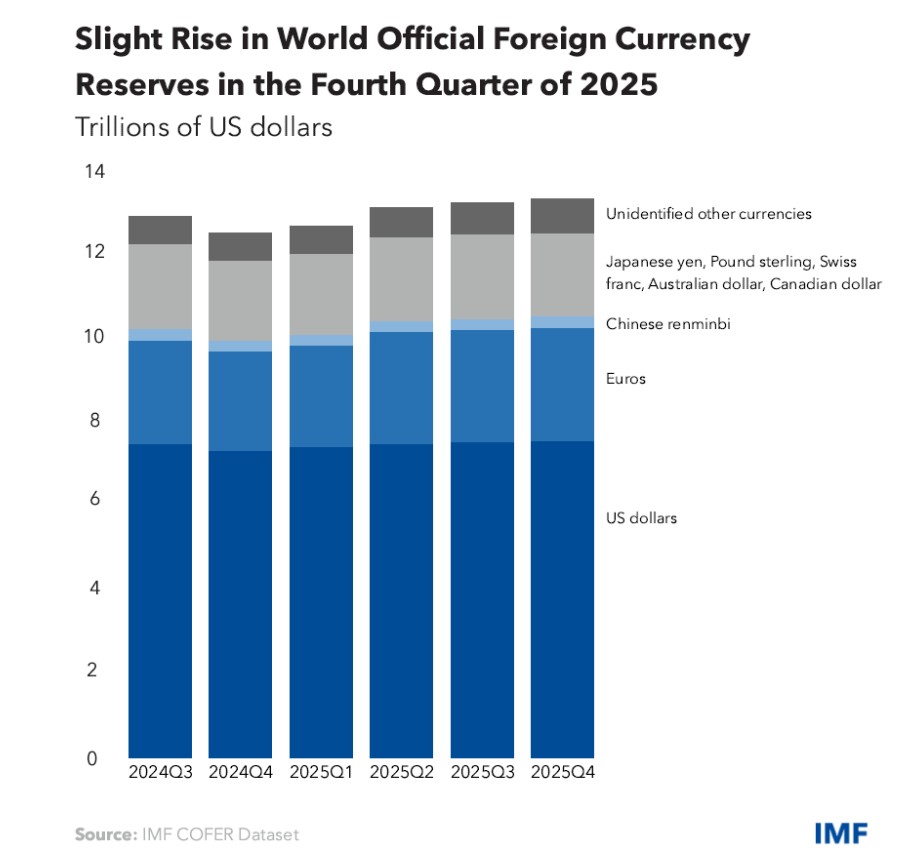
Even though China is the world’s second-largest economy, its foreign reserves are still dominated by the US dollar, followed by the Euro, with China’s Yuan a distant third.
This dominance of the US dollar in foreign reserves and international trade gives Washington an unmatched power to impose economic sanctions on countries that go against American interests.
The US Remains the Strongest Military
Militarily, also, China is a distant second.
US defense spending exceeds US$900 billion, and in the 2027 financial year, the US is planning a record US$1.5 trillion defense budget.
China’s defense budget, while the second-highest in the world, is still below US$300 billion.
In other words, the US defense budget is still five times China’s, if we take the official figures.
The US also benefits from its defense and security partnerships. The US leads the 32-nation NATO alliance and is also part of numerous other defense, security, and intelligence alliances, such as NORAD and the Five Eyes, and has security partnerships with many countries, including the Philippines, South Korea, Thailand, Japan, Israel, Canada, Qatar, and others.
Furthermore, the US has over 800 military bases in more than 80 countries, allowing global force projection. Whereas China has so far just two foreign military bases.
While China has made significant progress in drone and missile technology, in many other domains, such as submarines, aircraft carriers, and nuclear arsenal, Beijing is still years behind the US.
Besides, whether it is geopolitical alliances or emerging technologies like AI, semiconductor chips, or computing, soft power through instruments like Hollywood and the US music industry, or US dominance in global governance institutions like the IMF and World Bank, China is nowhere close to the US.
Therefore, Xi’s “declining power” rhetoric is more wishful thinking than strategic analysis.
The US possesses an economy 1.5 times larger in nominal terms, a military budget five times larger, a dominant reserve currency, unmatched alliances and military partnerships, technological leadership, and enduring soft power.
On the other hand, China faces a declining population, a shrinking workforce, and a stagnating economy. Global faith in the Chinese currency remains negligible, and Beijing possesses limited soft power.
While China has definitely emerged as a global power, and while multipolarity is real, the US is not in decline and will remain the hegemon for the foreseeable future.
- Sumit Ahlawat has over a decade of experience in news media. He has worked with Press Trust of India, Times Now, Zee News, Economic Times, and Microsoft News. He holds a Master’s Degree in International Media and Modern History from the University of Sheffield, UK.
- VIEWS PERSONAL OF THE AUTHOR.
- He can be reached at ahlawat.sumit85 (at) gmail.com