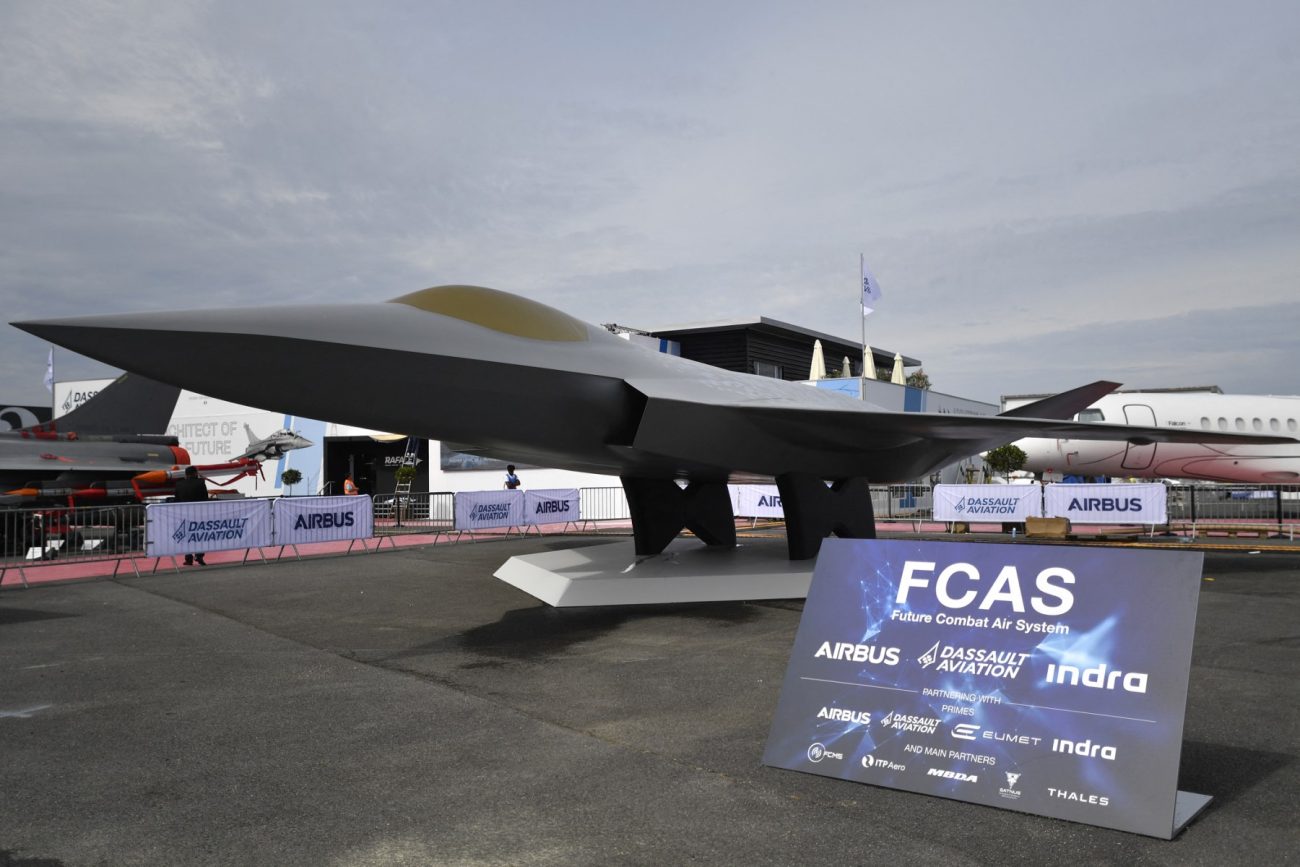
The troubled sixth-generation fighter program, the FCAS (Future Combat Air System), has finally collapsed after months in a tailspin. France and Germany have decided to abandon FCAS plans amid irreconcilable differences between Airbus (representing Germany and Spain) and Dassault (representing France).
German Chancellor Friedrich Merz and French President Emmanuel Macron met on the sidelines of the EU-Western Balkans summit in Montenegro last week in a last-ditch effort to salvage the sinking program. However, after lengthy discussions, Merz recommended pulling the plug on the NGF, emphasizing that the deadlock between the industry partners could not be broken despite the best efforts of both governments.
Launched in 2017, the FCAS was envisaged as a €100 billion “system of systems” program centered around a next-generation fighter (NGF), an adjunct aircraft, and a combat cloud for cross-platform information sharing.
The FCAS got off to a good start, with Dassault assuming responsibility for the next-generation fighter, Airbus agreeing to develop the “loyal wingman” remote-carrier drone design, new cloud capabilities, and stealth technologies, Spain-based Indra taking on the job to build sensor systems, and Safran developing a new jet engine for the fighter, as previously explained by the EurAsian Times.
However, it ran into trouble amid a deadlock between Airbus and Dassault over issues ranging from work-sharing to design philosophy and supplier selection, and has remained in abeyance for about a year.
German officials had repeatedly floated the option of continuing the FCAS collaboration even if the NGF is written off. “The fighter that is at the core of the difficulties today, there are different ways forward, and I would leave it to governments to reflect and decide what they want to do,” Airbus CEO Guillaume Faury had said at the Airbus Defence Summit earlier this year.
Some reports suggest that French officials were caught off guard by Berlin’s unilateral messaging, although the end of FCAS is hardly surprising, given that the Merz administration and Airbus Defence and Space have signaled on multiple occasions in the past that they were looking for alternatives to the collaboration with France in case the FCAS falls apart, including a potential partnership with Swedish aerospace company Saab.
Dassault CEO, Eric Trappier, maintained that a partnership centered on work sharing might result in a less-than-ideal technological solution, adding that Dassault has decades of experience and the requisite skills to build entire fighter jets on its own. Meanwhile, Airbus called for an equal work share, arguing that the 80% work share sought by Dassault would leave nothing for the German industry.
The two sides were also unable to see eye to eye on the aircraft’s design and doctrinal philosophy. While France needs a nuclear-capable and carrier-capable jet, Germany had no such requirement and preferred a heavier aircraft optimized for longer range, greater payload, air superiority, and stealth in a more continental defense context.
Can India Benefit From FCAS’s Collapse?
The Indian Ministry of Defense (MoD) informed the Parliamentary Standing Committee on Defense earlier this year that it was interested in joining a sixth-generation fighter program.
With Germany now officially out, India could seize the opportunity to advance its ambitions to develop a sixth-generation fighter while capitalizing on its age-old defense relationship with France.
Notably, the Indian-French defense relationship dates back decades, to when the Indian Air Force (IAF) acquired its first French fighter jet, the Toofani (Dassault Ouragan), in the 1950s. This was followed by several big-ticket deals with France, including for the purchase of the Mystère IVA, the Mirage-2000, the Rafale, and the April 2025 deal for Rafale-M for the Indian Navy.
India has also finalized the proposal to acquire 114 Rafale fighter jets under its Multi-Role Combat Aircraft (MRCA) program. The deal, expected to be signed in the coming weeks, will pave the way for the IAF to become the largest Rafale operator outside France.
When asked whether India could partner with France for the development of a sixth-generation fighter, IAF veteran and analyst Air Marshal Anil Chopra (retd) told EurAsian Times, “India should absolutely exploit this great opportunity to join forces with France. India has the talent and manufacturing base, and the IAF would place big orders for the jets.”
The case for India’s collaboration with France on developing a next-generation fighter is rather straightforward. India could replace Germany by providing financial contributions, co-development workshare, and co-manufacturing in India.
It is worth underscoring that designing and developing a sixth-generation fighter jet alone would be a costly, high-risk proposition for France at this moment. This is where India comes in.
In addition to providing more funding for the FCAS program, partnering with India will secure a large fleet order for the under-development fighter, significantly lowering its production costs, given the IAF’s size and need for hundreds of aircraft.
Moreover, there is more coherence and uniformity in this partnership than there was between France and Germany.
The NGF is meant to replace the French Rafales, which the IAF also operates. Additionally, like France, India would seek a nuclear-capable, carrier-capable aircraft capable of operating from its three carriers (two in operation, one in the planning stage).
This means India and France will have no differences in the FCAS design profile, unlike the bickering between Berlin and Paris over nuclear deterrence roles. India also has the infrastructure that France and Dassault would need for the NGF.
For example, India is expected to manufacture 90 of the 114 Rafales acquired from France under the upcoming deal, with 50–60% indigenisation. Meanwhile, French company Safran is already establishing a maintenance, repair, and overhaul (MRO) facility for the M88 engine that powers the Rafale in Hyderabad, and India is looking to collaborate with Safran to jointly build the power plant for its indigenous AMCA fifth-gen fighters.
Not just that, Safran and India’s BEL (Bharat Electronics Limited) have also partnered to domestically produce the “Hammer” air-to-surface weapon.
For India, cooperation on FCAS may hasten its exposure to sixth-generation technologies such as advanced propulsion and stealth, combat cloud networking, and manned-unmanned teaming. This could, in turn, also accelerate the development of India’s own fifth-generation Advanced Medium Combat Aircraft (AMCA).
As Air Marshal Chopra earlier told EurAsian Times, “India should consider joining the FCAS, but it will all depend on the work share. The FCAS partners have already had work share issues with France, which has been trying to dominate.”
Moreover, India would have to ensure that it not only bankrolls the development of the French fighter but also remains an equal and respected partner within the framework.
- Contact the author at sakshi.tiwari13 (at) outlook.com
- Follow EurAsian Times on Google News