As uncertainty continues to grip the Future Combat Air System (FCAS) 6th-gen aircraft program jointly pursued by France, Germany, and Spain, both Paris and Berlin are advancing plans to bolster their air power by upgrading their existing 4.5-generation combat jets—the Eurofighter Typhoon and the Rafale.
Airbus Defence & Space, the majority stakeholder in the Eurofighter Consortium, unveiled the new Tranche 4 Eurofighter, produced for Germany, during the Airbus Defence Summit in Manching. The single-seater aircraft was seen at the ceremony with production number GS0115 and service registration number 34+03.
Although Airbus has already produced multiple examples of Tranche 4 aircraft at its final assembly facility in Manching, this new variant has yet to take its maiden flight, though the manufacturer said the flight testing will begin in the coming weeks.
The Typhoon is a twin-engine, canard-delta-wing, multirole fighter, classified by Airbus as the world’s most advanced 4.5th-generation multirole fighter. The Luftwaffe currently operates about 138 Eurofighter Typhoon jets, including the Tranche 1, 2, and 3 variants.
Tranche 4 is expected to considerably boost Germany’s air power. The most noteworthy upgrade to this variant is the ECRS active electronically scanned array (AESA) radar, which features a pivoting antenna that provides a field of regard exceeding 180°, enhancing situational awareness and resistance to jamming. The new radar offers improved multi-target tracking, high scan rates, simultaneous air-to-air and air-to-ground modes, electronic attack capabilities, and enhanced jamming resistance.
The initial batches of Tranche 4 aircraft are likely to feature a transitional Mk0 standard before the full integration of the more advanced ECRS Mk1.
Tranche 4 builds on Tranche 3A, which already included hardware provisions for AESA, conformal fuel tanks in some configurations, fiber optics, and other upgrades. However, the new Tranche 4 variant incorporates upgraded mission computers and avionics for better weapon integration and data fusion, modernized cockpit interfaces, GPS-based navigation systems, and the human-machine interface.
The aircraft’s Long-Term Evolution (LTE) program, focused on the avionics architecture, will deliver further enhancements to the Tranche 4 aircraft. The project involves creating a new cockpit with a large-area display, as well as new computers for flight control and missions, communications devices, and weaponry control systems.
Tranche 4 can carry the Meteor missile, which can travel up to 150 kilometers, as well as IRIS-T short-range missiles, precision-guided bombs, and reconnaissance pods, among other munitions.

Germany plans to equip 15 of these Tranche 4 aircraft with the Eurofighter EK (Elektronischer Kampf) electronic warfare suite. This includes the Saab Arexis emitter locator system and integration of AGM-88E AARGM anti-radiation missiles for SEAD/DEAD roles, helping transition capabilities from the retiring Tornado ECR fleet. This EK configuration will be applied to selected Quadriga jets, not all of them.
Germany’s Tranche 4 Eurofighters represent a major step forward in sensor capability and multi-role flexibility.
It is pertinent to note that integrating these upgraded jets has become a tactical necessity for Germany, particularly as the future of the next-generation fighter (NGF) within the FCAS framework remains highly uncertain amid disagreements over work-sharing between Airbus and the French company Dassault, as EurAsian Times explained earlier.
Speaking at the Airbus Defence Summit, Airbus CEO Guillaume Faury recently said that the two sides were making progress in designing systems for future combat aircraft to operate together, even as the future of the NGF remained gridlocked. “The fighter that is at the core of the difficulties today, there are different ways forward, and I would leave it to governments to reflect and decide what they want to do,” he said.
Some defense sources told Reuters that discussions to resolve a dispute between Airbus and Dassault have stalled, and that the two sides may build their own fighters. In fact, previous reports suggested that Berlin was eyeing collaboration with Sweden and a potential partnership with the UK-Italy-Japan Global Combat Air Program (GCAP) grouping.
Even if Airbus and Dassault resolved differences and worked out a solution, they wouldn’t be able to roll out the NGF any time sooner than the mid or late-2040s. This timeline could be extended further if the two countries began work on their separate aircraft from scratch.
To prevent a capability vacuum from creeping into their air forces amid the deadlock in the FCAS program, both Germany and France are boosting their capabilities by enhancing their existing platforms.
Germany & France Boost Capability With Upgraded Jets
Germany ordered 38 new Eurofighter Typhoons in November 2020 as part of the Project Quadriga. The new jets, mainly the upgraded Tranche 4 standard (31 single-seaters and 7 two-seaters), are intended to replace the aging Tranche 1 aircraft currently in service with the Luftwaffe, as well as the many jets lost to accidents over the years.
Some reports suggest that Berlin plans to expand the Tranche 4 orders to replace the nuclear-capable Tornado jets, which have now become Cold War relics.
Notably, Germany had bypassed the F-35 offer in 2020 when it placed the order for Tranche 4 jets. However, the return of war to Europe in February 2022 and an enhanced security threat from Russia prompted a shift in overall policy, and Berlin caved in March 2022, ordering the American stealth fighters.
As the fault lines in the FCAS became clearer, Germany greenlit the purchase of 20 additional Eurofighter Typhoons to the Tranche 5 standard in October 2025. “The procurement of Tranche 5 [aircraft] serves to gradually transfer the capabilities of the aging Tornado fighter jet in the area of Electronic Combat and Reconnaissance (ECR) into a future-proof platform with which Germany will continue to honor its NATO objectives,” the German Ministry of Defense (MoD) stated.
The deliveries will take place between 2031 and 2034.
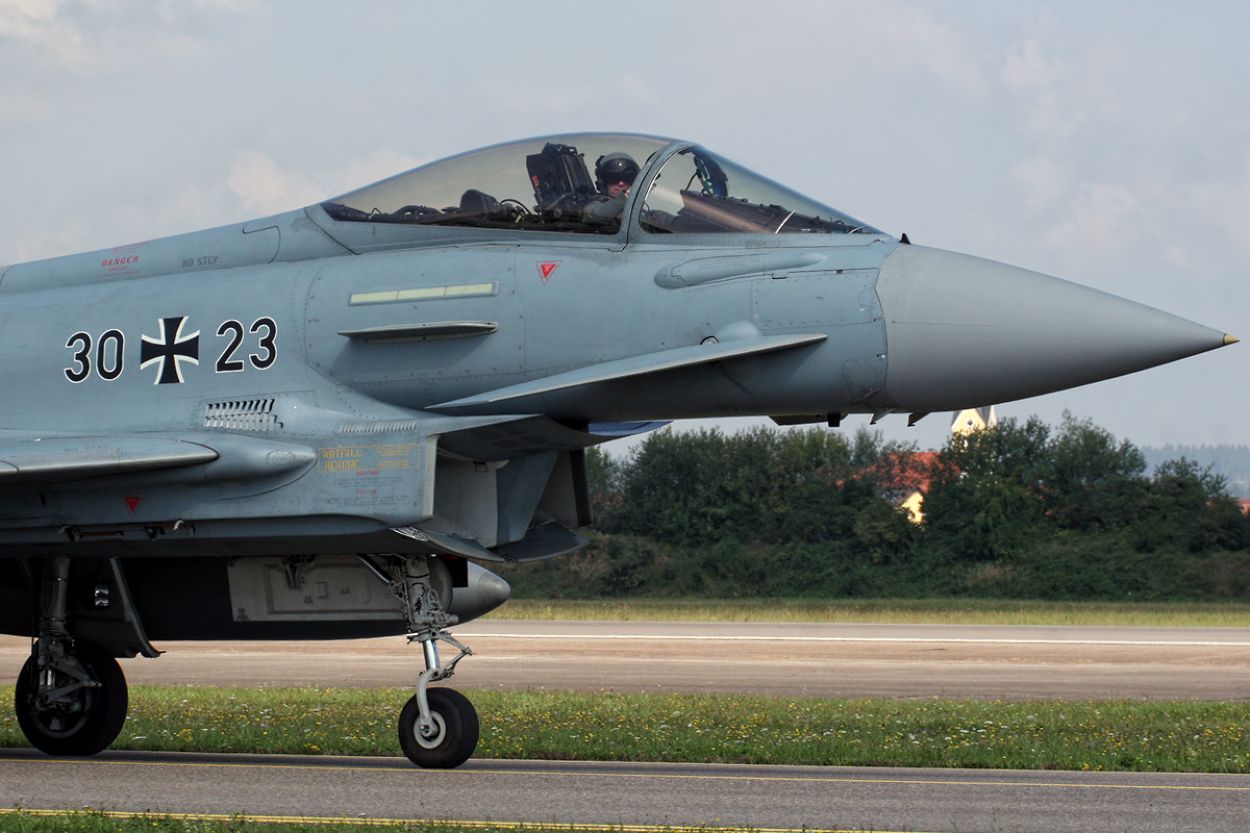
Tranche 5 builds on the upgrades to Tranche 4, focusing on enhanced electronic combat capabilities, improved future-proofing, and SEAD/DEAD (Suppression/Destruction of Enemy Air Defenses) roles. The variant represents a significant evolution in avionics, sensors, electronic warfare, and open-architecture design.
Tranche 5 introduces several major advancements, including the electronic E-Scan radar, which offers improvements in power, multi-mode performance, electronic attack, and jamming resistance. Additionally, it offers superior detection and tracking ranges and simultaneous operation.
The Tranche 5 Typhoon will be equipped with the Saab Arexis self-protection and electronic warfare system, which will provide enhanced emitter location, jamming, and survivability over Tranche 4’s suite. Further, the aircraft will feature a new computing architecture with more powerful onboard computers, an open software structure, and significantly faster sensor or data fusion. This will enable easier integration of future weapons, sensors, and other systems, including loyal wingman drones.
Germany is also upgrading 15 existing aircraft to the Eurofighter EK standard, separately for dedicated electronic combat roles.
It is safe to say that the combination of Tranche 4 and 5, along with the fifth-generation F-35A, will add teeth to Germany’s air power until the country is able to build and induct sixth-generation fighters.
Similarly, with the FCAS nearly sinking, France is currently producing two variants of the Rafale, the French equivalent of the Eurofighter. This includes the F4 and the F5.
The Rafale F4 incorporates significant upgrades, including a new Thales software-defined radio (CONTACT), which offers improved security, enhanced data links, and integrated civil and military satellite communication capabilities. Additionally, it features an improved RBE2 radar for detecting mobile ground targets and an upgraded infrared optronic system.
The Rafale F4 boasts an enhanced SPECTRA self-protection suite, with expanded low- and high-frequency coverage to counter future threats, and is armed with lethal weapons including a mid-life-upgraded SCALP cruise missile, MBDA’s MICA-NG air-to-air missile, and a new version of the AASM air-to-ground weapon. The MICA-NG, for one, offers a longer range and improved detection and acquisition capability.
France has ordered 42 new Rafale aircraft to the F4 standard and is upgrading earlier Rafales, F3 and F3R, to the F4 standard. Moreover, it is also exporting the F4.

In addition, France is developing the Rafale F5 as a bridging solution until the FCAS, or an alternative sixth-generation fighter, becomes operational.
The F5 standard will include new sensors, armaments, and a faster, more secure means of communication and collaboration. The aircraft will have a much better electronic warfare suite, with advanced capabilities for Suppression or Destruction of Enemy Defenses (SEAD/DEAD), including the latest jamming systems and anti-radiation weapons.
In addition to creating a “defensive bubble” surrounding the aircraft, it will be an improvement over the current SPECTRA EW and jamming system.
Additionally, fiber-optic wiring will be introduced in F5. In a disputed context, all of this will significantly increase penetration. With data fusion and processing capabilities that enable it to serve as a tactical airborne command post, the Rafale F5 will also serve as a sensor truck. Fifth and sixth-generation capabilities are intended to be bridged by the F5.
Additionally, the Anglo-French Future Cruise Missile (FCM) and Future Anti-Ship Missile (FASM) will be installed in the F5. Compared to the present M88-2, the T-REX engine will produce roughly 20% more thrust.
The “Super Rafale” will also be modified to carry hypersonic, nuclear-capable, guided missiles. Dassault calls it an Air Combat System within a system, rather than just a fighter jet, like the current Rafale F4 variant is.
- Contact the author at sakshi.tiwari13 (at) outlook.com
- Follow EurAsian Times on Google News