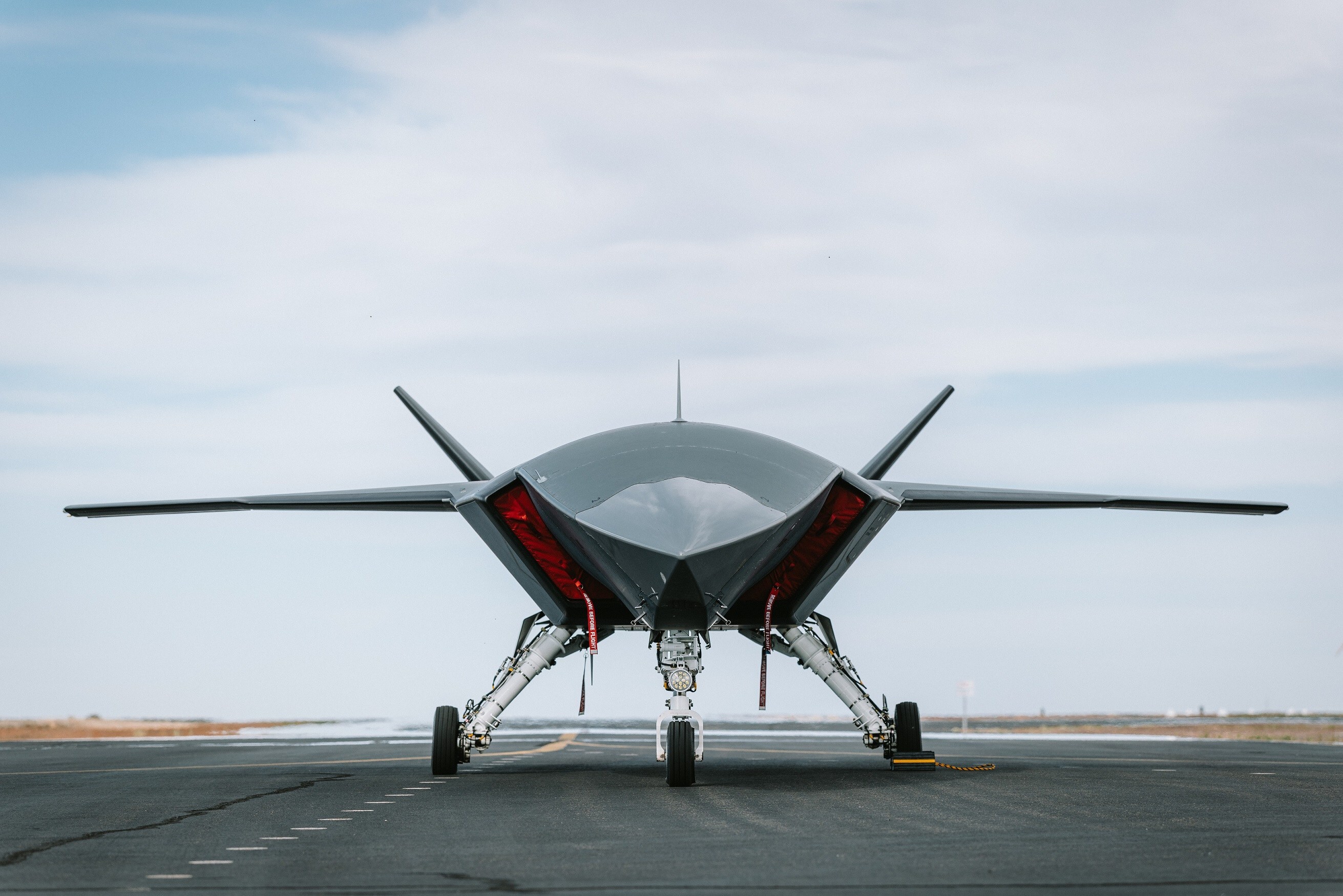
Boeing has unveiled major new capabilities for the MQ-28 Ghost Bat Collaborative Combat Aircraft (CCA) at the ILA Berlin Air Show in Germany, most notably the addition of internal weapons bays for the AIM-120 AMRAAM air-to-air missile.
The upgraded version of the MQ-28—the Block 3—was unveiled together by officials from both Boeing Australia and Germany’s Rheinmetall.
The development comes months after Boeing Australia joined hands with Rheinmetall, Germany’s largest arms producer, in March 2026 to formally offer the MQ-28 Ghost Bat uncrewed aircraft to the Luftwaffe, as the EurAsian Times reported at the time.
“This is the aircraft that we are offering to Germany,” MQ-28 Global Program Director Glen Ferguson said at the rollout of the MQ-28 Block 3 variant. “This is the third iteration of design now, and we are on point to build out the first aircraft next year,” he added.
The MQ-28 is a stealthy, AI-driven drone designed for intelligence, surveillance, reconnaissance (ISR), electronic warfare (EW), and strike roles. Australia has already acquired eight pre-production Block 1 MQ-28s and is poised to induct Block 2 and 3 as and when they become available.
The Block 1 and Block 2 variants have completed more than 150 test flights in Australia and the US, making the Ghost Bat one of the most mature CCA technologies in the world.
The wings of the Block 3 Ghost Bat will be about 25% larger than those of previous iterations, expanding from about 6 meters to 7.3 meters, according to Boeing. This will allow the MQ-28 to carry an additional 2,000 pounds of fuel, stores, and mission payloads.
✅ >25% larger wing
✅ Increased fuel and payload capacity
✅ Beyond Line of Sight capability
✅ Internal weapons stations for greater mission configurabilityMQ-28 Ghost Bat enhancements deliver flexibility, range and capacity advancements.
More: https://t.co/IPZLUy5Qub pic.twitter.com/7EK5fUD11h
— Boeing Australia (@BoeingAustralia) June 10, 2026
“That additional capacity gives operators freedom to balance payload and endurance to configure for the mission at hand, whether that means carrying extra fuel for longer-range operations, increasing weapons carriage, or any combination of both,” Ferguson stated. The MQ-28’s thrust is also being increased from 10,000 pounds to 12,000 pounds, though there is currently no information on how this will be achieved.
More importantly, Block 3 introduces internal weapons bays that can carry either two AIM-120 AMRAAM missiles or four Small Diameter Bombs (SDBs). This upgrade transforms the MQ-28 from a traditional “loyal wingman” escort drone into a fully combat-capable Collaborative Combat Aircraft (CCA) with credible air-to-air fighting capability.
The missiles will be carried in the aircraft’s internal weapons bay, which has been added to each side of the slab-sided fuselage. The internal weapon carriage is meant to preserve the drone’s stealth character and comes days after Boeing validated the Ghost Bat’s radar cross-section (RCS), demonstrating that this CCA is stealthy and largely capable of operating effectively in contested areas.
“The combination of a highly capable platform, stealth features, and advanced autonomy provides unprecedented ability for air forces to extend their mission effectiveness and operational flexibility,” Brad Thompson, director for Phantom Works Australia, had stated.

Notably, Boeing conducted the first live-fire test of the MQ-28 Ghost Bat in December 2025, firing an AIM-120 Advanced Medium-Range Air-to-Air Missile (AMRAAM) over the Woomera Range Complex (WRC) in southern Australia. At the time, the CCA successfully engaged and destroyed an Australian-made Phoenix jet-powered target drone in collaboration with a Royal Australian Air Force (RAAF) E-7A Wedgetail and an F/A-18F Super Hornet.
The air-to-air missile enhances the overall appeal of the CCA, transforming it from primarily a sensor or escort platform to a more lethal strike platform while preserving low observability. The air-to-air role is significant because it will enable the Ghost Bat to serve as a force multiplier in contested or denied airspace.
Ferguson emphasized that the MQ-28’s open architecture and design flexibility enable integration of a wide variety of weapons and payloads, provided they physically fit within the internal bays. Size, he noted, is the only real limitation.
Additionally, Boeing is reportedly developing three to four sensor payloads for the Block 3, made possible by a fully swappable nose section. This design allows operators to rapidly configure the MQ-28 with different mission-specific payloads — such as infrared search-and-track (IRST) systems or electronic warfare suites — depending on operational needs.
The other new capabilities include “significant software development upgrades compliant with Government Reference Architecture – open standards enable operators to tailor weapons, payloads, command and control, and mission autonomy to suit their operational requirements,” as detailed in a press release issued by Boeing.
The Block 3 version also includes beyond-line-of-sight (BLOS) control, allowing MQ-28 to be operated from a crewed aircraft, a naval vessel, or a ground station. Notably, adding BLOS to the drone will ensure it can operate autonomously when not under the control of a crewed aircraft and make the CCA more resilient against electronic warfare.
“These features, developed in partnership with the Royal Australian Air Force, will be progressively released to the fleet through a spiral upgrade program, and are available to interested allied countries,” said Ferguson. “Inclusion of features such as BLOS capability is a direct result of our learnings to date, along with feedback from Air Forces as they understand more about the role and integration of CCAs into joint force operations.”
“The advanced maturity of the MQ-28 systems is what allows us to continually adapt to the changing operational environment and minimize the risk as we transition to operations,” said Amy List, vice president and managing director of Boeing Defense Australia. “Combined with the MQ-28’s confirmed low observability characteristics and survivability upgrades, these capability enhancements support more flexible mission concepts and further allow Defense customers to distribute operational risk.”
In essence, Block 3 builds on earlier blocks and is positioned for operational capability in Australia around 2028. However, the unveiling of the variant in Germany underscores the importance of the offer made to Berlin.
MQ-28 Ghost Bat Offered To Berlin
Rheinmetall announced on March 31, 2026, that it reached an agreement with Boeing Australia to jointly offer the drone to the German military. The company noted that the MQ-28 would be presented as “a mature solution for the Bundeswehr’s procurement of CCA into Germany by 2029, and described the Ghost Bat as “a world-leading, proven CCA.”
The announcement came after German Defense Minister Boris Pistorius hinted that the country was considering purchasing the MQ-28.
Within the partnership, Rheinmetall will be the “system manager” in Germany. It will ensure the integration of the MQ-28 with existing and future Bundeswehr command-and-control and weapon systems and oversee its adaptation to national or sovereign requirements. In addition, it will provide in-country maintenance, logistics, and operational support for the uncrewed aircraft.
“As a system integrator, we ensure that integration, operation, and further development come from a single source while simultaneously strengthening industrial value creation in the form of an industrial hub in Germany and Europe. We see revenue potential for Rheinmetall in the range of three-digit millions of euros,” Armin Papperger, CEO of Rheinmetall AG, stated while announcing the partnership.
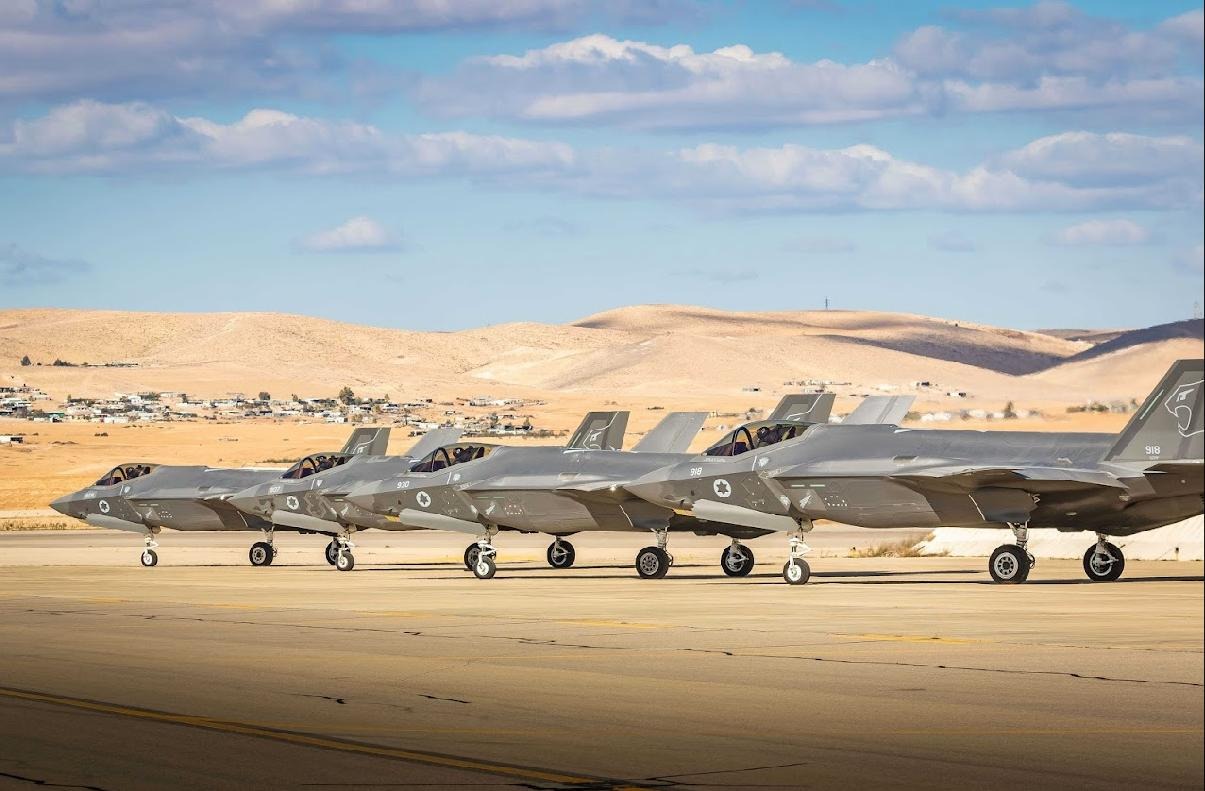
Germany intends to purchase hundreds of CCAs in a variety of weight classes to improve its crewed fleet, which presently consists of the Eurofighter Typhoons and Panavia Tornados, and will be supplemented by the American F-35 stealth fighter jets.
With the FCAS partnership with France to develop a next-generation fighter now officially over, Germany seeks to bolster its air power by integrating loyal wingman drones to operate as force multipliers. It aims to field operational CCA by 2029, as previously reported by the EurAsian Times.
The MQ-28 Ghost Bat faces strong competition in Germany from other Collaborative Combat Aircraft (CCA) offerings. The Airbus-Kratos team has already proposed the XQ-58A Valkyrie, while General Atomics Aeronautical Systems (GA-ASI) has signaled interest in a Europeanised version of its YFQ-42A prototype.
Not just that, Airbus unveiled the new U760 Ravenstorm Uncrewed Collaborative Combat Aircraft, designed for air-to-air, air-to-ground, and electronic warfare missions at the ILA Berlin 2026, right before the MQ-28 Block 3 was announced.
The MQ-28, on its part, is a stealthy, AI-driven CCA with a range of about 3,700 kilometers and an endurance of over 10 hours. This ‘loyal wingman’ drone can extend the jet’s sensor range and enhance its survivability in contested airspace.
The Ghost Bat’s most appealing feature is that it can be produced for a fraction of the cost of a manned fighter and is disposable in conflict zones. This means that if Germany chooses the MQ-28, it can deploy the capability quickly without having to start from scratch or wait for technology to mature.
- Contact the author at sakshi.tiwari13 (at) outlook.com
- Follow EurAsian Times on Google News