Development trials of the BrahMos-NG missile have been pushed back by at least a year, Russian news agency TASS reported on June 10.
BrahMos Aerospace Joint Venture (JV) Managing Co-Director Alexander Maksichev told TASS on the sidelines of the International Maritime Defense Show Fleet 2026:
“Flight tests of the new-generation BrahMos-NG missile have not yet begun due to the fact that the customer has slightly changed its requirements. Therefore, we still have to make some improvements.”
“In other words, the requirements for the missile have become stricter and more demanding, so we will need some time to upgrade this missile and meet the new requirements. So we are still acting according to plan,” Maksichev said.
The redesign of the BrahMos-NG is expected to take about a year, Maksichev noted.
BrahMos-NG Project Genesis
BrahMos Aerospace first announced the BrahMos-NG missile concept in March 2011.
The BrahMos-NG is not a BrahMos variant; it is a clean-sheet, high-supersonic missile that will be smaller and lighter than the current BrahMos.
Initially, the missile’s qualitative requirements included:
Weight and dimensional compatibility for carriage by lighter fighter aircraft such as the Tejas Mk.1A and MiG-29UPG.
Internal carriage by the FGFA, which was to be jointly developed by India and Russia.
The missile was initially projected to be 6 m long and 0.5 m in diameter, with a top speed of Mach 3.5, a 200–300 kg warhead, and a maximum range of 290 km.
However, in July 2019, a BrahMos official reportedly told India Today that the missile would be 5 m long—possibly to enable torpedo-tube launch.
More recent press reports have claimed that the new missile will be capable of launch from standard submarine torpedo tubes, similar to the submarine-launched Exocet used on Scorpène submarines.
Cause of Delays
In September 2025, Maksichev told TASS: “We are currently at the working design stage, which we will complete next year, and then we will move on to autonomous tests.”
He added that it was too early to discuss timelines for actual flight testing.
In April 2026, Navbharat Times reported that the BrahMos-NG project had not yet received government clearance.
It now appears that the clearance may have been withheld to accommodate an additional qualitative requirement.
Considering that torpedo-tube launch capability was first publicly discussed in 2019, it is clearly not a new requirement. So what additional requirement has emerged?
One possibility is to use an indigenously developed ramjet engine instead of a Russian-designed one.
A New Ramjet Engine
Because the BrahMos-NG must be significantly smaller and lighter, it requires a new scaled-down ramjet engine.
During Aero India 2019, a BrahMos official stated that Russia’s NPO Mashinostroyenia was developing this new engine.
This engine, like the missile itself, is a clean-sheet design. Feasibility studies and engineering analysis were reportedly completed around 2020.
It is possible that India’s Ministry of Defense, currently the only customer for the BrahMos-NG, now wants the missile to be developed around an Indian-designed and Indian-developed ramjet engine.
Initially, BrahMos Aerospace assembled BrahMos missiles in India using ramjet engines produced at a plant in Russia’s Orenburg region. Later, BrahMos Aerospace signed a technology-transfer agreement with its Russian partner to facilitate the indigenous manufacture of the engine.
India has since begun using locally manufactured liquid-fuelled ramjet engines in BrahMos missiles.
Major airframe assemblies that form an integral part of the ramjet engine are now indigenously produced by the Indian industry. These include metallic and non-metallic airframe sections comprising the ramjet fuel tank and pneumatic fuel-supply system.
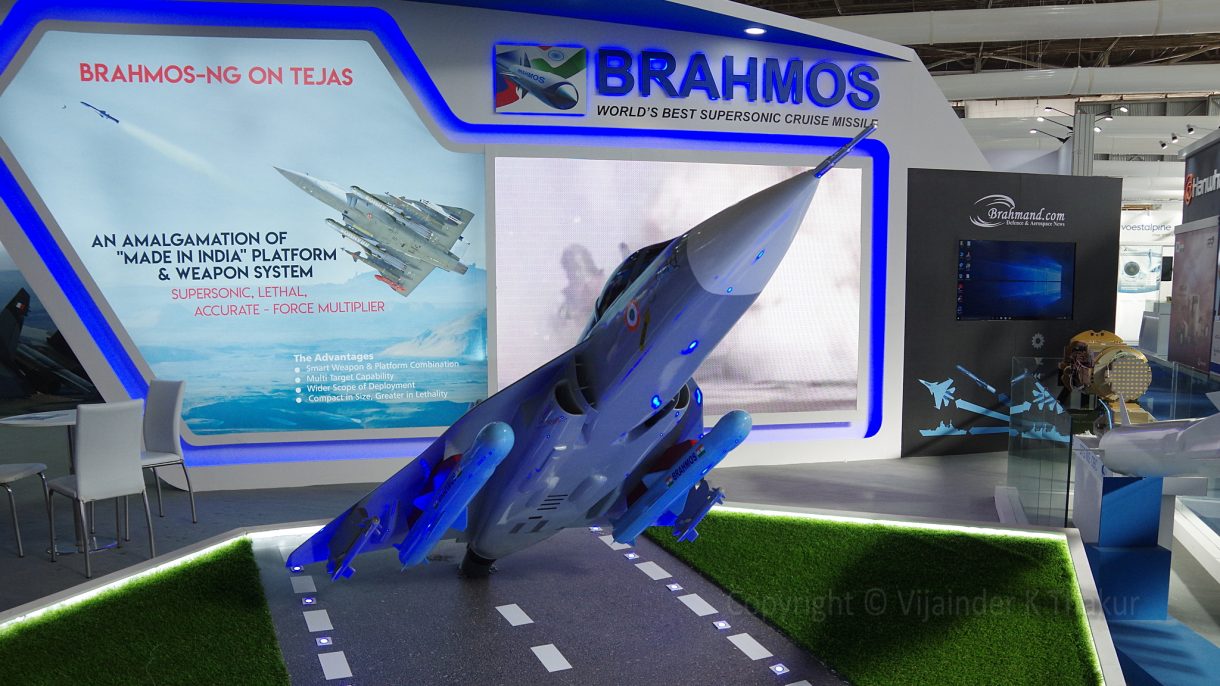
Indigenous Ramjet for the BrahMos NG
Building on the ramjet technology acquired through the BrahMos JV, India launched its own liquid-fuelled ramjet (LFRJ) design and development program.
DRDL, a DRDO laboratory, is developing a technology demonstrator LFRJ engine with a 350 mm diameter for potential applications in missiles and aerial targets.
The technology demonstrator powers DRDO’s Supersonic TARget (STAR) project. Primarily intended for training surface-to-air and air-to-air weapon systems, STAR features a booster-ramjet combination and can achieve speeds of Mach 1.8–2.5, ranges of 55–175 km, and operating altitudes between 0.1 and 10 km.
STAR is also evolving into a combat-capable platform, with potential anti-AWACS, anti-radiation, and low-cost anti-ship variants.
An LFRJ derivative is also reportedly being developed to power the BrahMos-NG.
In November 2025, DRDO reportedly issued a Request for Information (RFI) to select a Development-cum-Production Partner (DcPP) for an LFRJ engine. The RFI may be intended to develop a suitable LFRJ for the BrahMos-NG. If so, DRDL has likely firmed up the engine’s design specifications.
The design changes now being requested for the BrahMos-NG may well be intended to accommodate a DRDL-developed ramjet engine rather than a Russian engine.
Ramjet engines are mechanically simple, but their development involves demanding challenges in materials, inlet optimization, combustor design, and fuel-flow management. As a result, the propulsion system is often among the most difficult subsystems of a missile to indigenize. Under the circumstances, it is conceivable that the DRDO-developed ramjet does not match the dimensional specifications of the Russian engine originally envisaged for the BrahMos-NG, necessitating design changes to accommodate it.
Using an indigenously developed ramjet for the BrahMos-NG would be a bold move aimed at consolidating the self-reliance that India has already achieved in missile technology. Relying on a yet-to-be-developed indigenous engine does entail the risk of schedule slippage.
However, that risk is acceptable because import options will always remain available to bridge any temporary operational capability gaps caused by delays. Temporary import dependence is preferable to committing an indigenously developed weapon system to permanent dependence on a foreign vendor.
- Vijainder K Thakur is a retired IAF Jaguar pilot, author, software architect, entrepreneur, and military analyst.
- This is an Opinion Article. Views Personal of the Author
- Follow the author @vkthakur