China is actively flight-testing advanced sixth-generation air-dominance prototypes: the Chengdu J-36 (an ultra-long-range, heavy triple-engine design) and the Shenyang J-50 (a smaller, twin-engine tailless design).
The U.S. is set to fly its sixth-generation aircraft, but full-scale prototype testing is slated to begin in 2028.
The Future Combat Air System (FCAS/SCAF) was a major trilateral European defense program launched by France, Germany, and Spain to develop a sixth-generation “system of systems” fighter aircraft platform. However, the core Next Generation Fighter (NGF) jet project was canceled in June 2026 due to industrial and structural disagreements between Dassault Aviation and Airbus.
Russia has once again revived discussion around the long-rumored MiG-41 or PAK-DP sixth-generation fighter and high-altitude interceptor concepts intended to eventually succeed the MiG-31. Major questions remain over the aircraft’s capabilities, timelines, and whether the program truly exists beyond the concept stage.
The Global Combat Air Program (GCAP) is a tri-nation initiative by Italy, Japan, and the United Kingdom to build a sixth-generation stealth fighter by 2035. Canada recently joined as the first observer nation. A joint venture named Edgewing handles development, and the project remains on track for mass production by 2035.
Despite operating US-origin fighter jets including F-35 stealth fighters, Japan has partnered with European allies for 6th-Gen aircraft. Why is Japan moving away from a trusted defense ally with whom it shared a defense treaty?
Japan’s Dependence on American Military Hardware
Japan has heavily relied on American military aircraft since World War II, but it has balanced this import tradition with local manufacturing and co-development.
Japan and the United States signed a Security Treaty in September 1951 that ended the Allied occupation. It allowed U.S. forces to stay in Japan to protect it. Japan’s post-war Article 9 of the Japanese Constitution banned the country from waging war or maintaining offensive military forces, making U.S. protection crucial.
In 1960, the pact was updated into the Treaty of Mutual Cooperation and Security. This new version added a mutual defense promise where the U.S. agreed to defend Japan if attacked, and Japan agreed to let U.S. bases remain. The alliance remains active today, serving as a core element of security in East Asia.
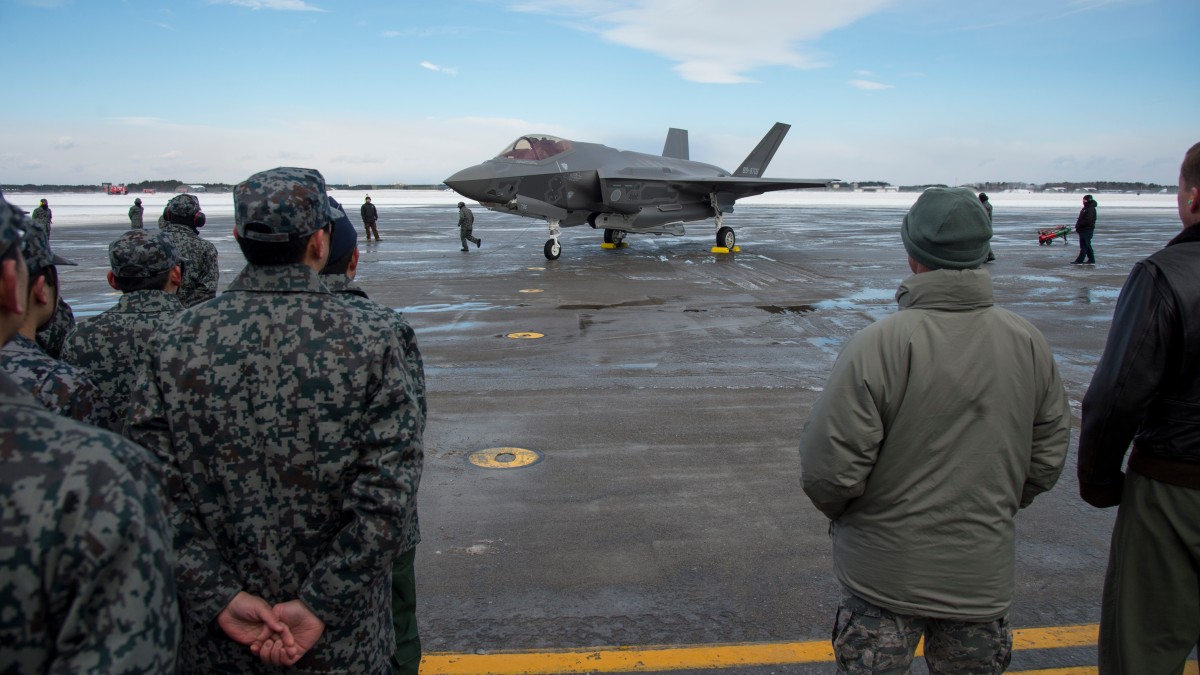
The Japan Air Self-Defence Force (JASDF) has approximately 55 operational F-35 aircraft in service, out of a total planned 147 jets. This order comprises 105 F-35A (conventional take-off) and 42 F-35B (short take-off and vertical landing) variants. Many are being assembled domestically.
“Hung Missile” Suspected as Ukraine’s MiG-29 Fighter Jet Catches Fire Mid Air & Crashes Over Odesa
However, driven by regional tensions with China, Russia, and North Korea, Tokyo’s latest defense policy focuses on active deterrence and counterstrike options. Japan is moving away from its post-WWII pacifist stance by acquiring long-range strike capabilities, increasing defense spending toward 2 percent of GDP, and reorganizing its military command.
Why Japan Chose to Join GCAP
F-35 partner nations cannot integrate their own weapons independently. All software updates, source code access, and weapon integrations require strict U.S. government and Lockheed Martin approval because the aircraft’s mission systems and data networks are centrally controlled.
For all other F-35 operators, it results in high dependence and puts them at the mercy of the USA. A top Japanese official who wished to stay anonymous told us that the inability to independently integrate weapons was a major restriction and often caused delays, even after repeated requests to U.S. agencies.
Only Israel can, and does, integrate its own domestic weapons onto the F-35I “Adir”, making it a unique exception.
Japan always wanted to gradually become an independent power. More recently, shifting foreign policies, unpredictable trade tariffs, and an “America First” strategic focus have led traditional partners in Europe, Asia, and North America to question whether they can depend on the United States for long-term stability and defense.
Japan has the technological wherewithal and is more willing to partner with more equal partners with a fair share of partnership and complete access to the program and platform.
GCAP Program
The GCAP was formed by combining the UK’s Tempest and Japan’s F-X project alongside Italy.
The program is managed by Edgewing, a joint venture equally owned by BAE Systems (UK), Leonardo (Italy), and JAIEC (Japan). This “System of Systems” platform is designed as a connected combat network integrating crewed stealth fighters with uncrewed collaborative combat aircraft (drones), advanced sensors, and artificial intelligence.
In July 2026, Canada became its first official observer nation with privileged access and no initial financial or procurement commitments.
GCAP International Government Organization (GIGO) is the governing body. The partner nations have awarded a substantial multi-billion-dollar contract (approx. $6 billion) to Edgewing for core technology maturation and design advancement.
It is in the development phase, where engineering and prototyping work is accelerating rapidly, with a national flight demonstrator in the UK targeted to fly by late 2027. Operational deployment and introduction into service remain targeted for 2035 to replace the Eurofighter Typhoon and Mitsubishi F-2.
All three partner governments have been providing adequate and timely funding support. On 9 September 2025, Rolls-Royce, Italy’s Avio Aero, and Japan’s IHI Corporation signed an expanded collaboration agreement allowing them to engage directly with Edgewing, cementing them as the international consortium for developing the fighter’s power and propulsion system.
Also, Japan’s Mitsubishi Electric, Italy’s ELT Group, as well as Leonardo and Leonardo UK, formed the GCAP Electronics Evolution (G2E) consortium in preparation for a contract award by Edgewing to deliver the advanced sensing and communication system.
GCAP Core Operational Capabilities
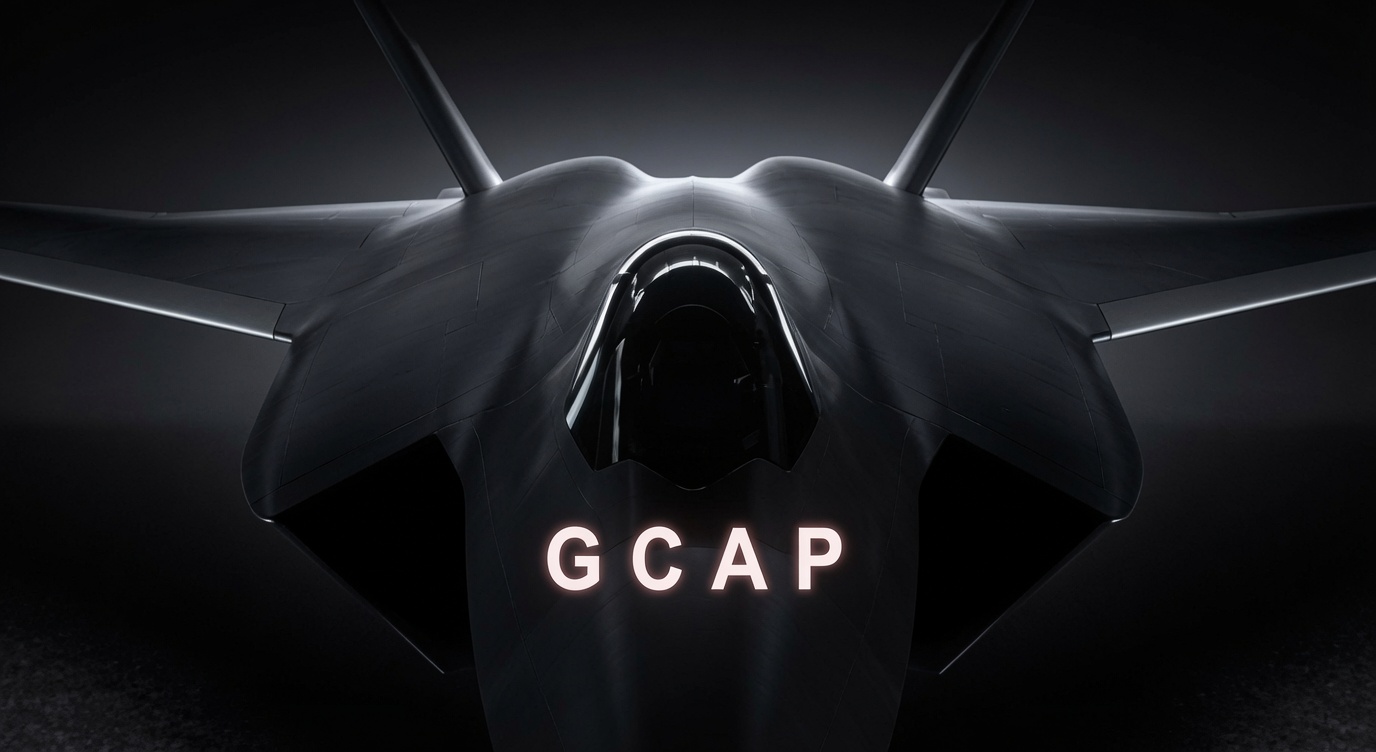
The program centers on multi-domain connectivity, autonomous teaming, and extreme sensor power and operations across air, land, sea, space, and cyber domains. It is designed to operate as a core airborne “quarterback” communicating seamlessly across domains and networks for multi-domain integration.
It is meant to be an advanced sensor powerhouse featuring next-generation ISANKE & ICS (Integrated Sensors and Non-Kinetic Effects and Integrated Communications Systems), providing massive data collection, up to 10,000 times more data than legacy radar systems.
It will have the capability of directly commanding and coordinating uncrewed collaborative combat aircraft (loyal wingman drones) and shared allied assets. It will employ advanced stealth profiles and low-observable shaping coupled with dynamic electronic and cyber warfare capabilities.
It will use combat cloud and AI architecture utilizing onboard supercomputing, AI-assisted decision-making systems, and a software-driven interactive cockpit to process high-tempo data in heavily contested A2/AD (Anti-Access/Area Denial) environments. It will balance kinetic and non-kinetic effectors with extended operational reach and high survivability.
Advantages of Aircraft Development Consortia
Aircraft development consortia pool financial resources, specialized engineering talent, and cross-border industrial capabilities to tackle multi-billion-dollar next-generation programs like stealth fighters or hybrid-electric fleets.
These partnerships mitigate individual financial risk, accelerate technical innovation, and secure guaranteed market access across participating nations or corporate entities. They spread the astronomical research, development, and prototyping costs across multiple balance sheets.
They minimize the risk of single-company or single-nation bankruptcy and project cancellation risks. They avoid redundant national spending by aligning resource allocation to pre-vetted milestones. They merge specialized strengths such as specific ability in airframe fabrication, advanced radar systems, and propulsion technology.
It also accelerates technological innovation and drives rapid breakthroughs in high-temperature materials, additive manufacturing, and sensor fusion. Securing direct buy-in from participating nations is a big plus. It cultivates robust domestic supply chains and moves private vendors into central integration roles. Retains national control over critical aerospace assets while leveraging global technology transfers and component exports.
Complexities for Aircraft Development Consortia
Aircraft development consortia do face hurdles such as fractured decision-making, conflicting partner priorities, intellectual property barriers, and complex cross-functional integration spanning design, manufacturing, and regulatory compliance.
Consensus-driven models slow down rapid engineering choices. Partner firms struggle to align corporate strategies with collective project milestones. Multinational or state-backed groups face or shape-shifting political mandates over work-share distribution. Misaligned budgeting and cost overruns lead to unexpected capital calls.
Disputes arise over high-value manufacturing allocation versus assembly roles. Delays in one partner’s deliverables penalize the entire timeline. Disparate digital toolchains and incompatible data libraries hinder unified verification. Reluctance to share proprietary avionics, material sciences, or source code becomes an issue. There could be difficulties in maintaining cross-functional transparency.
Amid “Death Threats”, Trump Golfs in the Shadow of Avenger AD System — Days After Ankara Plane Swap
Way Forward
As the world learns to navigate an era of volatile American politics, global defense partnerships are being reshaped. Donald Trump’s chaotic return to the White House has called into question America’s reliability as a security guarantor, and U.S. allies are seeking new forms of international cooperation.
Fifth- and Sixth-Generation fighter aircraft not only require futuristic technologies, but they also cost a lot of money. The costs can be amortized if the numbers produced are large, ideally over 600 aircraft. Most major and middle powers require no more than 150-250 aircraft.
Currently, only the USA and China can afford single-aircraft-type fleets of 500 and above.
In March 2024, Prime Minister Fumio Kishida said that further defense export reforms were necessary to support GCAP and allow the export of the future fighter to international customers, which would reduce production costs, strengthen Japan’s security posture, and ensure that Japan is recognized as a reliable partner in international defense joint development programs.
Meanwhile, Japan has been pushing India to join GCAP with the aim of sharing massive development costs, boosting technological cooperation, and strengthening Indo-Pacific security ties against regional rivals.
F-22 Raptor: U.S Air Force Sharpens Rapid Turnaround, Forward Refueling in Japan to Counter China
Tomoko Kiyota writes in the Japanese Times, “the idea of including India, one of the world’s fastest-growing major economies and an increasingly assertive geopolitical actor, makes strategic sense for both the trio and India. The GCAP is more than just a weapons platform. It is a statement of strategic autonomy, industrial innovation and trilateral cooperation among democracies that are, each in their own way, redefining their role on the global stage”. To bring India into the project now would almost certainly add complications, he adds. IAF’s significant aircraft requirements would add to the numbers.
But currently India has been tilting to the French-led FCAS program, where India could have a greater share of participation with Germany’s exit.
Interestingly, the U.S. soft-pitched F-35 jets to India, but New Delhi overlooked the offer and instead started exploring Russian Su-57 stealth fighters. The reason: India did not want to get “trapped” with the F-35 bait where IAF would have acquired the best stealth aircraft in the world but would have been subjected to American arm-twisting.
Japan faces essentially the same constraints with the F-35 that India sought to avoid, which is why Tokyo moved quickly into the Global Combat Air Program (GCAP).
- Air Marshal Anil Chopra (Retired) is an Indian Air Force veteran, fighter test pilot, and ex-director-general of the Center for Air Power Studies. He has been decorated with gallantry and distinguished service medals during his 40-year tenure in the IAF.
- He tweets @Chopsyturvey
- Follow EurAsian Times on Google News