Amid the ongoing Middle East war, many countries impacted by the conflict are partnering with Turkey to boost their sense of security. Turkey is not just a NATO member with a strong defense-industrial complex; it arguably commands the most powerful military in the Islamic world.
In the latest development, Turkey has signed a mutual defense agreement with Qatar.
“The two parties hailed the signing of the mutual defense agreement between Qatar and Turkey,” according to a joint statement carried by Qatar’s state news agency. The agreement was “aimed at bolstering collective defense and achieving regional security and stability, as well as adopting a unified position in the face of any external armed attack targeting either or both parties,” the statement said.
“The two parties agreed to hold consultations on threats to their security… and to strengthen cooperation through joint military exercises, collaboration in the field of defense industries, and the exchange of personnel training.”
Turkish President Erdoğan hailed the partnership and said: “A mutual defense agreement signed by Türkiye and Qatar today will add a new dimension to the brotherly ties between the two countries.” He added that the two sides would continue working together “to prevent the resurgence of war in the Gulf region and establish a basis for dialogue and achieve peace.”
Qatar’s Foreign Ministry said the agreement aims at “strengthening collective defense and promoting regional security and stability, and a unified stance in confronting any external armed attack targeting either party or both of them.”
It must be noted that Qatar has come under attack from both Iran and Israel.
As Iranian missiles and drones struck targets across the Gulf in response to US military strikes, Qatar was among the countries affected. Although Qatar is not part of US military operations, Iran’s strikes targeted Qatari infrastructure, including the capital Doha (home to US Al Udeid Air Base) and the vital industrial and natural gas hubs.
Earlier in September last year, Israel conducted an airstrike in Doha targeting senior Hamas political leaders. The strike hit a Qatari government residential complex in the Leqtaifiya district while Hamas officials were meeting to discuss a U.S.-backed ceasefire proposal.
It was the first known military attack on Qatari soil by Israel, which shocked Doha in particular and the Arab world in general.
Qatar condemned the attack as a “cowardly” violation of its sovereignty and an act of “state terrorism” and temporarily suspended its mediation efforts in Gaza.
The White House stated that striking a neutral negotiating ground and a close American ally did not advance Israeli or American interests. President Donald Trump expressed anger over the operation and subsequently assured Qatari leaders that such an incident would not happen again.
However, the damage had already been done.
Turkey Signs Badr MOU
Before the defense pact with Qatar, Turkey, Pakistan, Qatar, and Indonesia signed the Badr Memorandum of Understanding (MOU) in Doha on 21st October, focusing on joint defense production, technology sharing, training, and research.
Turkey’s Defense Ministry asserted that the agreement “holds substantial economic importance” and that “by leveraging the unique military production capabilities of each country, the initiative will facilitate cooperation and integration, enhance defense industrial capacities, and enable the fulfillment of the needs of allied and friendly nations.”
Haluk Görgün, head of Turkey’s Presidency of Defense Industries, said: “We believe that the Badr Memorandum of Understanding will contribute to transforming the complementary capabilities of Qatar, Pakistan, Indonesia, and Türkiye into concrete projects.”
Türkiye appears to be the pivotal player behind the formation of this grouping.
It has a robust defense industry and strong defense and security ties with other members. Türkiye has a military base in Qatar where approximately 5,000 military personnel are deployed. Erdoğan had earlier called the Turkish military base in Qatar “the symbol of brotherhood, friendship, solidarity and sincerity”.
For now, this is not a security pact; however, given that all the countries involved are Islamic nations, whether this will turn into another defense pact remains to be seen. It must be added that Indonesia follows a long-standing “free and active” foreign policy that emphasizes neutrality and non-alignment with major powers.
Mecca (Makkah) Joint Defense Agreement
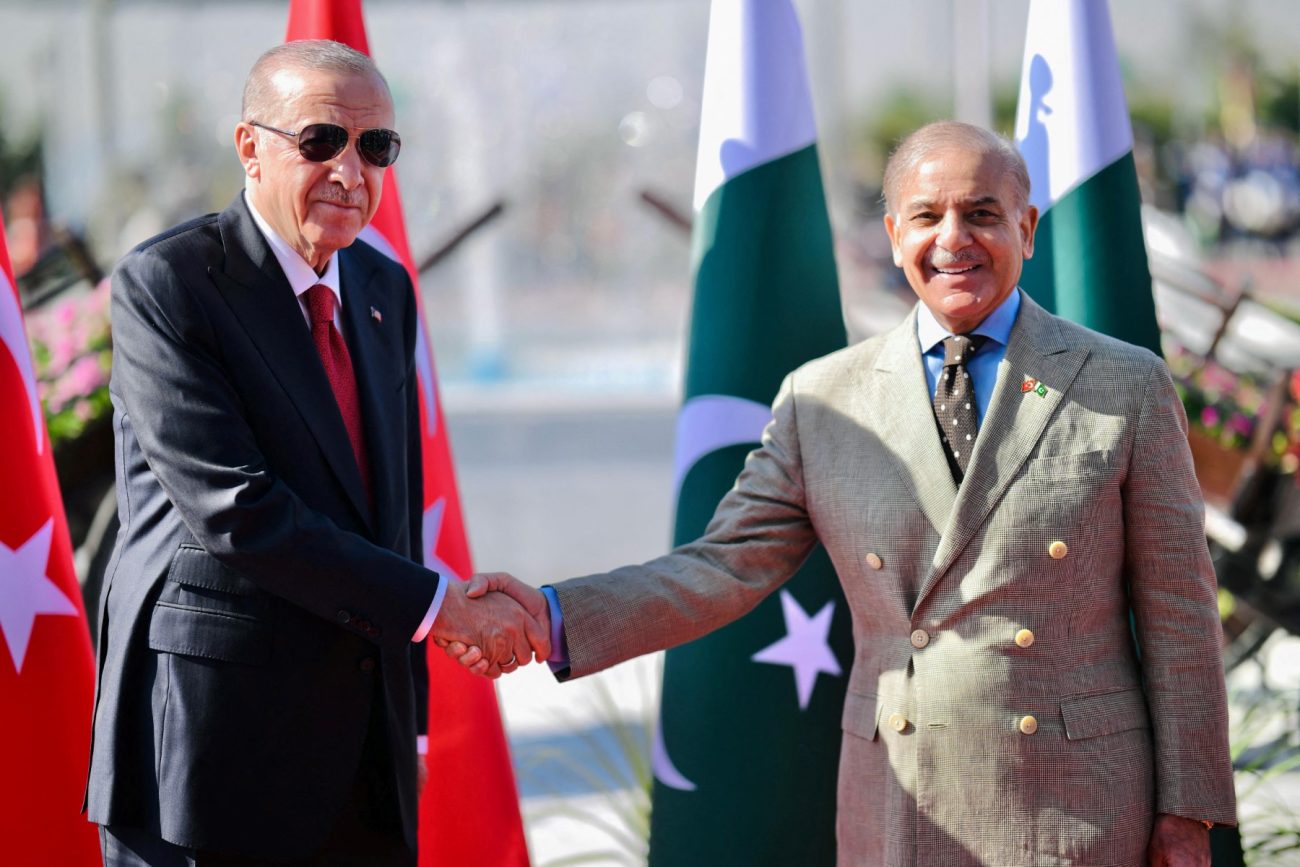
Before the Makkah pact, Saudi Arabia and Pakistan signed the SDMA (Strategic Mutual Defense Agreement) in September 2025.
The Makkah agreement, signed by Turkey, Saudi Arabia, and Pakistan, builds on the SDMA and the quadrilateral consultative mechanism that also includes Egypt.
Unlike the Badr MOU, the Makkah pact is a full-fledged security pact. Its core provision stipulates that an armed attack against any one member of the alliance shall be regarded as an attack against them all.
Turkish Foreign Minister Hakan Fidan reportedly described this commitment as ‘technically the same’ as NATO’s Article 5, while noting that the allies would determine, through consultation, the degree and form of assistance provided.
Turkish Deputy Foreign Minister Levent Gümrükçü told parliament that the agreement “is entirely defensive in nature and did not target any country.” He added: “The agreement envisions integration rather than bloc-building in the region, embracing an inclusive rather than divisive vision.”
Turkey’s parliament approved the pact in early November 2026, and President Erdoğan signed the ratification law on November 13.
Defense Industry Partnership with Canada
On October 22, during Canadian Prime Minister Mark Carney’s visit to Ankara—the first dedicated bilateral visit by a Canadian prime minister—the two countries signed a Memorandum of Understanding on Defense Sector Partnerships, along with agreements on air transport and energy. They also launched a Strategic Partnership with a three-year action plan covering trade, defense, energy, and people-to-people ties.
Canadian PM Carney said: “Today’s new Agreement on Defense Industry Partnership will connect Canadian and Turkish companies to work together, creating good jobs at home, export opportunities abroad, greater security for our citizens, and contributing to a stronger NATO alliance.”
He added: “Türkiye is one of the world’s most dynamic economies… It has NATO’s second-largest standing military and one of the world’s most important and innovative defense industries.”
Turkish President Erdoğan said: “Today, we have alleviated the long-standing Turkey-Canada disconnect. Now, we are starting a new era between Turkey and Canada.”
For Turkey, the gain is more strategic than commercial. As a G7 member and Five Eyes partner, Canada legitimizes Turkey’s defense industry as a partner after once embargoing it.
Will Turkey Help Its Allies?
The biggest question is this: if Israel strikes Qatar again, if India launches another operation against Pakistan, and if Iran attacks Gulf countries in response to American strikes, does Turkey have the military might to defend its new allies?
Start with Israel. It is the strongest military power in the Middle East.
It has F-35 jets, nuclear weapons, excellent intelligence, a strong local defense industry, and nearly unlimited American support. If Israel raids Qatar again, Turkey has limited options.
It cannot match Israel’s air force. However, Ankara could still assist Qatar through intelligence sharing, air-defense cooperation, military deployments, electronic warfare, and diplomatic pressure.
Next is Iran. The recent war showed Iran is not an easy target. Even with an outdated air force, Iran has many drones and missiles that are spread out and well fortified. If Iran fires at Saudi Arabia (under the Makkah Pact) or at Qatar, Turkey has no clear way to stop it, except by diplomatic means.
The United States and Israel have not been able to stop Iran’s attacks fully; Turkey and Pakistan together hardly stand any chance.
India would arguably be Turkey’s toughest test.
India has one of the world’s largest militaries, a massive economy, nuclear weapons, a powerful air force, and a growing blue-water navy equipped with two aircraft carriers.
Unlike smaller regional powers, India has the resources and military capabilities to sustain a prolonged conflict.
While Turkey has developed close defense ties with Pakistan, India’s key rival, India also maintains close strategic relationships with Greece, Cyprus, and Israel, all countries with strained relations with Turkey. While they may not intervene directly in a conflict, their diplomatic, technological, and defense-industrial cooperation could jeopardize Ankara’s position.
India’s powerful navy could also threaten Turkish military and commercial interests in the wider Indian Ocean region, and Ankara cannot hide behind NATO.
Article 5 is a collective-defense provision. Turkey cannot assume that its allies would automatically join the war on India if Ankara supports Pakistan. We have seen this in the recent Iran war, when NATO allies categorically refused to join the US to fight Tehran. Many even refused to let the US use its military bases.
Turkey can be expected to arm and train Pakistan, but nothing beyond that. It has been doing so since 1947, but has never managed to turn the tide in Islamabad’s favor.
Turkey’s emerging defense partnerships are more diplomatic gestures than a real combat pledge. They provide Ankara with opportunities to expand its military influence, defense exports, and strategic presence across the Middle East and South Asia.
Turkey may be willing to supply weapons, intelligence, training, and logistical support, but committing its armed forces to a major war against Israel, Iran, or India is unlikely.
- This is an OPINION ARTICLE
- For feedback, mail us at: editor (at) eurasiantimes.com