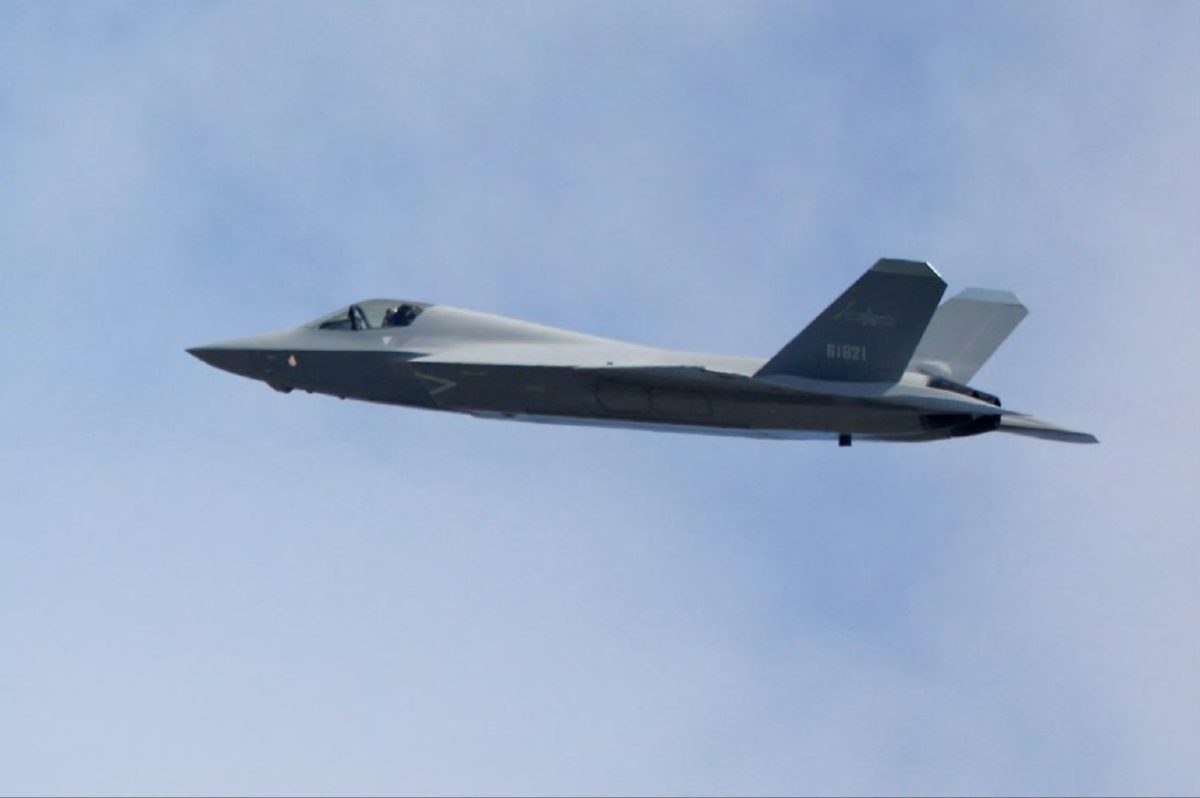
On the second anniversary of the J-35A stealth fighter’s public debut, Chinese military commentators appear to have formalized a new conceptual framing for the People’s Liberation Army Air Force (PLAAF) fighter force.
The traditional “three swordsmen”—the J-20, J-16, and J-10C—have been expanded into a “four swordsmen” lineup with the addition of the new medium stealth fighter, the J-35A.
PLAAF unveiled the J-35A on 12 November 2024 at the Zhuhai Airshow, becoming only the second air force in the world to operate two fifth-generation stealth jets. Currently, the US is the only other country with two fifth-generation aircraft — the F-35 and F-22.
Interestingly, the J-35A bears an uncanny resemblance to the F-35 and is being integrated into the PLAAF.
Chinese state media used the debut anniversary to detail key upgrades, including avionics, situational awareness, and weapons integration. It also noted that the aircraft could soon be powered by the full version of the domestically developed WS-19 turbofan engine, though the new engine remains a work in progress.
More importantly, though, the Chinese state broadcaster CCTV floated the new “Four Swordsmen” concept.

Four Swordsmen
For years, Chinese military analysts have referred to the J-20 heavy stealth aircraft, the J-16 heavy multi-role aircraft, and the J-10C lighter multi-role aircraft as the core “three swordsmen,” and the backbone of China’s combat jet fleet.
“The three models are utilized together, mainly with the J-20’s great capacity for situational awareness guiding the two other models, while the J-16 and J-10C exert their firepower superiority,” J-16 pilot Zhang Yang told CCTV in an interview in November 2022.
However, the public debut of the J-35A, followed by its progressive integration, completes the picture, according to Chinese military analysts.
The “four swordsmen” concept is now presented not merely as an inventory update but as a deliberate force-design approach: a high-low mix of fifth-generation stealth platforms paired with mature 4.5-generation multirole fighters, networked through advanced data links, and intended to operate as an integrated package rather than isolated platforms.
The concept closely resembles the classic high-low mix long practiced by the United States Air Force, which fields two fifth-generation fighters — the F-22 Raptor and the F-35 Lightning II —optimized for different roles alongside the F-15E and F-16.
In the Chinese version of this high-low teaming, each of the four aircraft has a complementary role within what is described as a networked team.
The J-20 remains China’s premier heavy stealth fighter, while the J-35A offers a medium-weight and potentially more economical stealth option. Meanwhile, the J-16 is a heavy-mass multi-role aircraft that provides firepower and flexibility, while the J-10C is a low-mass multi-role aircraft that brings agility and numbers.
Chinese experts highlight that the stealth aircraft could control the battlespace, while the non-stealth platforms deliver volume of fire under the stealth aircraft’s protection or cueing, as EurAsian Times explained earlier.
As per Chinese analysts, the J-20 remains the high-end “sword.”
It is optimized for long-range air superiority, high-value target engagement, and system confrontation. Much like the US F-22 Raptor, the Chinese Mighty Dragon is seen as a platform that will create openings in combat by penetrating contested airspace, suppressing enemy sensors and command nodes, and providing high-end sensing that lets the rest of the force operate more effectively.
The J-20’s size, internal volume, and sensor suite reportedly support extended-range missions and coordination with early-warning aircraft, unmanned systems, and other force multipliers. The aircraft gathers data through multiple sensors to support optimal tactical and combat decisions, in line with China’s ‘intelligentized warfare.’
The J-35A is believed to be better suited to large-scale fielding for routine air patrol, regional air defense, stealth reconnaissance, and multi-role strike. In stealth configuration, it carries internal air-to-air missiles, although external hardpoints allow heavier air-to-ground or anti-ship loads when low observability is less critical.
According to Chinese analysts, the J-35A’s primary mission is routine air patrol and regional air defense, while its secondary mission is multi-mission strikes. In stealth mode, it may breach defenses and strike ships, radars, and air-defense facilities, or switch to non-stealth mode with additional ordnance for air-to-ground and anti-ship support when needed. It also supports system-based distributed operations.
While the J-20 will handle the most demanding missions, the J-35A is meant to increase the quantity of stealth platforms available for patrol, escort, and secondary penetration tasks, thereby complicating an adversary’s ability to track and engage every low-observable threat.
However, the J-35A remains relatively early in its service introduction and has yet to evolve into a mature platform.
After the high-low mix of fifth-generation fighters comes the corresponding mix of 4.5-generation platforms.
The twin-seat J-16, often described as one of the most capable Flanker derivatives, functions as the primary “firepower delivery” platform. It can conduct air-superiority and extensive air-to-surface or anti-ship missions while carrying large external loads of precision munitions.
In the four-swordsmen structure, it is expected to benefit from targeting data provided by the stealth aircraft and to operate in greater numbers once the high-end threat environment has been degraded.
The J-16 also has a specialized Electronic Warfare variant known as the J-16D, which could be instrumental in jamming and spoofing in contested electromagnetic environments.
The single-engine J-10C provides the PLAAF with numbers, agility, and cost-effective coverage for medium- and short-range air combat, defensive counter-air, and secondary strike tasks. It is the most widely present fighter in the PLAAF inventory and is expected to fill gaps, provide mass, and conduct more persistent operations under the protective umbrella and cueing provided by stealth platforms, working in conjunction with the J-16.
This aircraft is the only one in the PLAAF inventory that has been used in real combat, with Pakistan deploying it against India during the May 2025 conflict. Pakistan claimed the jets shot down multiple Indian warplanes, including Rafales, but India has disputed the claims.
In this concept of warfare, the J-20 focuses on situational awareness and surveillance, exploiting its low observability to gather and pass information to the J-16 and J-10C “missile trucks.”
Once an opening is created, J-35As are expected to network with early-warning aircraft and unmanned wingmen for forward reconnaissance and wide-area surveillance.
As a Chinese expert explained on CCTV, when operating with fourth-generation fighters, the J-35A can slip in first to locate enemy radar and air-defense sites, share coordinates with the rest of the formation, and combine stealth reconnaissance with target guidance.
J-10C, J-16, and J-20 are known to use the PL-15. Beijing also has a compact PL-15E that stealth fighters can carry internally and could be integrated into the J-35A, but this has not been officially confirmed. Furthermore, the J-16 and J-10C are both equipped with AESA radars that provide strong independent tracking and engagement capability.
In the event of a contingency in the Taiwan Strait or the South China Sea, the four-aircraft mix is expected to provide the PLAAF with combat power density close to home bases while maintaining the ability to project high-end capabilities farther into the Western Pacific.
That said, unlike the F-35, the J-35A is still a relatively new fighter jet undergoing upgrades and has yet to reach full technological maturity.
- Contact the author at sakshi.tiwari13 (at) outlook.com
- Follow EurAsian Times on Google News