The US President’s pet project, the ’Trump-class’ battleship, already criticized for being an expensive experiment for the American taxpayer, is now expected to cost billions more than originally anticipated.
A Congressional Budget Office report released on August 5 estimates the cost of the US Navy’s new nuclear-powered battleship program at a striking $275 billion. The first Trump-class battleship (BBG(X)), named USS Defiant, is expected to cost about $23.4 billion.
Trump announced the new class in December 2025, calling the ships “the fastest, the biggest, and by far, 100 times more powerful than any battleship ever built.” He said two ships would be built initially, followed by roughly 20–25 more as part of the planned Golden Fleet.
Earlier this year, the US Navy (USN) reportedly requested about $17 billion for the first ship in FY28 and about $13 billion for the second ship in 2030.
However, the price of Trump-class battleships has fluctuated since the December announcement, with the revised cost about 6 billion higher than the original estimate.
Based on published estimates of size and nuclear propulsion, the CBO calculated that a full-displacement 35,000-ton nuclear battleship would cost around $18 billion per hull throughout the course of the program. However, the cost per hull would increase by 16% if displacement increased to 41,000 tons, resulting in a total cost of almost $528 billion.
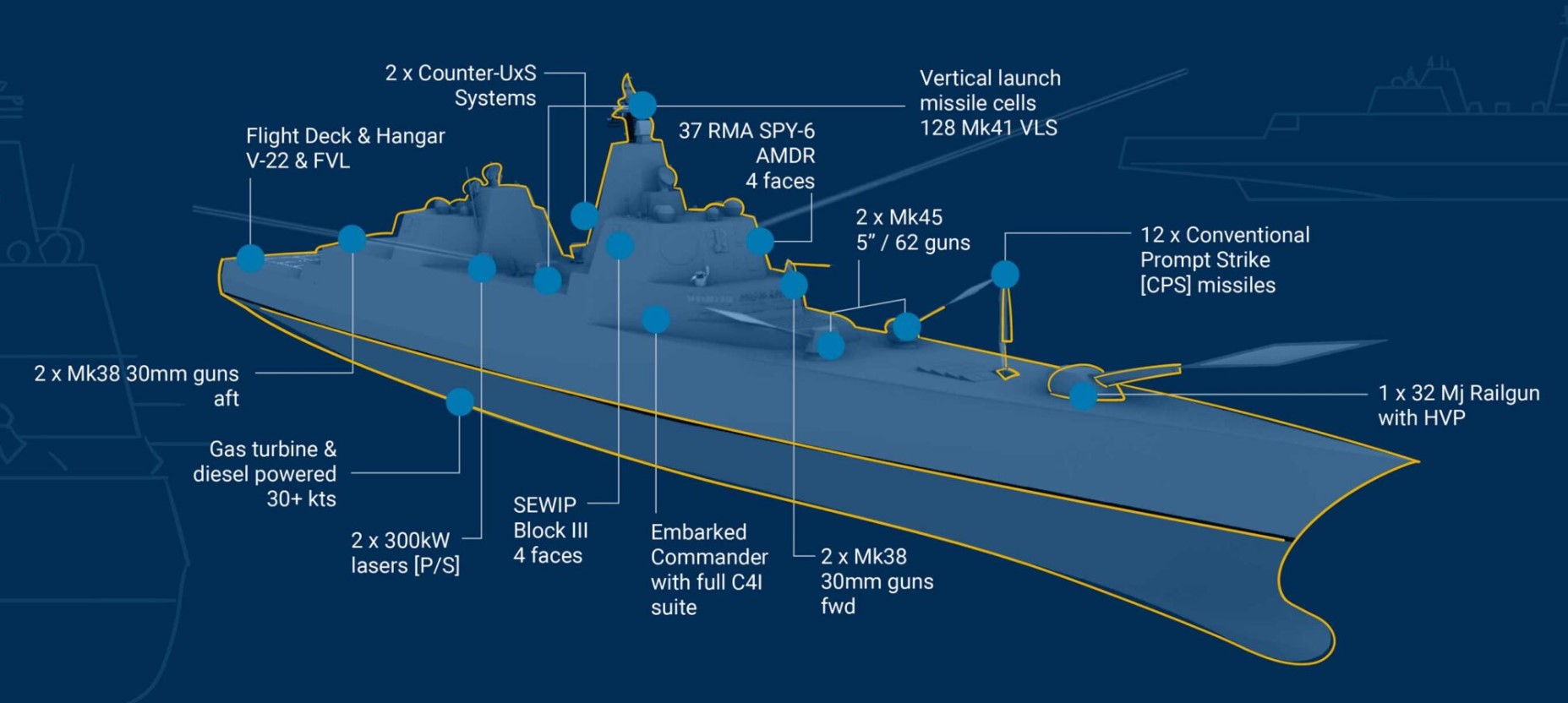
The ship is expected to be the most heavily equipped surface warship the US Navy has ever constructed. It is planned to be equipped with 128 Mark 41 vertical launch cells, an upgraded version of the Navy’s AN/SPY-6 integrated air and missile defense radar, an electromagnetic railgun, and four hypersonic missile tubes.
“If built to those specifications, the ship would be the largest surface combatant in the world and larger than any surface combatant built for the Navy since World War II,” the report states. “It would be more than three and a half times the size of the Navy’s Arleigh Burke-class guided missile destroyer and more than twice the size of the Zumwalt-class guided missile destroyer.”
“Other elements would include large lasers, a rail gun, and a variety of defensive systems such as guns, smaller missiles, decoys, and optical dazzlers intended to counter and disrupt unmanned aerial systems. If some of those technologies were not available when construction began, the Navy could still build the ship, reserving space and power for their later installation,” the report further adds, explaining the scope of development.

In addition to these, the addition of nuclear weapons will further cause a steep climb in cost, as noted by the report.
“The BBGN would add considerable firepower to the Navy’s fleet. The Navy has stated that the ship would be equipped to carry the nuclear-armed sea-launched cruise missile, or SLCM-N. The number of nuclear-tipped cruise missiles the ship would carry is unknown, but would probably be small given the Navy’s descriptions of the nuclear cruise missile program. Nevertheless, carrying nuclear weapons would give the battleship more firepower than any ship in the fleet other than the Navy’s 14 Ohio-class ballistic missile submarines.”
CBO emphasizes that precise costs remain difficult to pin down. “Those estimates are highly uncertain and rely on CBO’s assessments of the ship’s design and the overall battleship program. Other factors could also make costs higher or lower than CBO’s estimates,” reads the report. For instance, it would be roughly 13% less expensive to build a conventionally powered battleship program than a nuclear one, but a nuclear battleship would have reduced operating and maintenance costs.
The estimate rests on three assumptions: the lead ship ordered in 2028, as shown in Navy budget documents; a total of 15 ships built at the rate in the 2027 shipbuilding plan; and final assembly at one shipyard, with others producing sections.
The report warns that large surface combatant construction would need to rise 60 percent by 2058, which “could be a challenge for the shipbuilding industry.” By 2035, shipyards would also need to produce 12 percent more tonnage under the 2027 plan than under the 2025 version because of the shift away from smaller surface combatants.
Interestingly, the latest report comes months after the CBO estimated in January 2026 that the first Trump-class battleship could cost up to $21 billion if ordered in January 2026 and $22 billion if ordered in 2030. Furthermore, it stated that the cost of follow-on ships may range from $9 billion to $13 billion per vessel if orders are placed at that time, or from $10 billion to $15 billion if the first ship order is postponed until 2030.
The latest report makes these previous estimates look far more conservative, even though the eye-watering price tag has been criticized since the project was announced.
Trump-Class Battleships Too Expensive for US Navy
Experts contend that big, heavy battleships like the USS Defiant would be vulnerable, noting that, despite carrying nuclear and hypersonic weaponry, the ship’s size and displacement would still make it a “bomb magnet.”
They have repeatedly questioned the program’s viability, arguing that it would conflict with the US Navy’s distributed firepower doctrine.
The Navy’s distributed concepts prioritize spreading sensors, shooters, and risk across many networked platforms, such as destroyers, frigates, and unmanned systems. This increases the number of “nodes,” meant to complicate enemy targeting, improve overall fleet resilience and survivability, and multiply the existing sources of lethality. In contrast, a few high-value heavy ships create concentrated targets and reduce the total number of platforms the fleet can field for a given budget.
Indian Navy veteran and military commentator, Rear Admiral Girish Kumar Garg (retd), told the EurAsian Times: “This is a simply insane price for a warship, whatever be its capabilities. Even if America can afford them, it is a colossal waste of taxpayers’ money. Especially since, in my view, similar tasks can be performed equally effectively by warships costing less than a quarter of this cost. Moreover, the future of warfare is gyrating towards unmanned warfare in all three maritime domains-air, surface, and sub-surface. Such a huge expenditure on a warship is therefore not prudent.”
On top of that, the vessel’s cost may not justify the vulnerability, the pressure on shipyards, and the complexity of development.
Retired Adm. James Stavridis, the former NATO Supreme Allied Commander, criticized the feasibility of injecting precious dollars into a project that is clearly vulnerable.
“Does it make sense to put so much expensive weaponry and so many sailors on a single, potentially vulnerable platform?” Adm. James Stavridis, former NATO Supreme Allied Commander, wrote in an op-ed for Bloomberg. “Given today’s drone swarms, stealthy submarines, hypersonic missiles, advanced torpedoes and offensive cyberweapons, putting lots of eggs in a handful of big baskets doesn’t make much sense,” Stavridis wrote.
Several critics have gone so far as to say the project will likely be canceled once Trump leaves office, resulting in losses of billions of dollars for American taxpayers.
Meanwhile, others have pointed out that the Trump-class battleship would cost more than an aircraft carrier, whose price tag has apparently concerned the US Navy’s leadership.
Former US Navy Secretary John Phelan said earlier this year that the Navy is reviewing the design and costs, hinting that the cancellation of future versions of the carrier design has not been ruled out. He said that the objective of the review was to examine “the costs of the designs and the systems to make sure that they make sense and they have all the systems and requirements that we want going forward.”
Interestingly, the USS Gerald R. Ford cost approximately $13.3 billion, far less than the aspirational Trump-class battleship.
In May 2026, a Cato Institute report identified the battleship as unnecessary and ineffective. “We haven’t used this since World War II,” Ben Giltner, policy analyst at Cato Institute, told Fortune at the time, “because the aircraft was able to pick it off in the ocean.” Furthermore, he stressed, “We could be doing something even as simple as helping to pay down the debt, the interest on the debt right now, which is absolutely enormous.”
Notably, the revelations about the Trump-class battleship’s cost coincide with Pentagon-wide cuts undertaken by the Trump administration.
As Sen. Jeff Merkley, D-Ore., the top Democrat on the Senate Budget Committee, said in a statement after the CBO report was published, “While we continue to see too many Pentagon programs burdened by cost overruns, delays, and unrealistic promises that fail to meet reality, Congress cannot afford to commit to another massive military boondoggle that will only succeed in filling the coffers of the military-industrial complex.”
- Contact the author at sakshi.tiwari13 (at) outlook.com
- Follow EurAsian Times on Google News