Chinese President Xi Jinping’s closely watched three-day visit to the United States began with the roar of the B-1B Lancer, a bomber that has irked Beijing with its deployment to the Indo-Pacific region.
As they arrived at Joint Base Andrews on September 23, 2026, Xi Jinping and his wife, Peng Liyuan, were welcomed with a 100-foot red carpet and greeted by the US President Donald Trump and First Lady Melania Trump.
The ceremony marking the Chinese President’s arrival on US soil after more than a decade consisted of a 21-gun salute, a guard of honor, a display of six F-16 and six F-22 fighter jets, and the US Air Force (USAF) band playing the national anthems of China and the United States.
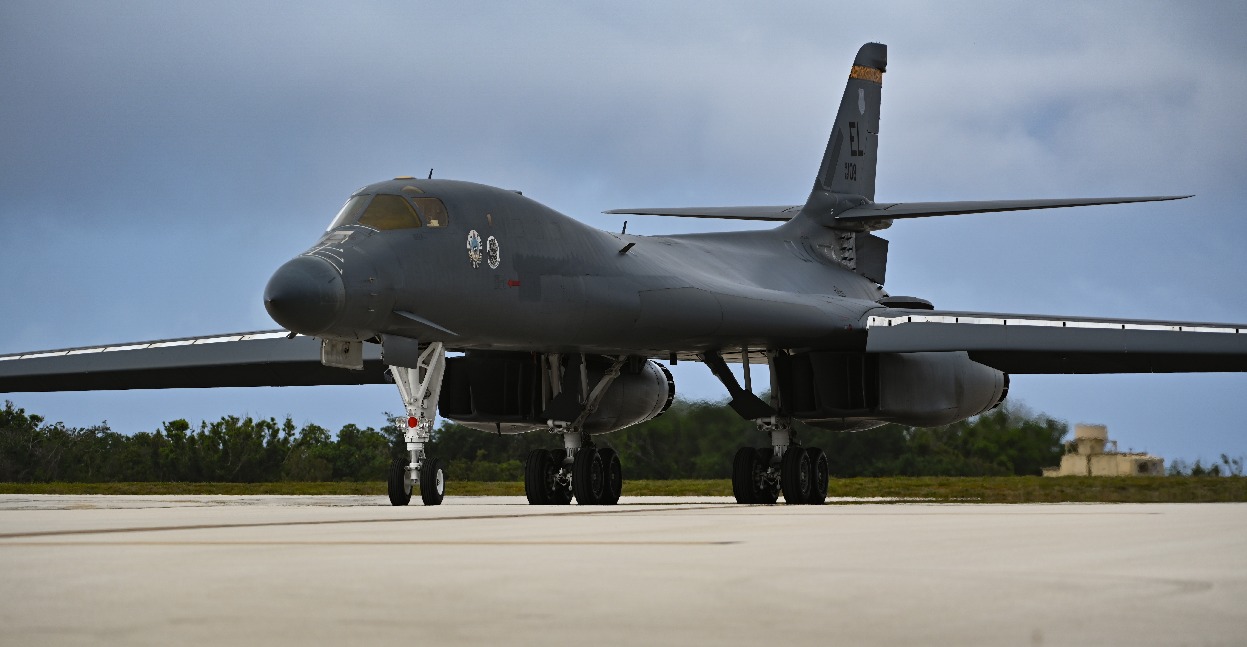
The most striking moment of this grand welcome came during the national anthem when two B-1B Lancers conducted a ceremonial flyover.
Interestingly, a video of the moment posted to social media shows Xi remaining composed and smiling for the cameras as the bombers passed overhead. Trump, by contrast, visibly grimaced at the thunderous noise, briefly ducked, and said, “That was really loud.”
The flyover was a clear show of force, even as the US President personally welcomed the Chinese President on the tarmac, a move observers described as extremely rare.
Trump last made a comparable gesture in 2025, when he met Russian President Vladimir Putin at Joint Base Elmendorf-Richardson in Anchorage for the Alaska Summit. At the time, B-2 bombers, escorted by four F-35 fighters, flew overhead as Putin walked onto the tarmac and up to the podium with Donald Trump, as the EurAsian Times previously reported.
The B-1B flyover at the Joint Base Andrews came as a complete surprise. Earlier, the Office of the First Lady, Melania Trump, said a military flyover featuring a B-2 Spirit bomber and four F-22 Raptor fighters would take place during the formal ceremony at the White House, but did not mention the Lancer.
The B-1B forms the backbone of the US long-range strategic bomber force alongside the B-2 Spirit and the B-52 Stratofortress. In fact, the USAF has postponed the bomber’s retirement and is extending its service life even as it prepares to welcome the B-21 next-generation stealth bomber, which will eventually replace both the B-1B and the B-2.
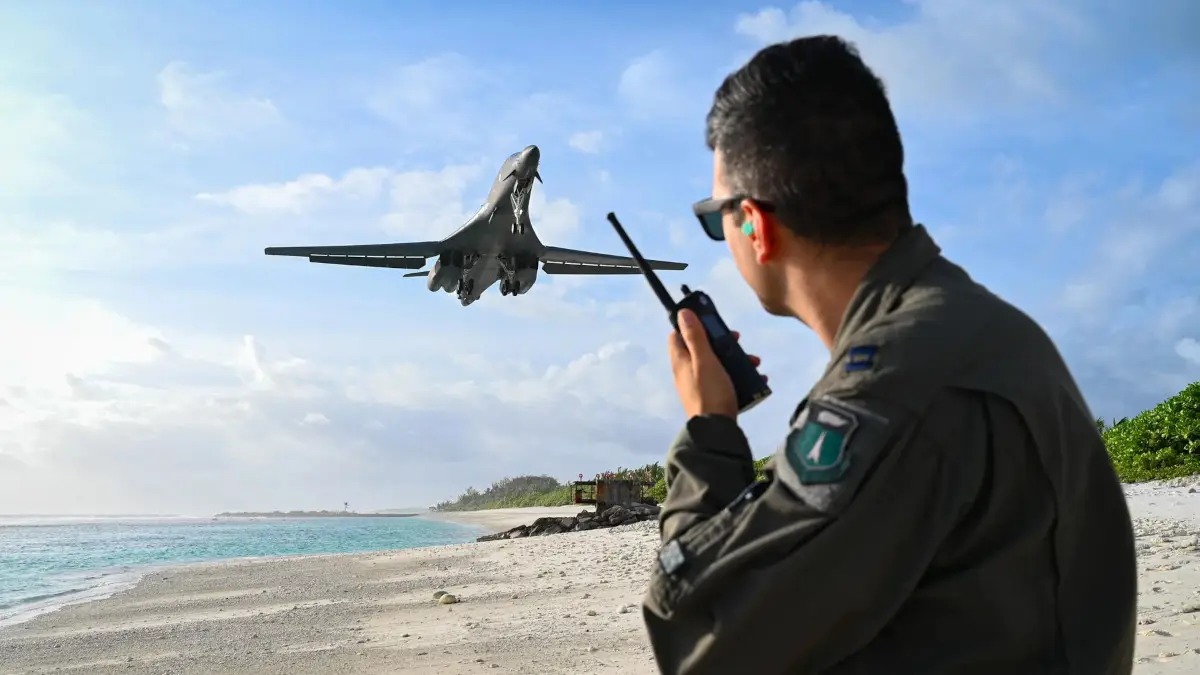
The B-1B Lancer is a supersonic variable-sweep-wing bomber that excels in conventional precision strikes and has a massive payload capacity of up to 75,000 pounds. It carries Joint Direct Attack Munitions (JDAMs), small-diameter bombs, and standoff weapons. It can perform a wide range of missions, including close air support, strategic bombing, maritime operations, and intelligence, surveillance, and reconnaissance (ISR).
With a 40-year legacy under its belt, the B-1B Lancers carried out long-range deep attacks in Iran during the initial days of the operation, as previously reported by EurAsian Times.
Although Xi Jinping showed no outward reaction to the flyover, the B-1B has a long track record of operations that Chinese officials have described as provocative.
The Bone of Contention
The choice of the B-1B Lancer was not accidental.
Nicknamed the “Bone,” the swing-wing strategic bomber has repeatedly operated in the Indo-Pacific in the last decade in ways that Chinese officials have condemned as provocative.
Over the years, B-1s have conducted freedom-of-navigation and presence missions near China’s claimed airspace, flown routes close to the South China Sea and Taiwan Strait, and participated in joint exercises that Beijing views as deliberate shows of force “too close to home.”
In March 2017, for instance, a B-1B based at Guam—the frontline US territory in the Western Pacific— flew a simulated attack mission on a range in South Korea amid tensions with Pyongyang. Escorted by South Korean F-15K and two KF-16 fighter jets, the bomber received a radio warning on the Guard frequency from China, which claimed that it had strayed into Chinese airspace and ordered it to leave. The US officials, however, maintained that the bomber was flying in international airspace 70 miles southwest of the South Korean island of Jeju.
The B-1B tested China again in July 2017 when two of these bombers from Andersen Air Base in Guam flew over the South China Sea and the East China Sea as part of military drills with Japan. According to reports, the Japanese F-15s escorted the bombers.
China claims almost the entire South China Sea as its sovereign territory, defying the 2016 ruling of the Permanent Court of Arbitration, and remains embroiled in a territorial dispute over the Senkaku Islands in the East China Sea.
Interestingly, this training mission occurred the day before President Trump and Chinese President Xi met at the G-20 summit in Germany. Responding to the flight, Geng Shuang, a spokesman for the Chinese Foreign Ministry, said there were no issues with overflight or freedom of navigation in the East and South China Seas. “But China resolutely opposes individual countries using the banner of freedom of navigation and overflight to flaunt military force and harm China’s sovereignty and security.”
The Lancers took a major long-range trip to China’s backyard on April 28, 2020. Two B-1Bs from Ellsworth AFB, South Dakota, conducted a 32-hour round-trip Bomber Task Force (BTF) mission over the South China Sea, demonstrating dynamic force employment and global reach.
“The bomber crews flew more than 32 hours, nonstop, as part of a joint US Indo-Pacific Command (INDOPACOM) and US Strategic Command (USSTRATCOM) Bomber Task Force (BTF) mission before returning home,” STRATCOM had said in a statement.
In November 2020, two B-1Bs—callsigns MAZER01 and MAZER02— from Andersen AFB entered China’s East China Sea ADIZ, northeast of Taiwan, with aerial refueling support from KC-135s. According to a video that surfaced on the Chinese social media site Weibo at the time, the People’s Liberation Army Air Force (PLAAF) responded to the brief incursion by scrambling two aircraft to intercept them.
The US has sent its B-1B to the Indo-Pacific for Bomber Task Force missions multiple times in the past decade, including in the East and South China Sea, although not all B-1B flights prompted warnings on Chinese radio. These deployments typically aim to deter adversaries, enhance interoperability with allies, and project presence.
Last year, for instance, the USAF deployed B-1B Lancer bombers at Misawa Air Base for a Bomber Task Force mission, as the EurAsian Times reported.
US officials consistently describe such flights as routine exercises of freedom of overflight and demonstrations of alliance interoperability and deterrence. Meanwhile, Chinese officials characterize them as deliberate shows of force and label them as provocative.
Therefore, the unexpected appearance of the B-1B was likely an attempt to combine diplomatic courtesy with a display of US military might ahead of summit-level talks.
- Contact the author at sakshi.tiwari13 (at) outlook.com
- Follow EurAsian Times on Google News