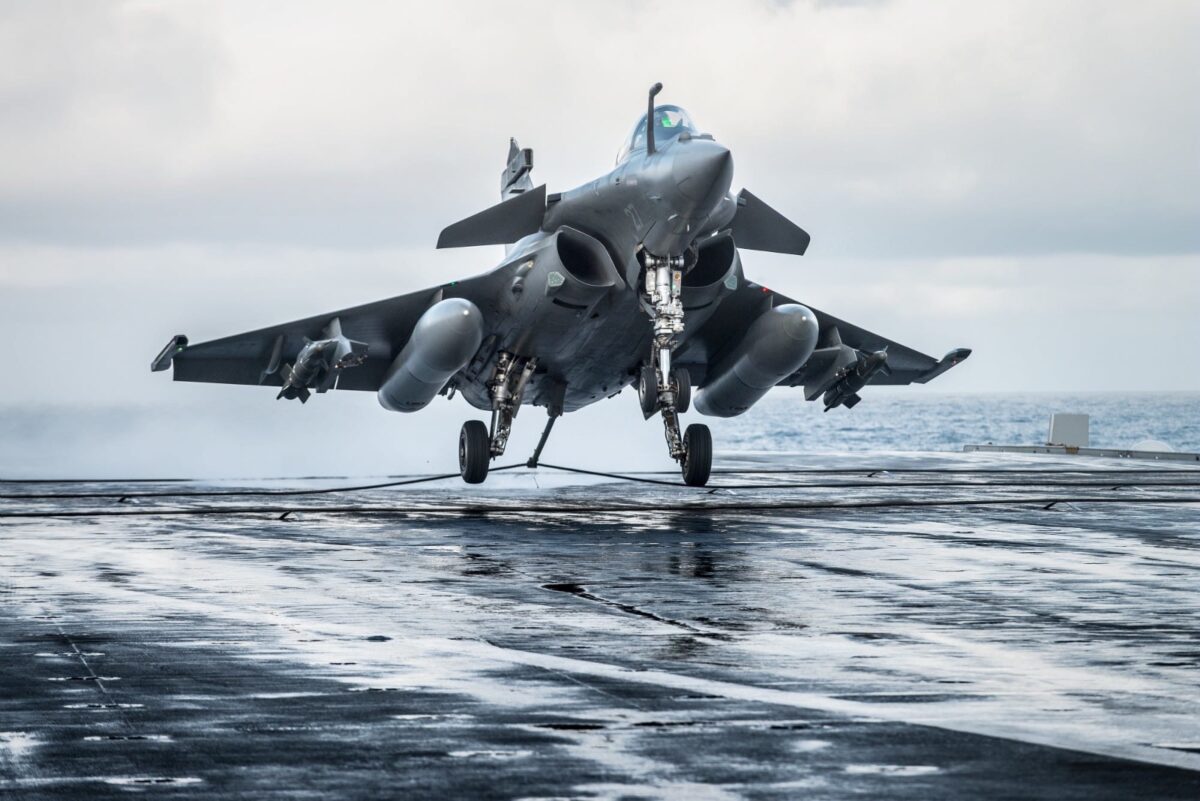
A French Rafale M fighter jet made an emergency landing at Exeter Airport in the UK after experiencing engine problems.
The Rafale-M (Marine) is the carrier-capable naval variant of the Rafale multirole fighter, built for catapult-assisted take-off and arrested recovery from carriers such as France’s Charles de Gaulle.
It features a reinforced airframe and landing gear, an arrestor hook, and navalised avionics while retaining the land-based Rafale’s twin Snecma M88 engines, canard-delta layout, RBE2 AESA radar, and SPECTRA electronic-warfare suite. The jet can carry a mixed load of Meteor and MICA air-to-air missiles, SCALP cruise missiles, Exocet anti-ship missiles and, in French service, the ASMP-A nuclear missile, giving a single air wing both fleet air defense and long-range strike.
Exeter Airport confirmed that a French Rafale aircraft requested permission to land after declaring technical issues. An Exeter Airport spokesperson said: “A French Navy Rafale fighter jet requested to land on Tuesday afternoon after reporting an issue with one of its two engines while over the English Channel.
“It was met by a precautionary emergency response including our own resources and external agencies, which all stood down when the aircraft landed safely without incident. The aircraft is awaiting inspection by engineers.”
The Rafale-M, operating from Landivisiau Naval Air Base, was participating in joint military drills with the UK when the bird strike happened. The pilot tried to land the aircraft “as quickly as possible”.
A spokesperson for the French military said: “On Tuesday, September 22, during a joint training exercise with the British armed forces, a Rafale Marine fighter jet from the Landivisiau Naval Air Base (BAN) was involved in a bird strike.
“In such cases, the procedure dictates that the aircraft must land as quickly as possible to ensure the safety of the pilot and the aircraft. The diversion airfield (the closest at the time of the collision) identified upstream was Exeter, in the United Kingdom, and the Rafale Marine landed there a few minutes later.
“The Landivisiau Naval Air Base protection team was immediately dispatched to the United Kingdom to provide 24/7 surveillance of the aircraft. A team of technicians flew to Exeter this morning to verify the aircraft’s integrity before it can fly again and return to Landivisiau. The technical team’s investigation is ongoing.”
Bird Strikes Also Threaten Fighter Jets
Although modern jets are well-equipped to defend against aerial threats, an unconventional threat like a bird strike still haunts aircraft worldwide.
Mid-air collisions are often unavoidable because of the aircraft’s speed. Typically, in such incidents, birds can also penetrate the windscreen, potentially injuring the pilot, impairing visibility or control, and increasing the risk of aircraft loss. As in this case, aircraft often experience engine problems or even complete failure.
When a bird is swallowed into an engine, it can severely damage the first compressor rotor. This damage may cause severe vibration and ultimately lead to a significant loss of thrust.
Additionally, bird strikes during takeoff or landing can also damage extended landing gear, potentially disabling the brakes or the nose-gear steering system. Such damage can cause serious directional-control difficulties during the subsequent landing roll.
Fighter jets with high-bypass turbofan engines are designed to ingest birds up to a certain size without flaring, and feature reinforced windshields that can lessen the impact of a bird strike at lower speeds. However, even the most advanced engines have a maximum mass they can consume before catastrophic power loss.

For instance, a bird struck a Tatmadaw (Air) fighter, the air force of the Myanmar Armed Forces, during a training flight in the Yangon region, causing the aircraft to crash. According to reports, a bird entered the aircraft’s engine, triggering a fire that caused the crash.
The Malaysian F/A-18 Hornet fighter reportedly crashed on the runway of Sultan Haji Ahmad Shah Airport in Kuantan during takeoff after its engine burst into flames on the night of August 21, 2025. An investigation later confirmed the bird strike as the cause of the accident.
A Royal Air Force F-35 Lightning II stealth aircraft struck a bird over north Wales in January 2025, damaging the aircraft’s front and forcing the jet to return to base.
In another incident, the pilot of a US Marine Corps (USMC) F-35B was forced to land after colliding with a bird shortly after takeoff from Kunsan Air Base in South Korea in April 2024.
During low-altitude flight in January 2022, an eagle damaged the left air intake of a South Korean F-35A Lightning II aircraft, damaging a hydraulic duct, power or wiring systems, and a bulkhead in the weapons storage. This affected navigation and the landing gear, forcing an emergency belly landing.
Although the pilot escaped unscathed, extensive damage to the aircraft eventually led to its retirement, as repair costs became unsustainable, as previously reported by the EurAsian Times, as previously reported by the EurAsian Times.
The fundamental vulnerability of aircraft operating in shared airspace is likely to persist well into the future.
- Contact EurAsian Times at admin (at) eurasiantimes.com
- Follow EurAsian Times on Google News