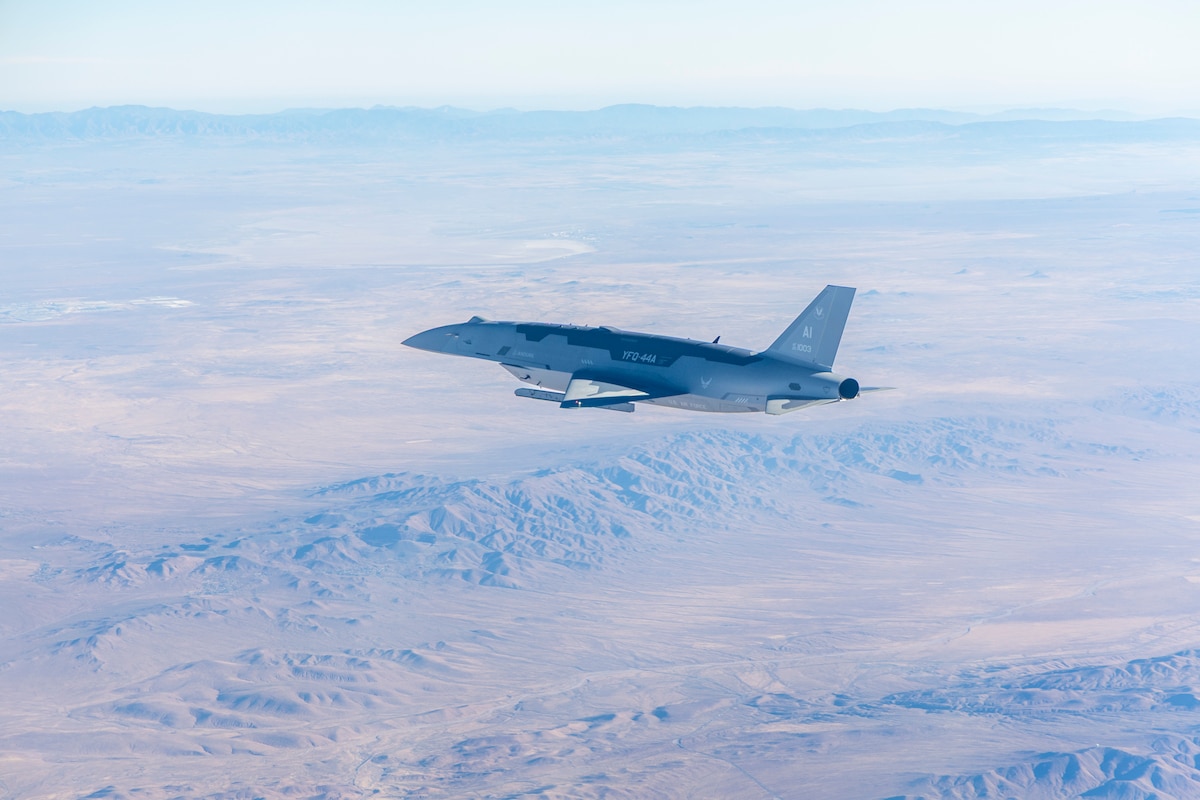
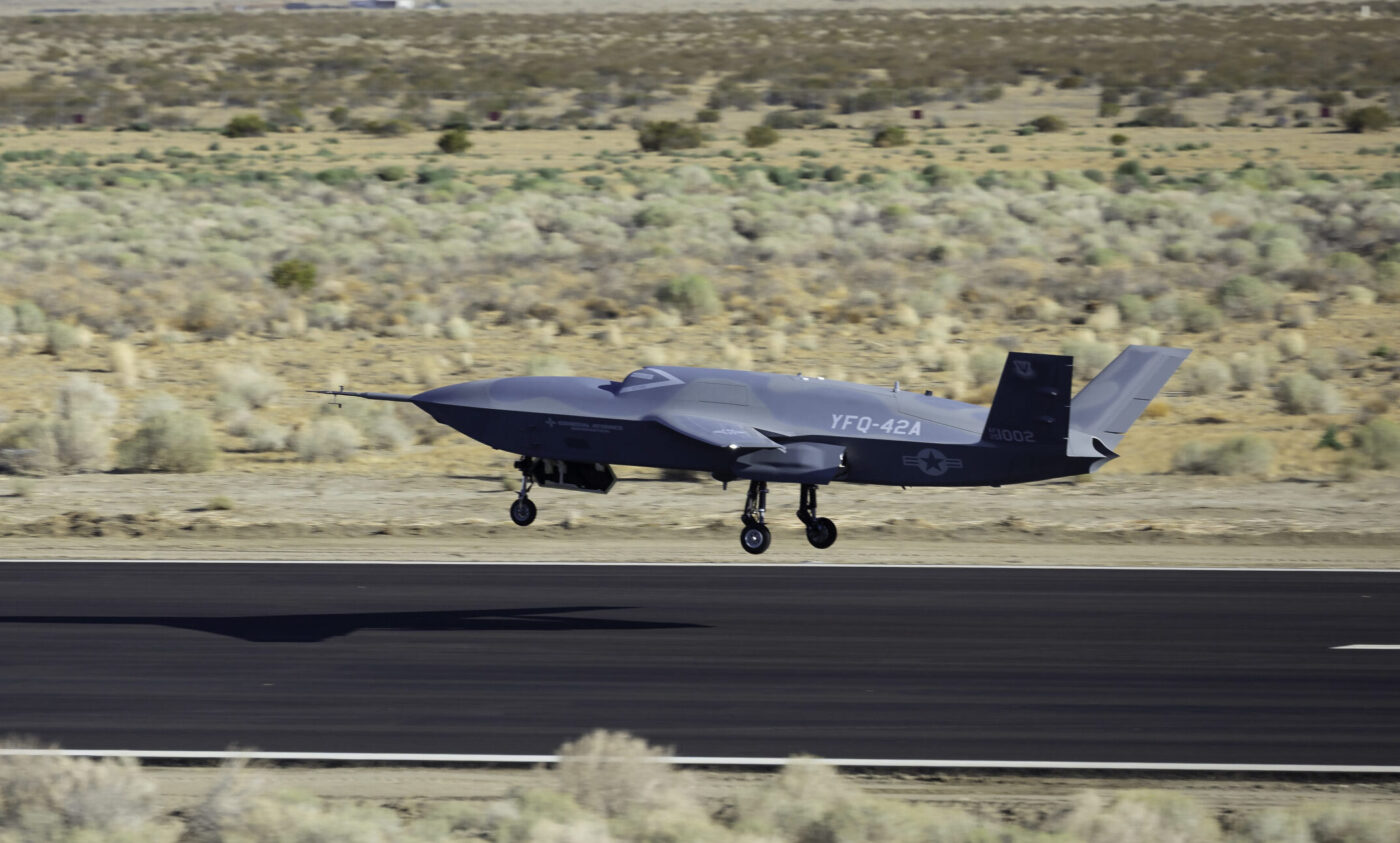
The US Air Force (USAF) has taken delivery of its first two Collaborative Combat Aircraft, Anduril’s FQ-44 Fury and General Atomics’ FQ-42 Vengeance, and sent them to the Experimental Operations Unit at Creech Air Force Base, Nevada.
The aircraft, developed under prototype designations YFQ-44A and YFQ-42A, will now be used to test how uncrewed, semi-autonomous jets can fly with crewed fighters and add cheaper mass in contested airspace.
The USAF’s CCA program aims to deploy a large number of modular, economical, and operationally valuable unmanned aircraft that can fly alongside manned aircraft to add “affordable mass” in contested environments.
“Anduril delivered the first CCA, the YFQ-44A, to the Experimental Operations Unit [EOU] last month, and General Atomics delivered the YFQ-42A last week,” the USAF announced on September 24. The aircraft were delivered at Creech Air Force Base, Nevada, and will now support Air Combat Command-led operational experimentation to refine how CCA will be employed alongside crewed aircraft in contested environments, the USAF added.
Secretary of the Air Force Troy Meink underscored the importance of putting the systems in Airmen’s hands: “Putting CCA in the hands of Airmen is how we build the operational future of this program. Anduril’s Fury and General Atomics’ Vengeance deliveries show we can move at incredible speed, compete, and deliver cost-effective combat power to the force.”
The sentiment was echoed by the Chief of Staff, Gen. Ken Wilsbach, who said, “We’re thrilled to welcome Fury and Vengeance to the experimental operational unit. Our Airmen are excited to see what Collaborative Combat Aircraft can do.”
CCA are now in the hands of Airmen at Creech AFB! @anduriltech Fury & @generalatomics Vengeance deliveries prove we can move fast and deliver cost-effective combat power. @aircombatcmd https://t.co/rHkPatMOCv
— Office of the Secretary of the Air Force (@SecAFOfficial) September 24, 2026
Notably, the program has advanced at a pace rarely seen in modern combat aircraft development.
The deliveries were secured in just over two years after the service down-selected the two contractors in April 2024, and within a year of the two aircraft’s maiden flights. Factors like early operator involvement, open competition, software-defined autonomy, and parallel production preparation have compressed timelines.
In July, an Anduril YFQ-44A fired an AIM-120 AMRAAM at a simulated target over the Mojave Desert after taking off from Edwards Air Force Base. The Air Force called it the first CCA live-fire event; some accounts said the missile was inert.
A human operator kept weapons-release authority. That same month, the service ran a separate Agile Combat Employment exercise with both CCAs at Creech Air Force Base, Nevada, to move the aircraft out of a sterile test setting and into more realistic warfighter use, as the EurAsian Times reported.
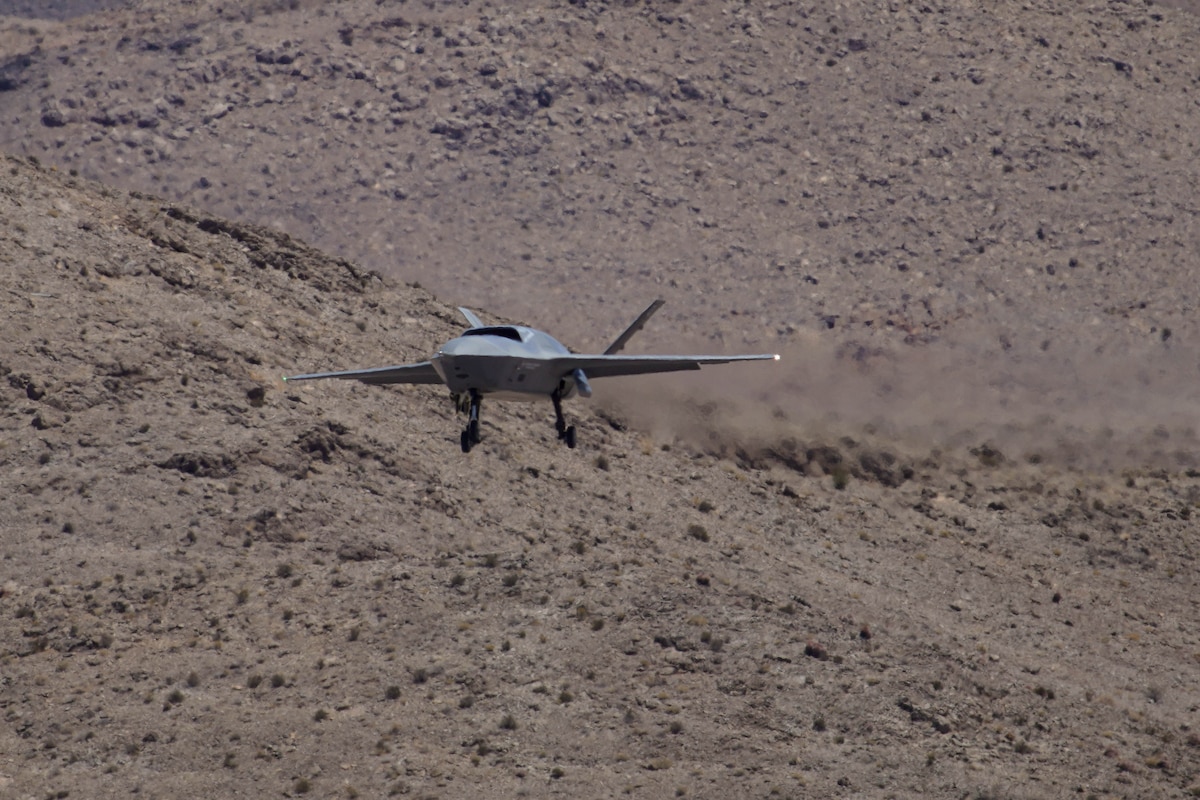
During the ACE exercise, Air Force operators were apparently already running mission autonomy flights of the YFQ-44A without Anduril personnel in the loop.
Now that the service has officially received the aircraft, the Air Force personnel are expected to fly and operate the CCAs with increasing autonomy, building the operational playbook for eventual combat use.
The delivery will allow the EOU to develop tactics, techniques, and procedures (TTPs) for collaborative missions in contested environments, including distributed basing, ACE deployments, and operations from austere locations—informing training, sustainment, manpower, and infrastructure needs.
Earlier this month, the head of the CCA EOU stated that the two CCAs will participate in their first large-scale exercise—The Emerald Flag—at Eglin Air Force Base in Florida. This will be CCAs’ “first dip of the toe in an actual force integration,” Lt. Col. Lyndon Bartlett, commander of the unit, said at AFA’s Air, Space & Cyber conference.
“That will, in [my] mind, be the first time that we will ever do some CCA end-to-end kill chain live,” Bartlett said. “That’s the first time we’ll ever be integrated in a fourth- and fifth-gen combined [offensive counter-air] push. It’ll be small, but those types of building blocks are where, I think, you get the intangibles like trust in the CCA.”
In June, the Air Force awarded production contracts for the two Increment 1 aircraft. The service later named them FQ-42 Vengeance, built by General Atomics, and FQ-44 Fury, built by Anduril. Vengeance replaced General Atomics’ earlier company name, Dark Merlin. YFQ-42A and YFQ-44A were the prototype designations.
More recently, USAF Secretary Meink stated that the service aims to have at least 500 CCAs in service by 2032 in his speech at the Air & Space Forces Association’s 2026 Air, Space & Cyber Conference. “Today, the first FQ-42 and FQ-44 increments are already rolling off the assembly line,” he said. “They’ll be performing many of the same missions that we do with manned fighters today,” he added.
Earlier, as Indian Air Force veteran Air Marshal Anil Chopra (retd) told EurAsian Times: “While the combat aircraft features such as agility remain important, they have become less consequential. Occasions for close-combat engagements are reducing. Long-range beyond-visual-range (BVR) combat requires sensors and weapons that allow ‘see first, shoot first, hit first’ ability.”
“Drones and unmanned platforms can now provide high-exposure close air support. The ability to conduct long-range precision strikes has become increasingly important. Exposing expensive manned aircraft to mobile air defenses will be risky. Air denial rather than air superiority will be easier to achieve,” Chopra added.
USAF Is Inducting CCA For Combat Of The Future
CCAs are jet-powered, semi-autonomous uncrewed aircraft designed to operate in manned-unmanned teaming (MUMT) configuration with crewed fighters such as the F-35, F-22, and the sixth-generation F-47. The CCAs are not meant to replace manned jets but to serve as essential force multipliers under the broader “affordable mass” concept, which focuses on acquiring low-cost platforms to overwhelm and overpower the adversary.
The anticipated cost of the CCA drones the USAF is acquiring is likely between US$25 million and US$35 million apiece, about one-third the price of an F-35 stealth fighter, which costs US$80 million to US$115 million depending on the configuration.
The idea is that using low-cost, attritable drones to support expensive manned aircraft will increase the manned platform’s survivability and mission success, particularly when facing near-peer adversaries like China and Russia, or even enemies like Iran, in a contested environment.
These CCAs will mostly function as airborne “missile trucks” during their initial deployment, flying in formation with crewed jets to provide extra firepower, although they are being modified for other combat roles to become true teammates for advanced manned jets.
CCAs can carry modular combinations of sensors, weapons, electronic warfare systems, and other payloads, enabling a range of combat roles for the next war the USAF may face. In air-to-air engagements, for instance, they carry missiles such as the AIM-120 to extend the formation’s reach, add extra missile rails, and engage threats while allowing the manned fighter to remain farther from the highest-risk areas.
Additionally, they can serve as forward sensors for intelligence, surveillance, and reconnaissance (ISR) missions, and for targeting, detecting, and tracking adversaries early enough to create first-look and first-shot advantages.
These adjunct aircraft could also be deployed for electronic warfare and suppression of enemy air defenses, jamming or deceiving radars, provoking defenses to reveal their locations, or absorbing incoming fire as attritable assets.
The recent conflict with Iran has highlighted the importance of CCAs.
A May 2026 Congressional Research Service report counted 42 American aircraft lost or damaged in Operation Epic Fury. That total included combat shootdowns, ground damage, mishaps, aircraft destroyed to prevent capture, and friendly fire.
Many of the losses were MQ-9 Reapers. Four F-15Es were lost: three to friendly fire over Kuwait, and one F-15E shot down over Iran on April 3. Supporters of the CCA program argue that cheaper uncrewed aircraft could have absorbed some of that risk. That remains an argument from the war, not evidence that Fury or Vengeance would have changed the outcome.
In high-end combat against near-peer adversaries like China, which has a formidable Anti-Access/Area-Denial (A2/AD) network along its coastline, CCAs could provide a decisive advantage.
For example, an adversary’s radars, missiles, and command systems can only process a limited number of simultaneous threats. Thus, dispersing multiple CCAs alongside manned fighters—such as the F-35, F-22, and bombers—from varied directions and altitudes will force the enemy to expend resources shooting down these drones. This will impose high costs, create battlespace chaos, and reduce attrition of expensive crewed aircraft.
These CCAs can also operate tens or hundreds of kilometers ahead of the main formation, expanding sensor coverage and weapon-employment ranges and producing high-quality tracks before manned fighters enter the most hazardous areas. This will increase overall lethality while safeguarding pilots and valuable assets.
Since these platforms are designed to be relatively risk-tolerant, they can lead penetrations into contested airspace like China’s, serve as decoys, or absorb enemy fire, lowering manned-fighter losses. Furthermore, deploying CCAs will also let less-stealthy aircraft, such as the F-15 (shot down by Iran during the hostilities earlier this year) and F-16, contribute more effectively in high-threat environments.
The CCAs could become the vanguard of the Agile Combat Employment strategy, which the USAF has emphasized in response to China’s A2/AD capabilities. ACE prioritizes rapidly dispersing aircraft across a network of smaller airfields to reduce vulnerability.
CCAs have reduced logistical footprints and simpler maintenance requirements, as seen in ACE exercises. They achieved very low maintainer-to-aircraft ratios and quick turnaround times, including hot reloads estimated in minutes. These CCAs can operate from scattered, remote areas, making it harder for an adversary to target US airpower on the ground and allowing them to continue generating sorties even under attack.
The portable command-and-control systems allow tasking from multiple nodes, supporting disaggregated control that reduces manpower demands.
In a peer conflict, the USAF could pair one or more crewed fighters with several specialized CCAs performing complementary tasks at the same time—one sensing and targeting, another conducting electronic attack, a third carrying weapons, and a fourth acting as a decoy or relay. This will create a more flexible, resilient, and lethal team that multiplies the effectiveness of limited numbers of expensive manned aircraft.
CCAs essentially change the calculus of air superiority in favor of the side that fields them at scale by transforming a small number of highly skilled pilots into commanders of larger, more adaptable, and more attritable combat teams. Therefore, the deliveries at Creech move that vision from concept and prototype into the hands of the operators who will ultimately employ them in combat should they be called into one.
- Contact the author at sakshi.tiwari13 (at) outlook.com
- Follow EurAsian Times on Google News