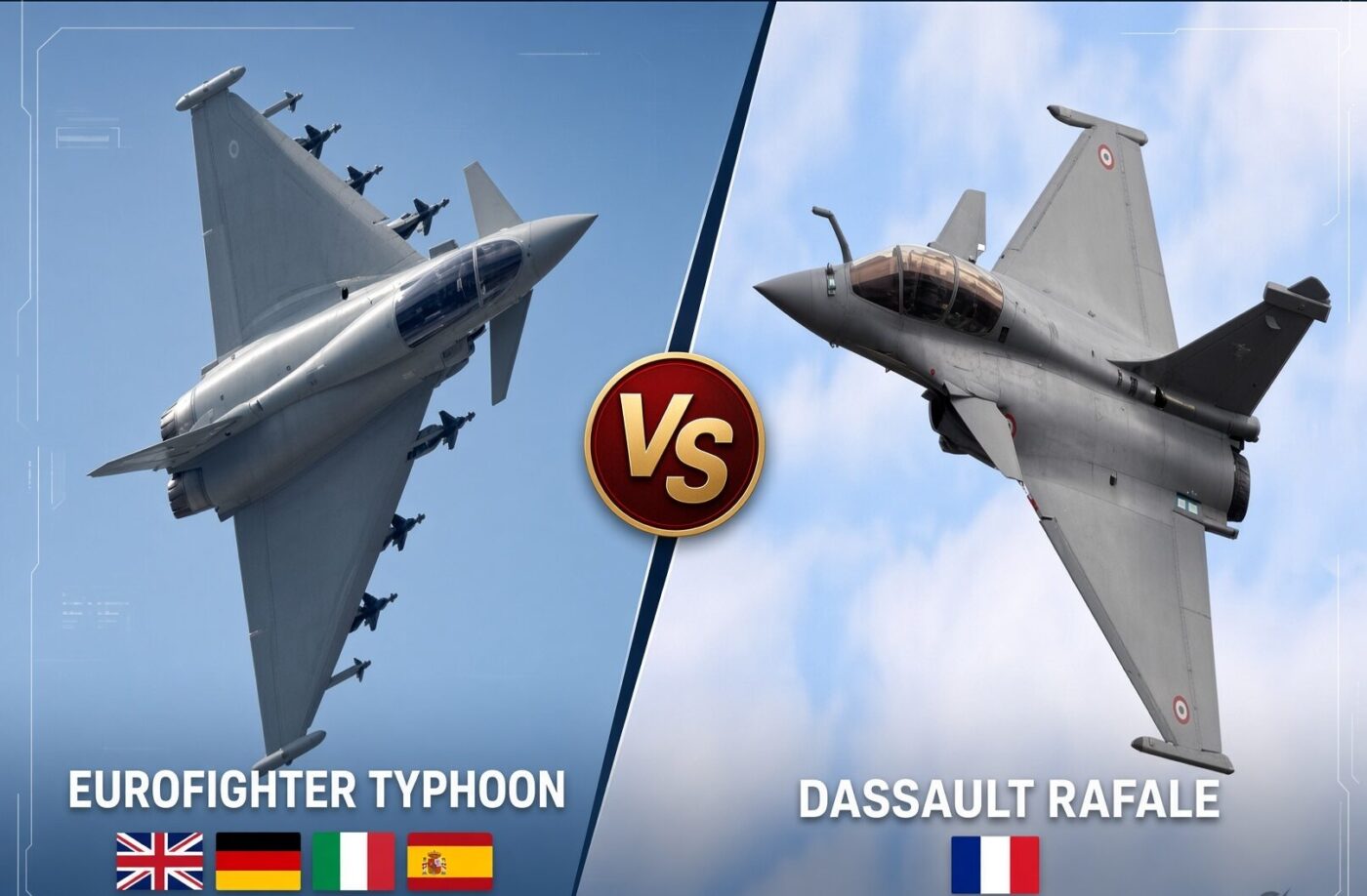
For decades, the Eurofighter Typhoon and the Rafale have competed for export orders. Airbus and Dassault briefly tried the opposite — partnering on Europe’s next-generation FCAS fighter — until that project collapsed. Now they are back as rivals, competing for Portugal’s aircraft deal.
After initially favoring the F-35A to replace its F-16A/B fleet, Defense Minister Nuno Melo said in March 2025 that Lisbon also had to weigh European options, citing strains in US–European relations and doubts over the predictability of American weapon systems.
“There are several options that must be considered, particularly in the context of European production,” Defense Minister Nuno Melo said at the time.
Although Portugal has yet to launch a formal tender to replace its F-16M fighter jets, two of Europe’s largest aviation behemoths—Dassault Aviation and Airbus Defense and Space—seem to be jostling to seize the opportunity. Interestingly, Melo said he wants competition among manufacturers to maximize benefits for the country and its industries.
Meanwhile, Saab is also in the race. The Swedish manufacturer has signed an industrial memorandum with AED Cluster Portugal covering the Gripen E, putting it alongside the Rafale, Eurofighter Typhoon and F-35 as a candidate to replace the F-16s.
Airbus Makes an Alluring Eurofighter Pitch
Airbus said on September 24 that it intends to submit an unsolicited proposal for the Eurofighter Typhoon to Portugal in late October or early November.
The proposal will include “public and private financing solutions for Portugal to alleviate the payment plan,” along with military cooperation and industrial engagement, Ivan Gonzalez Exposito, the Eurofighter campaign manager for Portugal, told the reporters. However, he did not explicitly state whether the proposal would include an offer for local manufacturing.
Meanwhile, Jose Luis de Miguel, Head of Airbus Defense & Space for Europe, said that the country would benefit from stronger defense, political, and industrial ties with important European partners in the Eurofighter program. The Eurofighter is produced by a four-nation consortium consisting of the United Kingdom, Germany, Italy, and Spain, and built jointly by industry partners including Airbus, BAE Systems, and Leonardo.
Airbus describes the twin-engine, canard-delta-wing multirole fighter as the world’s most advanced 4.5-generation combat aircraft.
Speaking to the press, Gonzalez Exposito contended that the Typhoon better matches Portugal’s operational profile than the stealth-oriented F-35. The Portuguese Air Force’s primary missions center on air policing, NATO quick-reaction alert duties, and defending national airspace and waters rather than deep-strike offensive operations—the F-35’s specialty.
“For that, the Eurofighter is the ideal solution,” he said, calling the aircraft “the best air superiority fighter in the world.”
Notably, the early, unsolicited bid reflects Airbus’s determination to shape the contest before a formal process begins.
Nonetheless, the company has been circling Portugal’s defense sector for nearly a year, eyeing a potential contract. In October 2025, Airbus inked a Memorandum of Understanding (MoU) with the Portuguese Cluster for Aeronautics, Space and Defense Industries (AED) to work together on an “industrial proposition” for the country’s fighter replacement program.
“In a time when European sovereignty and industrial autonomy are at the forefront of our strategy, Airbus strongly believes that the Eurofighter is the best option for this replacement,” Jose said at the time.
Airbus Defence and Space and the Portuguese Cluster for Aeronautics, Space and Defence Industries (AED Cluster Portugal) have signed a Memorandum of Understanding (MoU) to identify cooperation opportunities ahead of the upcoming fighter fleet replacement in the country. 🇵🇹
In… pic.twitter.com/4yT0lAuaV9
— Airbus Defence (@AirbusDefence) October 27, 2025
Airbus has been actively trying to leverage the existing association with Portugal, which already operates 11 Airbus C295 military transport aircraft, five of which are configured for maritime patrol.
“In the framework of this agreement, Airbus and AED have laid the groundwork to launch a series of studies to create a valuable industrial proposition to replace the current Portuguese F-16 fleet with a truly European solution, the #Eurofighter program,” Airbus Defense wrote in a post last October.
Dassault Rafale Enters The Fray
A day before Airbus told reporters it was gearing up to submit a bid for the Eurofighter Typhoon to Portugal, French aerospace giant and Rafale manufacturer Dassault Aviation signed a memorandum of understanding (MoU) with Portuguese industry, joining the contest to replace Lisbon’s F-16.
On September 23, 2026, Dassault said that it had reached a deal with AED Cluster Portugal, a trade group tasked with creating an aerospace ecosystem in the nation. “Dassault Aviation, representing its RAFALE partners, Thales and Safran, signed with AED Cluster Portugal, Portugal’s association for the aeronautics, space and defense industries, a Memorandum of Understanding (MoU) to explore potential areas of cooperation between RAFALE partners and the Portuguese industrial sector, in the context of the Portuguese Air Force’s F-16 fleet renewal,” it said in a statement.
#DassaultAviation signe un accord de coopération avec l’AED Cluster Portugalhttps://t.co/KqLmAb5r5p
Dassault Aviation signs a Cooperation Agreement with AED Cluster Portugalhttps://t.co/pMxSjJAaTd pic.twitter.com/a3vGT5IIyV— Dassault Aviation (@Dassault_OnAir) September 23, 2026
“This MOU demonstrates the commitment of the RAFALE partners already established in the country to build on the existing relationship and to take cooperation with AED and Portuguese industrial partners a step further, in order to boost the Portuguese economy and strengthen the country’s sovereignty,” it added.
According to reports, the MoU follows the French government’s formal submission of Dassault’s Rafale to the F-16 replacement contest in July, a move that was previously undisclosed. No information is currently available on the proposal’s specifics, including the number of aircraft, unit price, weapons/sensors, training, support, financing, or offsets. However, it probably covers the Rafale F4 variant and emphasizes a long-term evolution path, including the ongoing F4 upgrades and the F5.
France has actively positioned its systems as a premier European alternative to US platforms since several countries, including Portugal and Canada, began reassessing American equipment.
Moreover, Dassault CEO Éric Trappier said in a March 2025 interview with Le Journal du Dimanche (after Portugal announced it was shelving the F-35) that the company was ready and eager to offer the Rafale to Portugal as an F-35 alternative.
“We really want to offer our aircraft to Portugal… It would have the same interoperability capabilities that we have within the Alliance, so it seems logical,” he said.
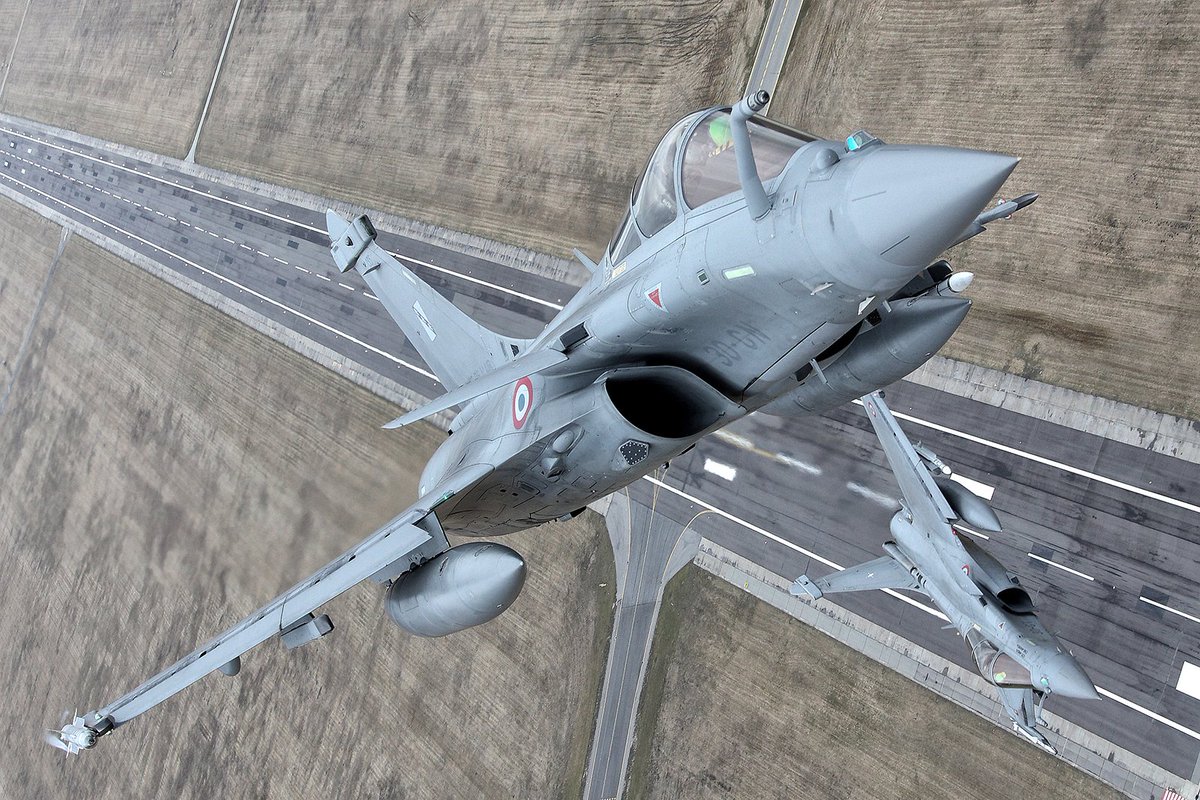
In June 2025, Trappier said at a Senate hearing that Dassault was “working a lot with Portugal to try to convince it to choose the Rafale,” noting that Portugal had not yet signed an F-35 order despite being close to doing so, as French media reported.
Rafale vs Eurofighter Typhoon
Dassault Aviation’s Rafale and the Eurofighter Typhoon are Europe’s two flagship 4.5-generation jets and have competed globally for lucrative aircraft contracts.
India’s Medium Multi-Role Combat Aircraft (MMRCA) was arguably the biggest showdown between the European defense giants. After field trials eliminated the F-16, F/A-18, MiG-35 and Gripen, only the Rafale and Typhoon remained.
In January 2012, India named Dassault the lowest bidder on both acquisition price and life-cycle cost for 126 aircraft. Even though the original deal collapsed, India acquired 36 Rafale jets in a government-to-government deal.
India later also ordered 26 Rafale-M for its Navy, which are yet to be delivered. India is also on course to acquire 114 Rafale jets from France and is contemplating joining the French-led FCAS 6th-gen fighter program. No contracts have been signed so far.
The case of Qatar was interesting. The Middle Eastern country evaluated several types in the early 2010s and then pursued a diversification strategy. In 2015, it ordered 24 Rafales for €6.3 billion; in December 2017, it added 12 more, bringing the total to 36.
The same month it signed for 24 Eurofighter Typhoons in a package worth about $8 billion. Qatar also bought F-15s (QA) from the United States. The strategy resulted in a win-win for both European firms and American defense giant Boeing.
Meanwhile, Switzerland evaluated four warplanes: the F-35A, Rafale, Eurofighter Typhoon and Super Hornet. Switzerland scored the F-35 highest on effectiveness, product support, and overall value while also quoting the lowest 30-year cost. They opted to acquire F-35As while sidelining both Rafale and Eurofighter jets.
In the UAE’s case, Abu Dhabi came close to buying Rafales around 2009–2011 but rejected the French offer as uncompetitive. It later discussed up to 60 Eurofighter Typhoons with BAE Systems; those talks ended in 2021.
After being “left hanging” for the F-35 stealth jets, the UAE signed a deal for 80 Rafales in December 2021, valued at €16–17 billion. It was Dassault Aviation’s biggest and most lucrative contract.
Meanwhile, Finland sought 64 aircraft to replace its Hornets. The five official bidders were the F-35A, Super Hornet (plus Growlers), Rafale, Eurofighter Typhoon, and Gripen E. Rafale and Typhoon failed to meet mandatory threshold criteria. The F-35 was judged the strongest overall system and was selected.
In a nutshell, in the two most recent European competitions (Switzerland and Finland), the F-35 outperformed both the Rafale and the Eurofighter Typhoon. Since the F-35 is out for Portugal, it will be interesting to see who emerges the winner this time.
- Contact the author at sakshi.tiwari13 (at) outlook.com
- Follow EurAsian Times on Google News