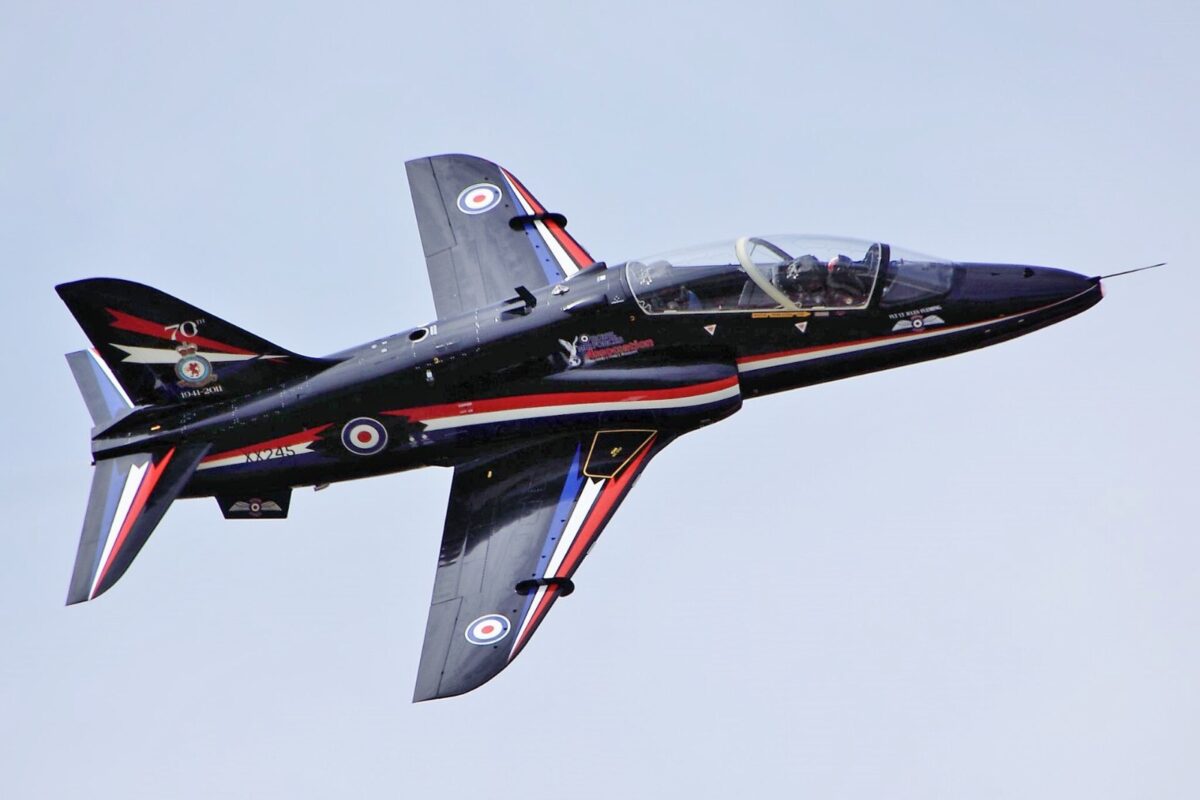
In a major setback for the British Royal Air Force (RAF), a Hawk T2 trainer aircraft crashed during a routine training mission, worsening problems for a fleet that the service has struggled to keep airborne for years.
A Hawk T2 advanced jet trainer crashed shortly after takeoff from RAF Valley on 23 September 2026, marking the first loss of the type.
“An incident involving an RAF T2 Hawk aircraft, flying out of RAF Valley, occurred near Anglesey. An investigation is underway, and we will not comment further at this time,” an RAF spokesperson said in a statement.
While the aircraft plummeted to the ground at nearby Pencarnisiog, both pilots managed to eject in time over Anglesey in north Wales and were treated for minor injuries.
In a video that surfaced on social media, the aircraft appears to ascend unevenly, then roll, descend violently, and erupt in a fireball, sending plumes of thick black smoke into the air. The aircraft reportedly crashed just over a mile from RAF Valley, which hosts No. 4 Flying Training School, where fighter pilots train on Hawk T2 and Texan T1 aircraft.
The cause of Wednesday’s accident has not been established.
🚨 WATCH: The moment an RAF training jet crashes shortly after take-off at RAF Valley pic.twitter.com/Pnc71YEuW5
— Politics UK (@PolitlcsUK) September 23, 2026
The Hawk T2 is a two-seat jet trainer aircraft used primarily by the RAF for advanced fast-jet pilot training. It is a fully aerobatic, low-wing, transonic trainer designed to prepare pilots for front-line combat aircraft such as the Eurofighter Typhoon and the F-35 Lightning II fighter.
The trainer features a modern glass cockpit with advanced avionics, synthetic radar simulation via datalink, and sensor simulation for realistic electronic warfare (EW) training against threats like surface-to-air missiles (SAMs). The Hawk T2’s controls and systems closely mimic those of modern fighters.
The Hawk T2 entered service in 2009 and became fully operational under the UK’s Advanced Fast Jet Training program. The latest crash reduces the fleet to 27 aircraft.

After the incident, the RAF announced it was temporarily pausing Hawk fighter jet training as a “precautionary measure” while the investigation continues. This includes both the Hawk T1 (used by the Red Arrows aerobatic team) and the Hawk T2.
The Red Arrows were expected to fly at the Le Touquet Airshow in France this weekend, making the grounding a major issue. It is unclear when the flying restrictions will be lifted.
Notably, the latest accident further exacerbates the sustained issues with the Hawk T2 fleet, which has already faced prolonged serviceability challenges.
Hawk T2: Marred By Issues
The Hawk T2 has been plagued for years by serious reliability issues, with the Rolls-Royce/Turbomeca Adour Mk. 951 engine at the heart of the concern.
In 2022, for instance, engineers identified major technical faults in the engine’s low-pressure compressor module, specifically excessive blade wear and cracking. These faults forced a drastic reduction in the engine’s certified life from the original design target of roughly 4,000 hours to about 1,700 hours.
As a result, far fewer engines remained available for the fleet, which in turn limited the number of serviceable aircraft.
BAE Systems admitted to Parliament that the intended flying rate dropped to about 3,700 hours, which was half of what was contracted.
“On March 25, 2022, Rolls-Royce reported that significant technical issues had been found in the Low Pressure Compressor (Module 01) of the Adour Mk 951 engine. The result was that the 4,000-hour planned design life of each engine was reduced to a certified life of 1,700 hours,” BAE Systems reportedly told the UK government’s Defense Select Committee in January 2023. “This limitation significantly and immediately affected the number of serviceable engines available for the Hawk T2 fleet, leading to an average of eight serviceable aircraft being made available each day throughout FY22/23 and a revised forecasted outturn flying rate of approximately 3,700 flying hours, which is 50% of the contracted levels,” the response added.
In January 2023, the entire fleet was grounded briefly after a blade failure on the runway at RAF Valley. Although flying resumed after investigations, the underlying engine problems persisted.
By March 2024, 16 of the fleet’s 28 aircraft were unavailable for training.
Subsequently, senior RAF leaders, including the Chief of the Air Staff, said the service was receiving only half the training capacity it needed, forcing some pilots to travel overseas to gain essential experience.
“I worry about the fighter training lead-in that is done with the Hawk. It is the pinnacle of our flying training, but today we are not getting what we need from the Hawk; we are getting half of what we should. We have problems with the engines and the support, and frankly, I would like to replace the Hawk T2 as soon as we can,” Chief of the Air Staff, Air Chief Marshal Sir Richard Knighton, stated, without mincing words. Furthermore, the RAF top boss called for a “more relevant and more reliable” capability.
Notably, BAE Systems and Rolls-Royce reportedly worked with the training contractor Ascent to improve availability, but the fleet continued to operate under significant constraints.
The combination of reduced flying rates, longer pilot training pipelines, and the need to outsource some instruction overseas prompted the Ministry of Defense to accelerate the search for a replacement advanced jet trainer and to retire the Hawk T2 well ahead of its original 2040 out-of-service date.
In March 2025, the UK Ministry of Defense acknowledged that it was assessing alternative options for the Hawk T2. A Defense Committee report published at the time noted that while the Hawk has proved to be an “export success,” factors such as the shuttering of the production lines four years ago and the loss of associated “skills and manufacturing capability … will prove challenging and costly to regenerate.”
“The Program of Record for Hawk T2 was for an out-of-service date (OSD) of 2040, which allowed for time potentially to design and build a follow-on successor for Hawk in the Advanced Jet Training role. However, recent events have led to an investigation of Hawk output and likely performance to that OSD,” the MoD comment in the report stated.
The 2025 Strategic Defense Review recommended replacing both the Hawk T1 and the Hawk T2 with a “cost-effective” advanced and fast jet trainer. It also called for urgently revising current fast-jet flying training arrangements to optimize capacity, increase contractor use, and support overseas student training.
Beyond availability issues, the aircraft may no longer suit training for advanced combat aircraft. RAF leadership has publicly noted that the Hawk T2 no longer fully meets the requirements for preparing pilots for the more complex environments of fifth- and sixth-generation aircraft. This includes challenges related to data fusion, distributed sensors, multi-domain mission management, and the sensor-fused, networked warfare expected with the Global Combat Air Program (GCAP).
In early August 2026, the MoD formally launched market engagement by issuing a Request for Information for the Jet Training System (JTS) successor to the Hawk T2.
However, until a suitable alternative is found, the Hawk T2 remains the cornerstone of RAF pilot training, and the latest aircraft loss is likely to further strain an already stretched fleet.
- Contact the author at sakshi.tiwari13 (at) outlook.com
- Follow EurAsian Times on Google News