

China has inducted its latest land-based nuclear-capable ICBM, the Dongfeng-61 (DF-61), into the PLA Rocket Force’s routine training just 14 months after its public debut, a record timeline that underscores Beijing’s accelerated pace in fielding strategic weapons.
The land-mobile DF-61 was unveiled at the September 2025 military parade, marking the 80th anniversary of Japan’s formal surrender in World War II.
On November 5, China’s state-run CCTV showcased the DF-61 and reported that the ICBM has entered routine training.
In China, routine training implies the missile has moved beyond public display, tests, and initial induction and is now part of the PLA Rocket Force’s regular combat-oriented training cycles, including field maneuvers and repositioning between launch sites.
A military expert who spoke to CCTV underscored that DF-61’s record induction timeline was much faster than previous ICBMs, such as the DF-41, highlighting how China’s military-industrial complex was now moving through design, development, testing, and induction at an accelerated pace.
Notably, the announcement coincided with the 66th anniversary of the DF-1, the first missile in China’s indigenous Dongfeng (DF) series.
The DF-1, launched on November 5, 1960, was a short-range surface-to-surface missile reverse-engineered from the Soviet-made R-2 missile. Gradually, China extended the range of DF-series missiles, developed their guidance systems, added nuclear warheads, and even developed ICBMs.
However, as with many Chinese strategic weapons systems, despite the DF-61’s public debut last year, its induction into regular training, and its critical role in China’s nuclear triad, very little officially confirmed information exists on the missile’s key metrics.
In fact, most of what we know about this crucial Chinese ICBM comes from open-source intelligence.
Therefore, it is critical to separate officially confirmed details from open-source assessments and speculation in order to clearly distinguish what has been disclosed from what is merely assumed about the missile’s capabilities.
DF-61’s Rapid Induction Into PLA Rocket Force
From its public display in September 2025 to its induction into the PLA Rocket Force’s regular trials, the DF-61 missile took only 14 months.
Military commentator Shao Yongling said the rapid transition suggests the missile had already completed the required procedures before its public unveiling.
Another factor behind the swift induction could be that the DF-61 shares many similarities with the DF-41, which the PLA Rocket Force has deployed for many years.
In fact, many commentators treat the DF-61 as a variant or upgrade of the DF-41, first tested in 2012 and entering serial production in 2019. Design commonality with the earlier DF-41 helped production capacity and faster crew training.
The DF-61 is compatible with existing command, communications, and logistical support networks, while the Rocket Force’s accumulated experience organizing and conducting ICBM training has helped units become familiar with the new equipment more quickly, Shao noted.
However, as the recent CCTV story about DF-61’s induction into the PLA Rocket Force’s regular training shows, most of what we know about the missile comes from carefully controlled images, displays, and statements released by China’s state-controlled media.
Contrary to popular belief, China still has not disclosed most of the DF-61’s technical specifications, such as its range, warhead load, accuracy, and propulsion method.
To assess the missile’s capabilities realistically, it is important to distinguish what is officially disclosed about the DF-61 from what is assumed based on open-source information.
What We Know About the DF-61
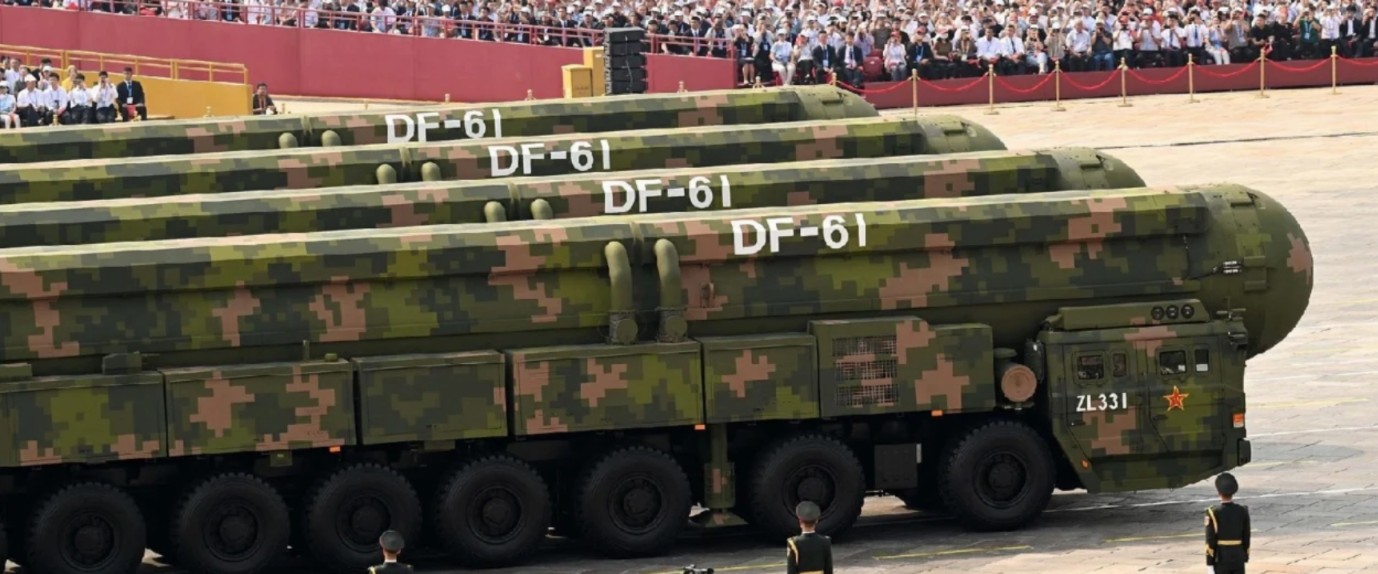
The DF-61 is a land-based intercontinental ballistic missile (ICBM). China first displayed it in September last year during the Victory Day parade in Beijing.
It was displayed alongside the air-launched JL-1 (Jinglei-1), the submarine-launched JL-3 (Julang-3), and the DF-31BJ land-based ICBM.
China’s state-run media framed it as the first concentrated display of China’s land-, air-, and sea-based nuclear triad. Therefore, the DF-61 is nuclear-capable.
It is a road-mobile system displayed on large transporter-erector-launchers (TELs). Chinese commentators have repeatedly stressed that the missile’s mobility offers improved survivability compared to silo-based systems.
It creates a targeting problem for potential adversaries and provides Beijing with stronger counter-strike options.
The DF-61 shares many visual elements with its predecessor, the DF-41. For instance, both ICBMs have near-identical TELs.
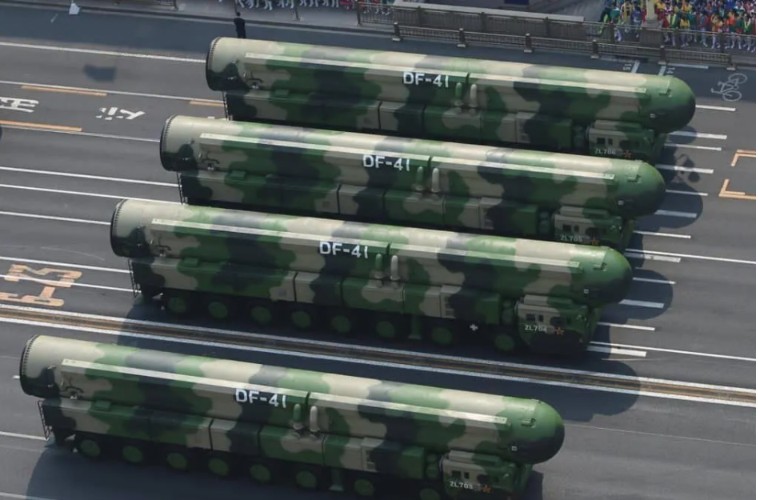
In fact, much of the publicly available technical information on the DF-61 is inferred from its similarity to the DF-41.
For instance, China has not disclosed the DF-61’s range. However, Chinese commentators have given a range of 12,000 to 15,000 kilometers for the DF-41 ICBM.
According to CSIS’s Missile Threat, the DF-41 “has an operational range of up to 15,000 km,” making it China’s longest-range missile.
For the DF-61, Chinese commentators have given a range of 18,000 km. This means that the DF-61 can strike anywhere in the US. However, Chinese sources have not officially confirmed its range.
Similarly, while China has not disclosed the propulsion system, the DF-61 is assumed to be a three-stage solid-fuel missile, based on its similarity to the DF-41 and most modern Chinese mobile ICBMs.
Solid-fuel missiles are pre-fueled and can be stored in a “ready-to-go” state for years. They can be launched on a moment’s notice or within seconds during a crisis.
It is assumed that the DF-61, just like the DF-41, has multiple independently targeted warheads (MIRV) capability.
However, China has never confirmed this for either the DF-61 or the DF-41. Still, DF-41’s MIRV capability is not in doubt. In fact, on August 6, 2015, U.S. defense officials confirmed that China had flight-tested the DF-41 with two independently targeted warheads.
It is also unclear how many warheads it can carry. Assessments vary from 3 to 10 warheads, but some commentators have also estimated 8 to 12 warheads. According to Missile Threat, the DF-41 can carry up to 10 nuclear warheads.
We also do not know the DF-61’s Circular Error Probability (CEP). However, according to the Missile Defense Advocacy Alliance (MDAA), the DF-41 has a CEP of 100-500 meters.
China has also not disclosed the guidance systems for the DF-61 or DF-41.
According to Missile Threat, the DF-41 “likely uses an inertial guidance system (INS) with stellar or satellite updates.” We can assume the DF-61 uses a similar guidance system.
This withholding of technical details is a tried-and-tested pattern for China.
Beijing reveals the designation, land-based mobile ICBM role, its placement in the nuclear triad, and its training and maturity status.
However, key technical details remain unreleased and are often inferred from statements by Chinese military commentators in state-controlled media.
This means adversary countries often struggle to make precise threat assessments.
What we know about some of China’s latest and frontline nuclear-capable ICBMs is a strange amalgam of official disclosures, visual assessments based on tightly controlled image releases, statements attributed to experts in Chinese state-controlled media, and open-source intelligence.
- Sumit Ahlawat has over a decade of experience in news media. He has worked with Press Trust of India, Times Now, Zee News, Economic Times, and Microsoft News. He holds a Master’s Degree in International Media and Modern History from the University of Sheffield, UK.
- He can be reached at ahlawat.sumit85 (at) gmail.com