The Eurofighter Typhoon consortium appears hopeful of securing another order for its multi-role aircraft from Saudi Arabia, even as the Royal Saudi Air Force (RSAF) appears to prefer the American-made F-15 jets for combat operations against the Houthis.
An infographic presented by the consortium—comprising industry partners from the UK, Germany, Italy, and Spain—at the International Fighter Conference in Munich this week outlined opportunities for more than 200 additional multirole Eufofighters.
The infographic shows a second-batch order for Turkey of 24 aircraft, a 54-aircraft order from Saudi Arabia, and an existing order for 36 aircraft to Austria. It also lists more than 150 aircraft under the “other opportunities” category, bringing the total to more than 200.
However, these figures represent potential demand rather than signed contracts.
Notably, the number of possible Eurofighter exports has surpassed the 134 aircraft reported at last year’s 2025 International Fighter Conference. The uptick also shows the consortium remains hopeful of a sustained sales resurgence after a long period of losing contests to the Lockheed Martin F-35A.
The infographic does not name the other prospective customers behind its 200-strong demand projection. However, we know the Eurofighter Typhoon has been pitched to countries like Poland, Portugal, the Philippines, and Bangladesh, all of which are looking for a new multi-role fighter.
In August this year, aerospace and defense manufacturer Leonardo, which is part of the consortium alongside BAE Systems and Airbus, stepped up its pitch to sell the Eurofighter Typhoon to the Philippines, offering a new customization option to meet Manila’s requirements, as the EurAsian Times reported at the time.
A month later, Airbus said on September 24, 2026, that it intended to submit an unsolicited proposal for the Eurofighter Typhoon to Portugal, which is looking to replace its aging F-16 Fighting Falcons.
The proposal will include “public and private financing solutions for Portugal to alleviate the payment plan,” along with military cooperation and industrial engagement, Ivan Gonzalez Exposito, the Eurofighter campaign manager for Portugal, told the reporters at the time.
Poland, meanwhile, is considering a contract to purchase 32 new fighter jets to meet a program requirement for air superiority, although it may choose to press ahead with an F-35 purchase after obtaining a $4 billion Foreign Military Financing (FMF) loan from Washington in September this year.
Meanwhile, Bangladesh earlier signed a letter of intent to begin negotiations on a Eurofighter agreement, as previously reported by the EurAsian Times, although the country is also said to be considering the Chinese J-10C.
Of the two definitive customers mentioned in the infographic, Turkey signed a deal in October 2025 to buy 20 Eurofighter Typhoon fighter jets from the United Kingdom and has since been discussing purchasing an additional two dozen fighters, which will bring its Turkish Air Force Typhoon fleet to 48.
Ankara is also pursuing used Typhoons from Qatar and Oman to accelerate capability.
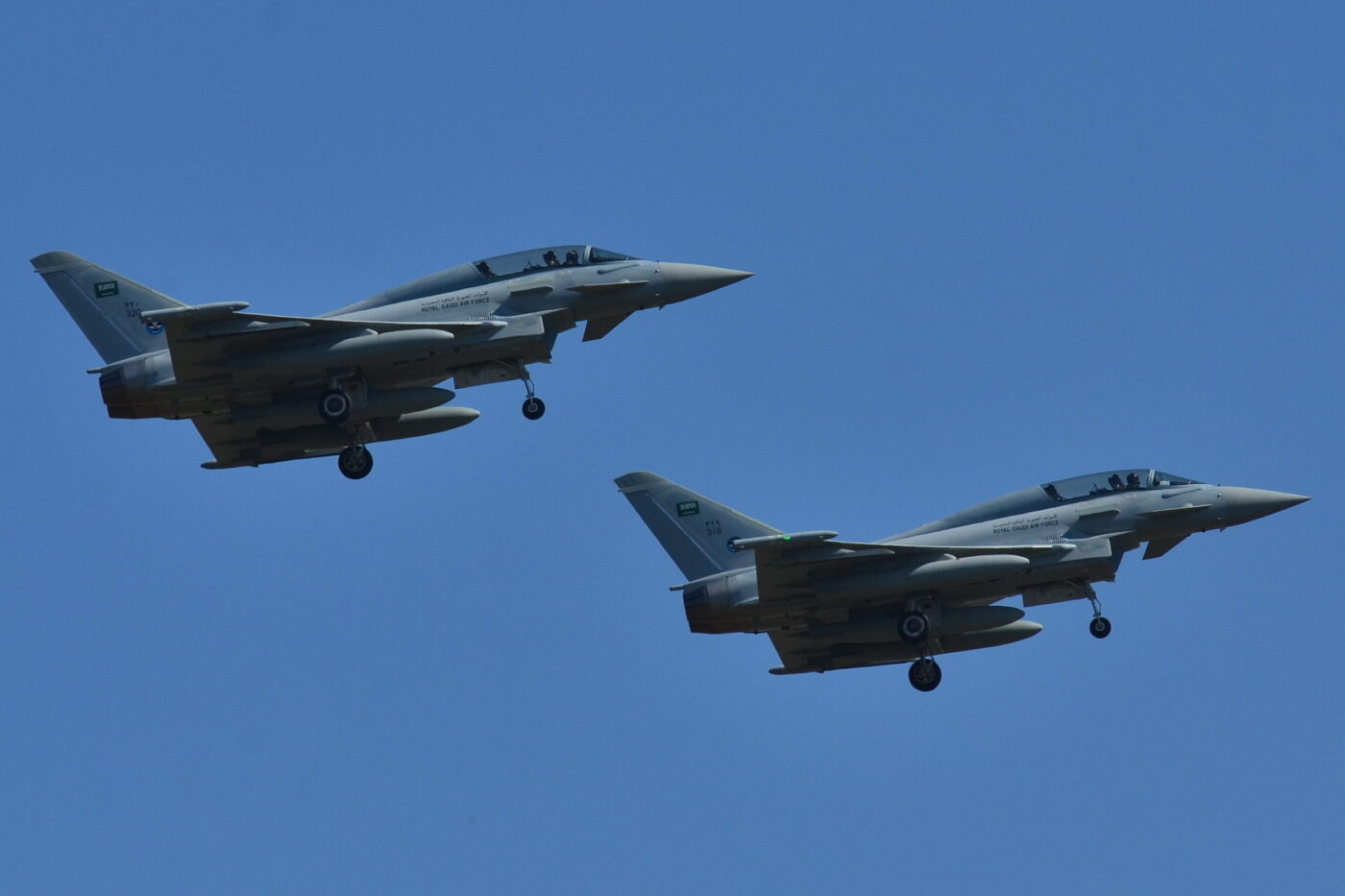
The Kingdom currently operates 72 Typhoons, with the Yemen-based Houthis claiming the downing of one jet last month and heightened tensions. Therefore, acquiring an additional 54 jets would bring the Kingdom’s Typhoon fleet to 125, retaining its position as the largest operator outside Europe.
However, despite being the Eurofighter’s largest export buyer, the Royal Saudi Air Force routinely prefers the F-15SA for combat operations.
Why F-15 Scores Over Eurofighter?
The RSAF operates one of the most capable and diverse fighter fleets in the Middle East, which is centered on two primary modern jets: the Boeing F-15SA (Saudi Advanced) and the Eurofighter Typhoon.
While both aircraft have seen extensive combat employment—particularly in operations against the Houthis—the F-15 is believed to be the preferred choice for high-intensity operations.
Currently, the RSAF’s Eurofighters are hugely outnumbered by the American-origin F-15s.
According to publicly available information, the service operates 84 new-build F-15SAs delivered between 2016 and 2020, supplemented by roughly 68 older F-15S aircraft upgraded to a near-identical F-15SR standard. This brings the combined advanced Eagle fleet to nearly 150 aircraft.
The Eurofighters form the RSAF’s second major multirole jets, with 72 units. This numerical disparity is believed to be a major factor shaping operational preferences.
With more than twice as many advanced F-15s available, commanders can generate higher sustained sortie rates without excessive strain on a single type. Therefore, the F-15SA fleet forms the backbone of high-tempo strike operations, while Typhoons serve as a complementary high-performance asset, often tasked with air superiority, defensive counter-air, or precision strike missions.
Another major factor favoring the F-15SA for combat operations, especially against non-state actors like the Houthis, is its payload and strike capacity. The F-15’s design prioritizes heavy payload and long-range strike—attributes that align closely with the demands of operations against dispersed Houthi targets deep in Yemeni territory.
The aircraft features up to 11 external hardpoints and a maximum weapons payload of 13,000–13,400 kilograms. It routinely carries mixed loadouts including AIM-120 AMRAAMs, AIM-9X Sidewinders, AGM-88 HARMs for suppression of enemy air defenses (SEAD), Joint Direct Attack Munition (JDAM) and Paveway guided bombs, AGM-84 Harpoon or SLAM-ER standoff weapons, and sensor-fuzed munitions.
By contrast, the Eurofighter Typhoon’s maximum external payload is around 9,000 kilograms. While the Typhoon also carries a sophisticated mix of air-to-air weapons such as the Meteor, AMRAAM, IRIS-T, and AIM-9 Sidewinder, and air-to-ground weapons such as Paveway IV, Brimstone, and Storm Shadow, its lighter payload and fewer stations limit the volume of munitions it can deliver in a single sortie compared to the F-15SA.
The F-15SA has a longer range than the Typhoons, which may be another important factor in campaigns against the Houthis.
F-15SA Conformal Fuel Tanks substantially increase the combat radius, enabling deeper strikes and longer loiter times without immediate tanker support. By contrast, Typhoons are supercruise-capable and agile, but tend to depend more on external tanks or aerial refueling.
The F-15SA is a more effective option for primary strike tasking in a high-tempo campaign involving repeated assaults on assets such as missile launchers, drone facilities, command nodes, and air defenses because it can carry more ordnance farther and remain on station longer. It also has a mission-system advantage over the older Typhoon variants (Tranche 2 and Tranche 3A) operated by the Royal Saudi Air Force.
Unlike most Typhoons in the Saudi arsenal, the F-15SA is a twin-seat aircraft, which is immensely valuable for complex missions as it has a dedicated weapons systems officer (WSO) who manages sensors, targeting pods, and large mixed loadouts while the pilot focuses on aircraft handling and threat avoidance.
However, these factors do not mean that the Typhoon is less advanced than the F-15.
The F-15’s range and payload make it better suited to the attritional, high-volume campaign style required against resilient, dispersed Houthi forces equipped with Iranian-supplied or locally adapted surface-to-air systems. Typhoons excel in scenarios demanding superior agility, rapid reaction air defense, or lower-payload precision strikes, but they are less often the primary “truck” for heavy ordnance delivery.
That said, both platforms have conducted extensive combat operations since hostilities with the Houthis began, as evidenced by the militia’s claims of downing both jets.
Eurofighters have performed precision strikes, including early use of Paveway IV bombs and air-defense missions, while F-15 variants have formed the bulk of deep-strike and SEAD sorties against Houthi infrastructure in the country’s rugged terrain.
Because of the long-standing relationship between Saudi Arabia and the United States, Riyadh now boasts a mature logistics, training, and sustainment ecosystem for the F-15s.
Meanwhile, the Typhoon, while supported through BAE Systems, has historically faced export and industrial hurdles. Despite this, the Typhoon’s value has not diminished in the RSAF, and the jet remains a high-end air superiority and multirole asset.
- Contact the author at sakshi.tiwari13 (at) outlook.com
- Follow EurAsian Times on Google News