Russia has steadily lost its advantage in drone warfare in Ukraine and is now reeling under the onslaught of Western-supplied drones in general and US-supplied drones in particular.
At one point, Russian innovations — such as Lancet and Kub kamikaze drones, fiber-optic cable-controlled kamikaze drones, and inexpensive long-range one-way attack drones — had given Russian forces a significant edge over Ukraine.
Now, not only has the Russian edge been blunted, but Ukrainian forces have seized the initiative using interceptor and strike drones featuring advanced US technology.
The sophistication of US-supplied drones has put Russian forces on the back foot and brought the Russian offensive in Donbas to a grinding halt.
Among the several US companies that have developed potent drones for use by Ukrainian forces is Perennial Autonomy, a company owned by Eric Schmidt, the former CEO of Google.
Two drones developed by Perennial Autonomy are giving Russian forces a hard time — the Merops interceptor drone and the Hornet strike drone.
Merops AS-3 Surveyor
The Merops AS-3 Surveyor has reportedly proven effective in intercepting Russian drones.
The fixed-wing Surveyor interceptor was first combat-tested in Ukraine around June 2024. By late 2025, it had reportedly achieved over 1,900 intercepts. In some sectors, it is claimed to have brought down roughly 40% of Russian Geran drones. Recent reports claim 4,000 successful interceptions of Russian drones.
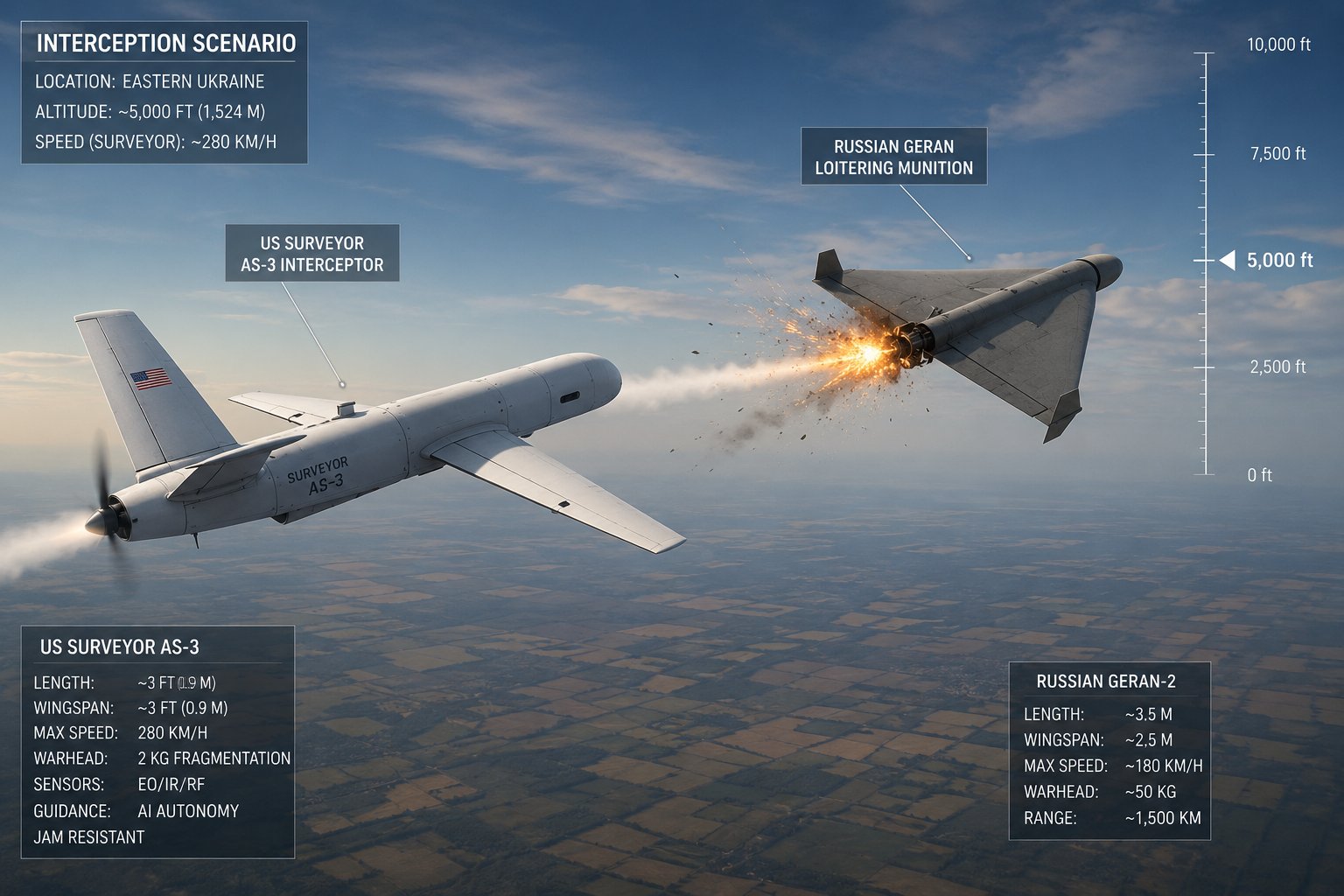
The propeller-driven drone is roughly three feet long and can reach a maximum speed of 280 km/h.
It can be launched pneumatically from the bed of a standard pickup truck alongside a ground control station. The entire system is highly portable and requires minimal training.
Its success in Ukraine reportedly prompted the US Army to order 13,000 units shortly after the US and Israel launched an unprovoked large-scale aerial attack on Iran on February 28, to counter Iranian Shahed drone barrages.
The drone is currently priced at $15,000, but its cost is projected to fall below $10,000.
The Surveyor is an effective interceptor owing to its greater autonomy, speed, and resistance to jamming. The drone features electro-optical, thermal, and RF sensors. More importantly, it can fuse inputs from its different sensors into highly effective machine vision. Using AI-based autonomy and machine vision, it can home in on targets even when SATNAV and communication signals are jammed. With its maximum speed of 280 km/h, the drone outpaces Russian Gerans.
Its 2 kg fragmentation warhead increases the probability of a successful interception. Combined with its $15,000 price tag, it offers an optimized cost-to-kill ratio.
Hornet Strike Drone
The effectiveness of US interceptor drones has substantially relieved the financial and operational burden on Western-supplied Ukrainian air defense (AD) systems deployed to defend Ukrainian airspace, despite the adverse cost-to-kill ratio of using high-cost interceptor missiles to destroy low-cost strike drones such as the Geran. More effective interception of Russian attack drones will reduce Russia’s ability to degrade Ukraine’s warfighting potential. It would allow Ukraine to continue the fight much longer.
The introduction of the US-supplied Hornet strike drone has yielded a more immediate gain. Along with other factors, the Hornets can be credited with bringing the Russian offensive in Donbas to a crawl along the line of contact and, in some sectors, to a complete halt.
The Hornet drone is estimated to cost less than €5,000. Its takeoff weight is approximately 15 kg, its wingspan is 2.2 m, and its fuselage length is 1.4 m. Its maximum payload reaches 5 kg.
The technological features that make the Hornet potent include stealth, long range, autonomy, navigational accuracy, and EW resilience.
Stealth & Range
The drone uses a conventional airframe that allows RF signature reduction. It also cruises at low altitudes, sometimes extremely low altitudes.
It mostly operates at altitudes of up to 200 m but has reportedly been seen flying as low as 5 m.
It is claimed to have a maximum range of 160 km.
Navigational Accuracy
The drone autonomously tracks along adversary logistics routes using its optical sensors, identifying and prioritizing targets.
It features two daylight cameras — forward-facing and downward-facing — that facilitate terrain orientation, altitude stabilization, target recognition, and target lock-on.
When it detects a target, the system seeks operator clearance to attack. Once clearance is granted, the low-audio-signature drone autonomously dives onto or approaches the target, giving the adversary little reaction time.
EW Resilience
Tracking along logistics routes enhances both navigational accuracy and resilience to EW.
The drone’s built-in autonomy minimizes communication with the operator.
The drone is controlled using the following non-traditional protocols and frequencies:
1. Radio communication in non-standard frequency bands of 1800–1900 MHz, 2000–2300 MHz, and 3300–3800 MHz
2. Starlink or MESH networking
3. LoRa (Long Range)
A large number of operationally deployed Russian EW systems cannot disrupt the Hornet’s non-standard frequency bands.
Starlink and MESH networks are inherently resilient to jamming.
The LoRa protocol facilitates the transmission of small amounts of data over long distances using very little power. The fact that Russian forces use DMR (Digital Mobile Radio) systems for tactical communication complicates their ability to jam the LoRa spectrum.
Hornet’s SATNAV module can simultaneously receive and process signals from all major satellite constellations — GPS, GLONASS, BeiDou, and Galileo. It can additionally leverage SBAS support to improve signal accuracy.
The drone’s unique communication architecture reportedly enables positioning accuracy of 1.5 m RMS in the absence of EW jamming, significantly exceeding that of previous-generation SATNAV modules.
It has been reported that Ukrainian forces leveraged the accuracy of Hornet drones to destroy the support poles and framework holding protective nets in place over a logistics supply route, collapsing the barriers and opening the routes to follow-on attacks.
Technologically, Russian forces have no effective counter to the Surveyor interceptor drone, other than making their Gerans fly faster. As far as attack drones are concerned, there is evidence that Russia is attempting to regain the initiative with its Geran-5 jet-powered drone — a clean-sheet design bearing no physical resemblance to earlier Geran variants.
According to Ukraine’s Main Intelligence Directorate, the Russian Armed Forces plan to ramp up production of jet-powered drones and increase their share of all long-range drones launched to 50%.
- Vijainder K Thakur is a retired IAF Jaguar pilot, author, software architect, entrepreneur, and military analyst.
- This is an Opinion Article. Views Personal of the Author
- Follow the author @vkthakur