What sets the AIM-424 apart is the extreme range without the bulk of the AIM-174B. The compact form factor that fits inside the F-35C’s weapons bay while still delivering over 250 nautical miles (463 km) of reach is an engineering breakthrough.
The US Navy sprang a surprise over the weekend by unveiling a new long-range air-to-air missile, the AIM-424 “Malice,” whose range exceeds that of the AIM-174B Gunslinger—the previous longest-range air-to-air weapon in the Navy’s inventory.
The US Navy released an image of the missile showing an F/A-18E/F Super Hornet of Navy Air Test and Evaluation Squadron 23 (VX-23) equipped with four of the weapons. The image was taken in April 2026, suggesting the weapon has been under testing for some time.
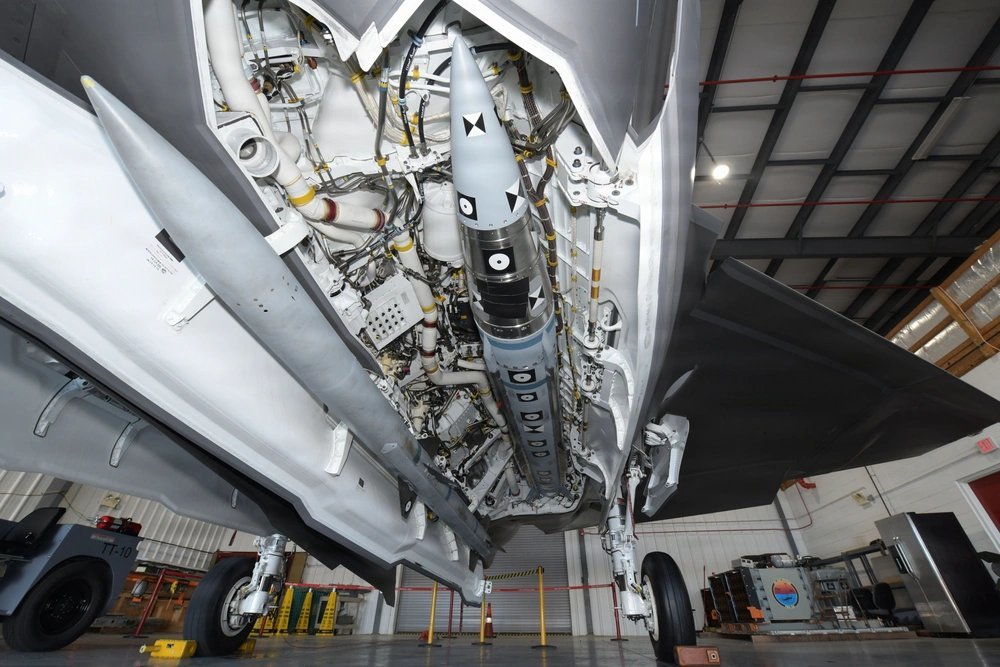
Meanwhile, a separate image published by the service showed the missile inside the internal weapons bay of an F-35C carrier-capable aircraft.
“The Department of the Navy is developing the AIM-424 Long Range Air-to-Air Missile (LRAAM), a next-generation missile intended to strengthen fleet defense and maintain a decisive air-domain overmatch against advanced threats,” the US Navy said in a statement. “The LRAAM directly supports the Department’s contribution to integrated deterrence by increasing range, lethality, and combat effectiveness for Marine and Naval Aviation forces that are defending our fleets, our interests, and our homeland.”
“LRAAM sustains the Department’s first-look, first-shot, first-kill advantage by providing our aviators with greater reach, greater survivability, and greater tactical flexibility in the air-to-air fight. Built for 4th, 5th, and 6th generation platforms, LRAAM is designed for the air wing of today and the future,” the service further emphasized.

The AIM-424 Malice will be equipped on the US Navy’s primary fighters, including the F/A-18E/F Super Hornets, the F-35C, and the sixth-generation F/A-XX fighter.
Notably, the F/A-XX program is still awaiting contractor selection, meaning the service has advanced the munition ahead of the platform that will carry it. However, the missile is still under testing, and the US Navy has not disclosed when it will enter service.
The AIM-424 is the second long-range air-to-air missile the Navy has publicly highlighted in as many years, following the AIM-174B Gunslinger, which was unveiled in July 2024. The AIM-174B missile is the air-launched version of the SM-6 missile carried by the Super Hornet and has a baseline range of about 130-150 nautical miles (about 240 to 280 kilometers).
While the AIM-174B was, until now, treated as the longest-range air-to-air missile in the USN’s arsenal, the unveiling of the AIM-424 Malice has changed that.
Developed by Raytheon, the AIM-424 has a range of about 250 nautical miles, or 463 kilometers, according to the latest update from the US Navy.
The AIM-424 is also more compact than the AIM-174B. It measures 13.5 feet (4.11 meters) in length, 13.5 inches (0.34 meters) in diameter, has a wingspan of 26.2 inches (0.67 meters), and weighs 1,500 pounds (680.4 kilograms). In contrast, the AIM-174B is 16.5 feet (5.03 meters) long, shares the same 13.5-inch diameter, has a much larger 42.7-inch (1.08-meter) wingspan, and weighs approximately 1,830 pounds (830 kilograms).
Because of its smaller size, the missile can be carried inside the F-35C and the F/A-XX, preserving the aircraft’s stealth features, which are essential for breaking through advanced integrated air defense systems (IADS) and engaging valuable targets at greater distances without risking early detection by the enemy.
In fact, observers have assessed that the AIM-174B may have been built as an interim solution until a longer-range, smaller-sized missile like the Malice was ready.
“If Raytheon has managed to retain the proven Mk 104 dual thrust rocket motor from SM-6 and the AIM-174, that combination alone should buy a real leap in performance. Which makes it fairly clear the AIM-174B was the interim ‘get it into service now’ answer while Raytheon and the Navy quietly worked on a properly optimized long-range weapon for 4th-, 5th-, and 6th-gen. fighters, a prominent national security and defense analysis account, Air-Power I NatSec Ledger, wrote on X.
The AIM-424 also outranges the secretive AIM-260 Joint Advanced Tactical Missile (JATM), which is estimated to reach roughly (or more than) 120 miles (193 kilometers). This essentially positions the Malice as the Pentagon’s longest-range air-to-air missile currently acknowledged in public sources.
More importantly, though, the AIM-424 appears to be a counter to the Chinese PL-17, which has a range of about 400 kilometers, and the Russian R-37M, which has a range between 300 and 400 kilometers.
The Pentagon has expressed interest in multi-stage, extremely long-range air-to-air missiles on multiple occasions. It continues to refine concepts such as the Air Force Long Range Weapon (AFLRW), which envisions an air-to-air missile with a range of around 1,000 nautical miles (1,850 kilometers) to complement long-range missiles such as the AIM-424 Malice.
“Malice isn’t just about range — it’s about rewriting the dynamics of the air battle. By arming Super Hornets and F-35Cs with the weapons to target “high-value” aircraft from over 250 nautical miles, we force the adversary to operate farther from our carriers,” a Navy official told EurAsian Times on condition of anonymity.
US Needs Long-Range Missiles Against China?
The US prioritizes long-range air-to-air missiles primarily because of the geography and military balance in the Western Pacific against China. Analysts believe sustained tensions in two significant Indo-Pacific hotspots, including the South China Sea and the Taiwan Strait, have increased the likelihood of conflict between the US and China.
This also means that any such conflict would occur thousands of kilometers from the US mainland and hundreds of kilometers from the nearest major US bases, giving China a home-field advantage. Therefore, US carrier strike groups would need to operate at extended ranges to remain outside the densest Chinese missile coverage, requiring weapons capable of reaching far beyond the launching aircraft.
This is why the US needs long-range air-to-air missiles.
The AIM-424 will help extend the US “first-look, first-shot, first-kill” advantage in high-end air combat, particularly against Chinese People’s Liberation Army (PLA) forces.
With long-range missiles such as the Malice, US fighters can engage high-value targets, including fighters, bombers, early-warning platforms, and tankers, from beyond the effective range of many enemy air-to-air and surface-to-air threats. This would bolster strike potential whilst improving the survivability of both the shooters and the carrier strike group or expeditionary force that they are deployed to protect in a conflict.
Since the missile can be carried internally, a stealthy platform like the F-35C could effectively penetrate the formidable Chinese A2/AD, at least in theory.
To keep US forces at a distance, China has purposefully developed a complex anti-access/area-denial plan. This includes sophisticated fighters like the J-20, equipped with extremely long-range air-to-air missiles such as the PL-15 and PL-17; long-range anti-ship and surface-to-surface ballistic and cruise missiles; and a dense integrated air defense network backed by airborne early warning aircraft. These systems are designed to endanger valuable aerial assets necessary for ongoing US operations.
Without the ability to push Chinese aircraft and sensors farther back, American carriers and fighters become significantly more vulnerable. Therefore, using AIM-424 and other long-range missiles would help create a “defensive bubble,” as hostile aircraft that attempt to launch anti-ship missiles or conduct other attacks on naval forces can be engaged earlier, reducing the threat to surface ships in conflict.
It would potentially help counter the anti-access/area-denial (A2/AD) challenge by pushing the air battle farther from US forces. Longer reach, however, usually gives aviators more options, such as supporting wider networked operations, forcing adversaries into unfavorable geometries, and shooting from safer distances.
The US Navy explicitly frames Malice as strengthening fleet defense, increasing range, lethality, combat effectiveness, and supporting “integrated deterrence.”
The United States needs these missiles because China’s combination of geography, long-range strike systems, and advanced air-to-air weapons makes shorter-range munitions insufficient for protecting carriers, bases, and supporting aircraft in the Western Pacific in the event of a conflict. The testing and future integration of the AIM-424 is, therefore, a welcome addition to a war-ready arsenal.
- Contact the author at sakshi.tiwari13 (at) outlook.com
- Follow EurAsian Times on Google News