For the first time, China’s J-16 heavyweight fighter jets and the French-made Rafales are participating together in a joint combat exercise, Eagles of Civilization 2026, in Egypt.
The drills will give China’s J-16 fighters a rare opportunity to exercise alongside one of the most advanced Western fighter jets.
Notably, the Eagles of Civilization 2026 is taking place nearly a year after the May 2025 India-Pakistan clash, in which Pakistan claimed to have shot down multiple Indian jets, including Rafales, using a combo of J-10C aircraft and PL-15E missiles.
While the Indian Air Force (IAF) accepted combat losses, it refused to divulge how many aircraft were lost or which ones. The IAF also claimed to have destroyed up to 12-14 Pakistani warplanes (excluding the J-10C), but Islamabad did not acknowledge any loss.
The exact number of losses, if any, on both sides has not been officially disclosed and cannot be verified by the EurAsian Times.
While many countries, including Egypt, Bangladesh, Iran, Uzbekistan, and Indonesia, considered buying the J-10C, no deals have been finalized yet, and Pakistan remains the only country to operate the export version of the 4.5-generation J-10C fighter jet.
Now, nearly a year after the May 2025 India-Pakistan clash, another Chinese fighter jet, the J-16, is “clashing” with Rafale in joint drills.
This comes as India nears finalization of a massive deal for 114 Rafales, which will make it the world’s second-largest operator of the fighter jet. India is also actively mulling joining the French-led FCAS program, which Germany exited earlier.
Eagles of Civilization 2026
The inaugural “Eagles of Civilization” joint air drills began in April 2025 as a bilateral military exercise between Egypt and China at an Egyptian air base.
In last year’s joint drills, China sent the J-10C multirole fighters, supported by assets such as the KJ-500 AEW&C, YY-20/YU-20 tankers, and Y-20 transports. The J-16, however, is larger and heavier than the J-10, with twin engines and two seats, and is designed for longer-range missions.
Meanwhile, the Egyptian side primarily deployed Russian-made MiG-29M/M2 fighters for the 2025 drills. The drills focused on air combat training, aerial refueling, joint maneuvers, and related tactics between the J-10C and MiG-29 aircraft.
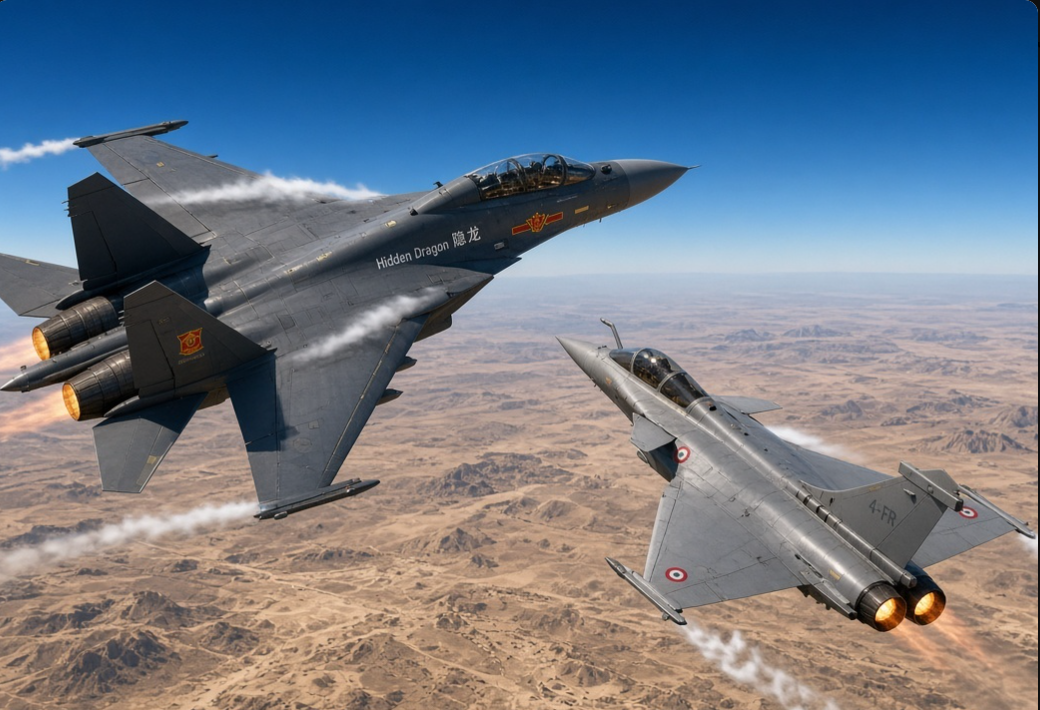
For the 2026 edition, while China is deploying its advanced J-16 jets, Egypt is deploying its French-made Rafales. The drills officially launched on August 22 and will run till early September, the Egyptian Air Force (EAF) said in a statement.
Egypt has so far ordered 54 Rafale jets in two batches. It ordered 24 Rafales in 2015, followed by a second order for 30 jets in 2021. So far, France has reportedly delivered 36 Rafales to Egypt, which remain in service.
China, on the other hand, has over 450 J-16s, including a smaller number of J-16D electronic warfare variants, in operational service.
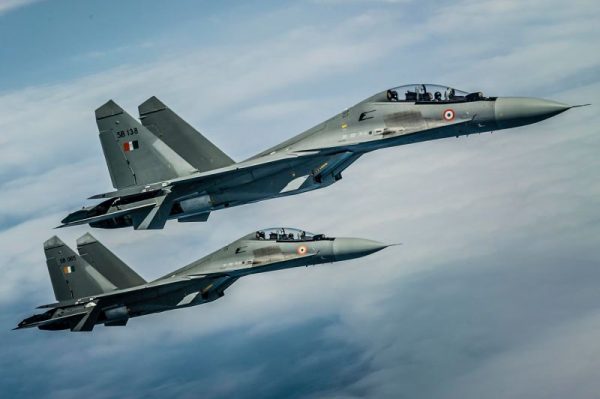
The J-16, nicknamed the Hidden Dragon, is a twin-seat, twin-engine 4.5-generation multirole strike fighter, developed from the J-11 airframe and inspired by the Russian Su-30MKK family. Both the Russian Su-30 and the Chinese J-16 are considered analogous to the US’s F-15E Strike Eagle.
The J-16 has an indigenous AESA radar, advanced avionics and electronic warfare systems, long-range capabilities, a heavy weapons load (12 external hardpoints), the ability to carry long-range air-to-air missiles such as PL-15 and PL-17, precision air-to-ground munitions, and anti-ship missiles.
The J-16 first flew in 2011 and entered operational service in 2015.
The J-16 forms a major part of the PLAAF’s modern heavy fighter force and has been deployed widely, including in exercises over the South China Sea and Taiwan Strait.
The jet has previously been featured in other overseas drills, including those with Russia and Pakistan, but this is the first time it has taken part in an exercise with the Egyptian air force.
Rafale, on the other hand, is a twin-engine, 4.5-generation, multi-role fighter jet. It is primarily a single-seat jet; however, two-seat variants exist for training purposes.
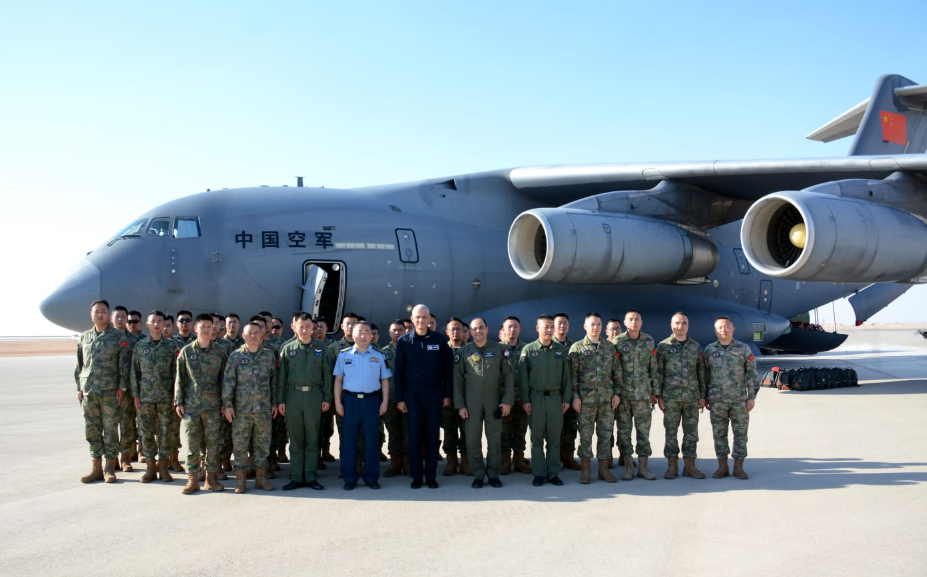
A fleet of Chinese J-16 fighters arrived in Egypt on August 21 for the joint drills.
Notably, the J-16 fighters flew nearly 6,000km (3,700 miles), a journey that took 9 hours and required the planes to refuel mid-air, according to the People’s Liberation Army.
In video footage published by the PLA Air Force on August 24, Chinese pilots were seen operating their J-16s to engage with the Egyptian Air Force’s Rafale fighters.
Shenyang J-16 VS Dassault Rafale:
Chinese and Egyptian air force pilots participating in the Eagles of Civilization 2026 joint training conducted medium- and close-range air combat drills on August 23, 2026. #China #Egypt #AirForce#EaglesofCivilization2026#J16 #MiG29… pic.twitter.com/DduBaktqeM
— China Military Bugle (@ChinaMilBugle) August 24, 2026
In a clip apparently filmed by the rear-seat pilot of a J-16 jet, a Rafale can be seen performing maneuvers while the two aircraft fly relatively close.
Interestingly, as EurAsian Times has reported earlier, Pakistani JF-17 aircraft had drilled with Qatari Rafale jets before the India-Pak May clash.
During the “Anatolian Eagle” exercise conducted in June 2021 between Turkey, Pakistan, Azerbaijan, and Qatar at a Turkish Air Force base, Turkish F-16s, Pakistan’s JF-17 “Thunder” Block II, Qatar’s Rafale, and Azerbaijan’s MiG-29 and Su-25 “Frogfoot” participated in the drills.
Joint Military Drills With China To Strengthen Egypt’s Strategic Autonomy
Notably, Egypt has been a close US ally in the region. Egypt is also one of the first Muslim countries in the region to sign a peace agreement with Israel.
Egypt’s joint military drills with China will, therefore, allow Cairo to diversify its military tactics and suppliers and strengthen its strategic autonomy.
Notably, Egypt was also invited to join the Mecca pact, a mutual defense agreement between Pakistan, Saudi Arabia, and Turkey.
While Cairo has expressed openness to joining the agreement, it is hedging its bets rather than putting all its eggs in one basket.
Joint military drills with China will give Cairo more strategic space to maneuver in a complex and swiftly changing geopolitical environment in West Asia.
Egyptian Air Force operates American F-16 fighters as well as CH-47 Chinook and AH-64 Apache helicopters. However, it also operates French Mirage 2000 and Rafale aircraft and Russian MiG-29s, avoiding complete reliance on a single supplier.
In the past, Egypt has also shown interest in Chinese fighter jets, such as the J-10CE. Regular joint drills with Chinese jets will allow Cairo to closely observe the strengths and weaknesses of the Chinese aircraft.
Meanwhile, China will have an opportunity to practice against the Rafales operated by the Indian Air Force (IAF).
It must be noted that training against Egyptian Rafales will give Chinese pilots valuable exposure to the aircraft’s flight characteristics, sensor fusion, and basic combat tactics. However, these are not Indian Rafales. Differences in weapons configuration, electronic warfare suites, pilot training, and support systems mean the PLAAF will get only a partial picture. Still, any real-world data against a Western 4.5-generation platform is better than nothing.
China Gains Practice Against Rafales as India Expands Fleet
The IAF currently has 36 Rafales and has ordered 26 more Rafale M. France has also submitted a detailed INR 3.25 lakh crore (US$38 billion) commercial and technical proposal to India to supply 114 Rafale fighter jets, with 94 of the aircraft to be manufactured locally in India through industry partnerships.
India has also strategically stationed and operated its Rafale fighter jets at key forward bases near the northern and eastern sectors of the China border, including airbases in Ladakh, to maintain deterrence along the Line of Actual Control (LAC).
Furthermore, in February this year, an IAF Rafale participated in a major air display and touch-and-go operations at Northeast India’s first Emergency Landing Facility on the Moran Bypass in Dibrugarh, Assam.
The Moran Bypass is just 300 kms from the China border.
In any conflict with China, New Delhi is set to deploy its Rafale fighters; therefore, the joint drills with Egyptian Rafales will give Beijing limited but useful insights into the Dassault jets.
- Nitin J Ticku holds a double master’s degree in Journalism and Business Management from the University of Glasgow. He has over 20 years of global experience in MARCOM, Journalism, and Digital Marketing, and has worked & traveled widely across Europe, the Americas, and Asia. Nitin is the Editor of the EurAsian Times.
- He can be reached at editor (at) eurasiantimes.com