The UK-based Martin Baker, which makes ejection seats for cutting-edge fighter jets, has now saved more than 7,800 lives, with the recent crashes of the US F-35B and Hungarian Gripen contributing to the new total.
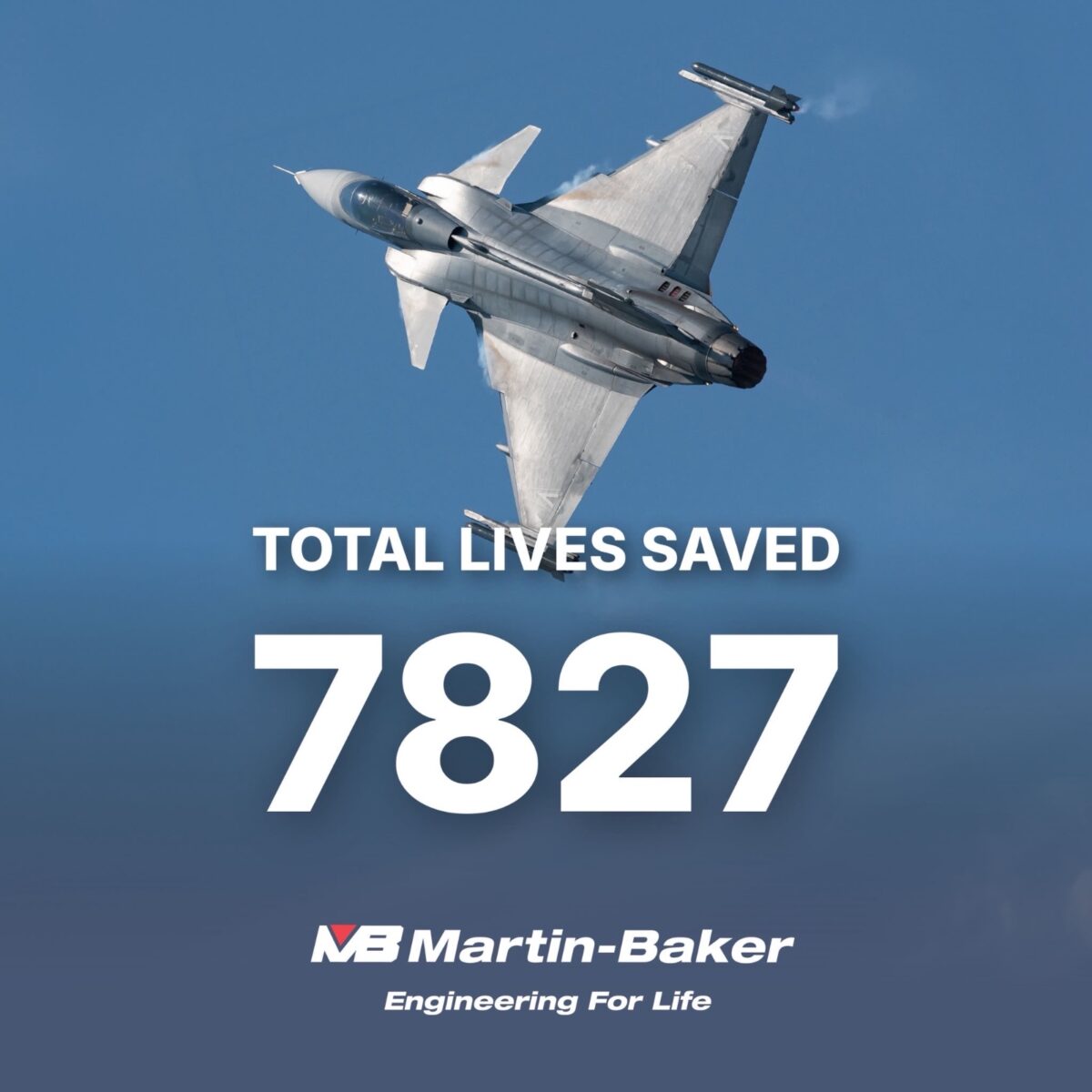
The number of lives Martin Baker’s ejection seats have saved so far has reached 7,827 after pilots flying the US Marine Corps (USMC) F-35B and the Hungarian Air Force Gripen ejected from their respective aircraft on two separate occasions.
A Hungarian JAS-39 Gripen-C fighter jet crashed near the town of Szolnok on August 24. Although the cause of the accident is unclear, Hungarian Prime Minister Peter Magyar announced on Facebook that there were no injuries or casualties and that civilian infrastructure was not damaged.
“According to a preliminary report, there were no injuries, and there was no harm to civilian infrastructure,” he wrote in the post.
“The pilot is in an ambulance; he is alive,” Minister of Defense Romulusz Ruszin-Szendi said in a Facebook video post shortly after. An investigation into the crash is currently underway.
Hungary operates 18 JAS 39 Gripen fighter aircraft and has been mulling over the purchase of the Gripen-E/F, the most advanced variant of the type.
Notably, the last time a Hungarian Gripen was involved in an accident was in 2015, when one of these aircraft crash-landed in central Hungary due to a technical fault. The pilot ejected, and the jet was later recovered, repaired, and returned to service.
A Saab JAS 39 Gripen C EBS HU operated by the Hungarian Air Force crashed early Monday morning on the site of Szolnok Air Base in Central Hungary. According to a statement released by Hungarian Prime Minister Péter Magyar, the pilot was able to successfully eject prior to the… pic.twitter.com/aPJgoBUFVg
— OSINTdefender (@sentdefender) August 24, 2026
The last time a Gripen crashed was in 2018 in Sweden due to a bird strike, and the pilot ejected safely.
The incident comes weeks after a single-seat F-35B Lightning II aircraft from Marine Aircraft Group 11, 3rd Marine Aircraft Wing crashed and burst into flames at USMC Air Station Miramar in California on July 31. The aircraft went down just short of the runway, sending thick black smoke billowing into the sky, as seen on videos retrieved by the media.
Additional footage of firefighting operations earlier this morning at Marine Corps Air Station Miramar in San Diego, California, following the violent crash landing of a U.S. Marine Corps F-35B Lightning ll. pic.twitter.com/mt6mPXstKp
— OSINTdefender (@sentdefender) July 31, 2026
The pilot was able to eject in time and recovered with minor injuries and was subsequently transferred to a medical facility for treatment. “The pilot ejected (and) was transported to a local medical facility in stable condition for evaluation and treatment of non-life-threatening injuries,” the wing said in a statement after the incident.
This was the second F-35 crash of the year.
Earlier, a US F-35 aircraft assigned to Nellis Air Force Base crashed on March 31 within the Nevada Test and Training Range during a routine mission, as the EurAsian Times reported at the time.
Like in the latest incident, the pilot managed to eject from the stealth jet using the Martin-Baker seats and sustained only minor injuries.
Two F-35 jets crashed in 2025—an F-35A crashed at Eielson Air Force Base, Alaska, in January 2025; and an F-35C crashed near Naval Air Station Lemoore, California, in July 2025. In both cases, the pilots ejected. Meanwhile, an F-35B crashed in May 2024 near Albuquerque, New Mexico, and the pilot ejected.
All these cases have one thing in common—the pilots escaped using Martin-Baker ejection seats.
Martin Baker Seats To The Rescue
Both the Lockheed Martin F-35 and the SAAB Gripen use Martin Baker ejection seats.
The F-35B uses the Martin Baker US16E ejection seat, which includes an automatic ejection mode that can fire if the lift fan fails, a feature unique among current Western fighters. The US16E is a true zero-zero seat, which means it can safely extract the pilot even when the aircraft is stationary on the ground. It also incorporates a Neck Protection Device to reduce the risk of injury from the heavy helmets used with modern helmet-mounted displays.
Meanwhile, the Saab JAS-39C/D Gripen uses a different Martin-Baker seat, the S10LS (a specialized Mk.10-series design). Much like the US16E, it is zero-zero capable.
This is how ejection works: The pilot pulls the ejection handle located between their legs or above their head, removing safety pins and firing the initial sequence. Following this, small rockets or explosive charges blast the aircraft’s glass canopy away, giving the pilot a clear path out. Meanwhile, straps and guards instantly pull the pilot’s arms and legs tight against the seat to protect them from high-speed windblast during the ejection.
Then comes the catapult launch. In this stage, a telescopic under-seat gun using explosive cartridges fires, pushing the seat up the guide rails and out of the cockpit. Immediately after the catapult stage, built-in under-seat rocket motors ignite, providing the seat with additional thrust to soar high enough to achieve zero-zero capability.
A small drogue parachute opens immediately after ejection to prevent the seat from spinning erratically in the wind. In the last phase, the pilot is released from the seat and the main parachute is deployed for a safe descent by an inbuilt timer or barometric sensor.
The entire sequence from handle pull to main parachute deployment typically takes only a few seconds, though the process itself is violent. Typically, high acceleration forces routinely produce spinal compression injuries.
Martin Baker has supplied about 92,000 ejection seats to 117 operators worldwide and is currently considered an industry leader. The most advanced fighters, such as the F-35 and F-16; European fighters like the JAS-39 Gripen and Eurofighter Typhoon; South Korea’s KF-21 and India’s Tejas; and training aircraft like the L-39NG and the Italian M-346, are all equipped with Martin-Baker ejection seats, to name a few.
A dominant player in the ejection seat market, Martin-Baker is widely regarded as a trusted brand through proven, life-saving performance rather than traditional advertising. The company deliberately publicizes only successful ejections. In fact, aviation observers often treat the company’s posts on X as near-real-time confirmation that a crash has occurred and the pilot has survived.
The two latest incidents — the US Marine Corps F-35B at Miramar and the Hungarian Gripen near Szolnok — once again demonstrated that these seats work when needed.
At the same time, though, every successful ejection is also a reminder that a multi-million-dollar aircraft has been lost and that the underlying causes of these accidents still require rigorous investigation.
- Contact the author at sakshi.tiwari13 (at) outlook.com
- Follow EurAsian Times on Google News