The report that Iran would attack US military targets in Europe and the European countries helping America, should Donald Trump escalate the war, has revived once again the debate over whether Iran has the capacity to carry out its threats.
The newly appointed Chief of the General Staff of Iran’s Armed Forces, Major General Ali Abdollahi, posted on X, warning that any form of assistance to the US military will be interpreted by Tehran as active “complicity” with American forces.
He pointed to a rising concentration of US military aircraft across regional installations, saying, “It is improbable that this volume of military aircraft, particularly aerial refueling tankers, is operating out of regional bases without the awareness of host nations.”
Also on July 19, Iran’s deputy Foreign Minister for Legal and International Affairs, Kazem Gharibabadi, emphasized that “any country that hands its destiny over to foreigners will pay a heavy price”.
Thus, Tehran’s message is no longer confined to the Middle East. Europe is now being told explicitly that it cannot stay on the sidelines of the Iran-Israel-US confrontation.
But the question is whether Iran has the capacity to hurt the Europeans. And if so, in what forms?
So far, a British airbase in Cyprus is the only European location that an Iran-made drone has struck since the start of the US-Israel war on Iran in February.
The attack on March 2 was in response to the then British Prime Minister Keir Starmer announcing that the US could use British bases for limited defensive purposes, though the UK government maintained the drone was airborne before the policy shift was finalized.
Secondly, in March, NATO and Turkish defense officials confirmed multiple occasions where alliance air defense assets intercepted ballistic missiles launched from Iran heading toward or entering Turkey’s airspace. This was a threshold Tehran had not crossed before.
These interceptions—occurring on separate dates marked a critical escalation as Iranian missiles crossed Iraq and Syria before being neutralized.
On March 4, the first reported incident was intercepted by NATO forces before the incoming ballistic missile crossed fully into Turkish territory. A second missile entered Turkish airspace and was destroyed on March 9. NATO successfully intercepted the third and fourth incursions on March 13 and March 30.
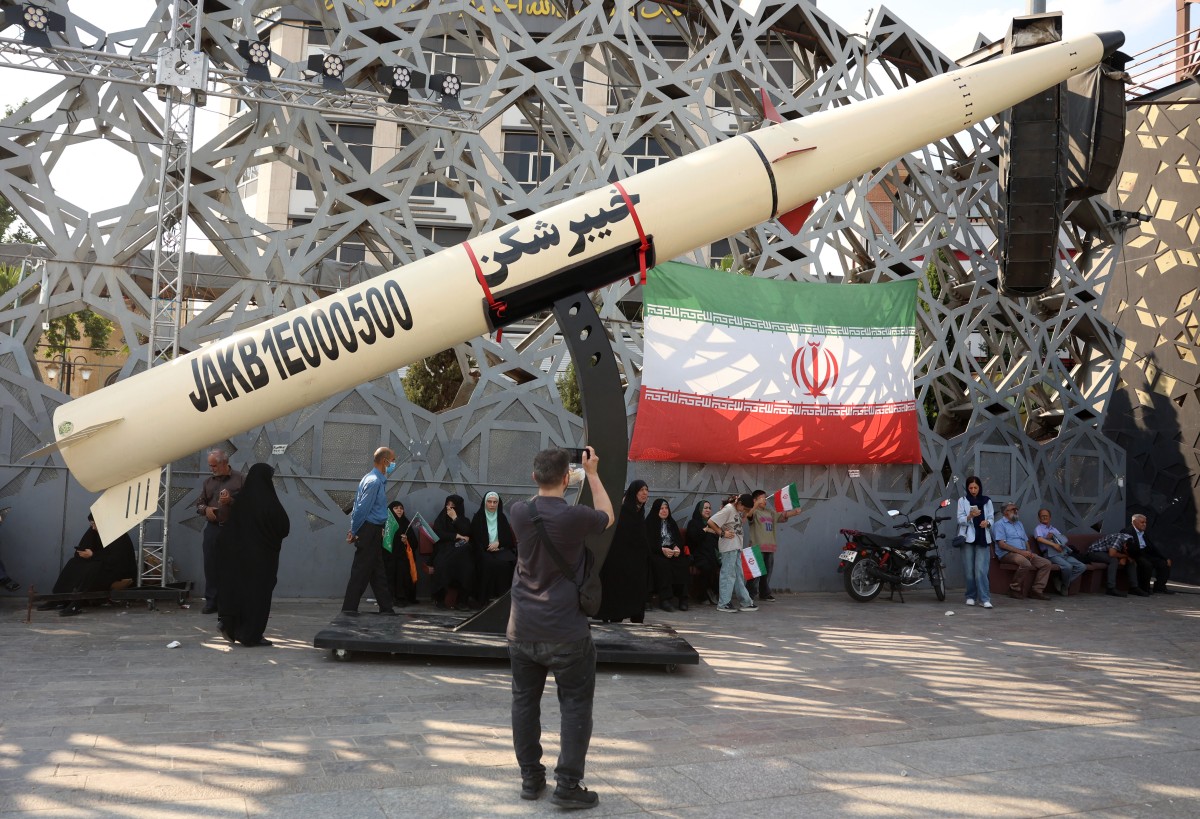
Thirdly, on March 20-21, US and Allied officials reported that Iran launched two modified Khorramshahr intermediate-range ballistic missiles targeting the joint US–UK military base on the Indian Ocean island of Diego Garcia, roughly 4,000 kilometers away.
Though one missile broke apart mid-flight and the second was neutralized by American air defenses, Iran’s strategic message was clear that it possesses the engineering capability to project kinetic power up to 4,000 kilometers, placing the heart of Western Europe theoretically inside its crosshairs.
Historically, Iran had adhered to a self-declared, politically sensitive cap of 2,000 kilometers on its ballistic missile range. This distance was intentionally calibrated to hold regional adversaries like Israel, Saudi Arabia, and the immediate fringes of southeastern Europe hostage without provoking a direct conflict with Washington or major NATO powers like Germany, the UK, and France.
By targeting Diego Garcia, Iran removed this cap.
Modifying the propulsion stages and payload configurations of its premier solid-fueled systems—such as the Khorramshahr-4 and the hypersonic-class Sejil—Iranian engineers effectively doubled their reach. The test towards Diego Garcia proved that capitals like Berlin, Paris, and London are no longer geographically isolated from Iranian reach.
According to experts, a breakdown of the specific European countries at risk includes:
The Immediate Frontline
Southeastern European states of Albania, Bosnia and Herzegovina, Bulgaria, Croatia, Greece, Kosovo, Montenegro, North Macedonia, Romania, and Serbia are the most immediately vulnerable to any Iranian missile attack due to their geographic proximity and the presence of Western military bases.
These nations fall comfortably within Iran’s historically proven 2,000-kilometer missile range.
Here, Cyprus has been identified as the most vulnerable flashpoint. As pointed out already, the RAF Akrotiri British airbase in Cyprus was already struck by an Iranian-made drone.
Then, there is Bulgaria. Here, high-level security alerts were triggered at the Bezmer Air Base when intelligence reports revealed that Iranian planners mapped the base as a primary target after Bulgaria approved its use for US military refueling aircraft.
Both Greece and Romania host key US and NATO infrastructure. The US Aegis Ashore missile defense site is in Deveselu, Romania. Heavy-payload Iranian ballistic missiles like the Khorramshahr can directly hit these two countries.
The Extended Target
Following a dual ballistic missile test toward the US-U.K. base at Diego Garcia, security officials have warned that modified Iranian propulsion systems could extend their reach up to 4,000 kilometers.
In that case, Germany, France, and Italy in Western Europe would theoretically be in the crosshairs if Iran deploys intermediate-range configurations.
While geographically distant, the UK may be relatively safe, but not its assets in Cyprus, Gibraltar, and Diego Garcia.
However, will Iran really attack Europe even if, theoretically speaking, it can?
Two factors make one raise this question.
First, a strike on a European nation would trigger Article 5 of the North Atlantic Treaty, inviting a devastating collective military response that the Iranian leadership recognizes as an existential threat.
A NATO official reportedly said, “NATO is prepared to address any threat and will always do what is necessary to defend all Allies.”
In a statement, the NATO official added that NATO intercepted four ballistic missiles Iran launched towards Turkey this year, offering it as proof the military alliance’s “deterrence defense posture is strong and effective” against outside threats.
But what about the European countries that are not exactly under NATO’s formal umbrella? For instance, Cyprus, Ireland, Austria, Switzerland, and Malta are not NATO members.
But then there are ways out. These countries are members of the European Union(EU). That membership provides a parallel layer of obligations. Under Article 42(7) of the Treaty on European Union, any attack on an EU member state legally compels all other EU member states to provide assistance.
And there is the European Sky Shield initiative — a German-led procurement and integration program that neutral states, including Austria and Switzerland, have joined — which is steadily weaving non-NATO nations into the continent’s shared air defense network.
That explains why when an Iranian drone hit Cyprus, even NATO members like Greece, Italy, the Netherlands and Spain rapidly deployed frigates and F-16s to defend the Mediterranean island’s airspace.
Secondly, there are also operational limits to the Iranian missiles and drones. So far, none of its attacks on the European assets mentioned above worked; they were repulsed. But what is more serious is the scenario where diverting high-value strategic assets toward Europe would degrade Iran’s domestic defense posture and invite immediate pre-emptive counter-strikes.
Despite Iran’s bravado about its industrial resiliency, there are merits in the logic that the US-Israeli attacks have caused setbacks to the country’s missile capabilities and that it is highly improbable that Tehran will dare to test Europe’s guaranteed retaliation.
However, experts fear that Iran can damage Europe by executing a sophisticated, asymmetric strategy. Tehran has successfully built a “hybrid threat matrix” designed to paralyze Europe from within—all while staying just below the threshold of triggering a full-scale war.
It is noteworthy that on June 10, the US, UK, and 19 other countries, including Germany, France, Sweden and the Netherlands, released a joint statement condemning “lethal plotting and other malign actions in Europe… by Iran’s Islamic Revolutionary Guard Corps-Intelligence Organization, Quds Force, and Ministry of Intelligence and Security”.
The targets, they said, included “Iranian dissidents, journalists and Jewish and Israeli communities and interests”.
The statement also condemned “the recent campaign of attacks across Europe targeting Jewish communities, Iranian journalists, and U.S. interests”.
The governments warned that “attempts to kill, kidnap, harass, intimidate, or otherwise attack people on our soil undermine national sovereignty and international norms. These actions must stop immediately”.
Incidentally, the EU had designated the Islamic Revolutionary Guard Corps as a terrorist organization on January 29 this year.
Europol, the European Union Agency for Law Enforcement Cooperation, the official crime-fighting agency of the European Union, has said that the Middle East conflict has had “immediate repercussions” for EU security, with an increased threat of terrorism, organized crime, violent extremism and cyberattacks.
It has also warned of radicalization via social media: “The rapid spread of polarising content on the internet can accelerate short-term radicalization processes among diaspora communities within the EU”.
In fact, in May 2026, Europol led a coordinated international crackdown across 19 countries targeting more than 14,200 online posts, accounts, and links tied to the IRGC. This digital operation restricted the IRGC’s main X account in the European Union.
British security agencies have also pointed out that IRGC-related cyber units are no longer merely conducting espionage. Instead, they are actively pre-positioning destructive “wiper” malware inside European critical infrastructure.
Financial networks, municipal water facilities, telecommunications hubs, and regional energy grids in nations aligned with Western defense policies are facing a relentless wave of digital probes. It is said to be a highly effective campaign of low-level paralysis, allowing Tehran to project tangible power into Western Europe without ever flying a drone across European borders.
Considering all this, one can say that the bravado of Iranian hardliners displaying a narrative of Iran launching a rain of ballistic missiles or drones down upon Europe may be too far-fetched. But Tehran’s strategy of slowly fracturing Allied cohesion, destabilizing European domestic politics through cyber sabotage and proxy terror, is not being overlooked and is under constant vigilance.
- Author and veteran journalist Prakash Nanda is Chairman of the Editorial Board of the EurAsian Times and has been commenting on politics, foreign policy, and strategic affairs for nearly three decades. He is a former National Fellow of the Indian Council for Historical Research and a recipient of the Seoul Peace Prize Scholarship.
- CONTACT: prakash.nanda (at) hotmail.com