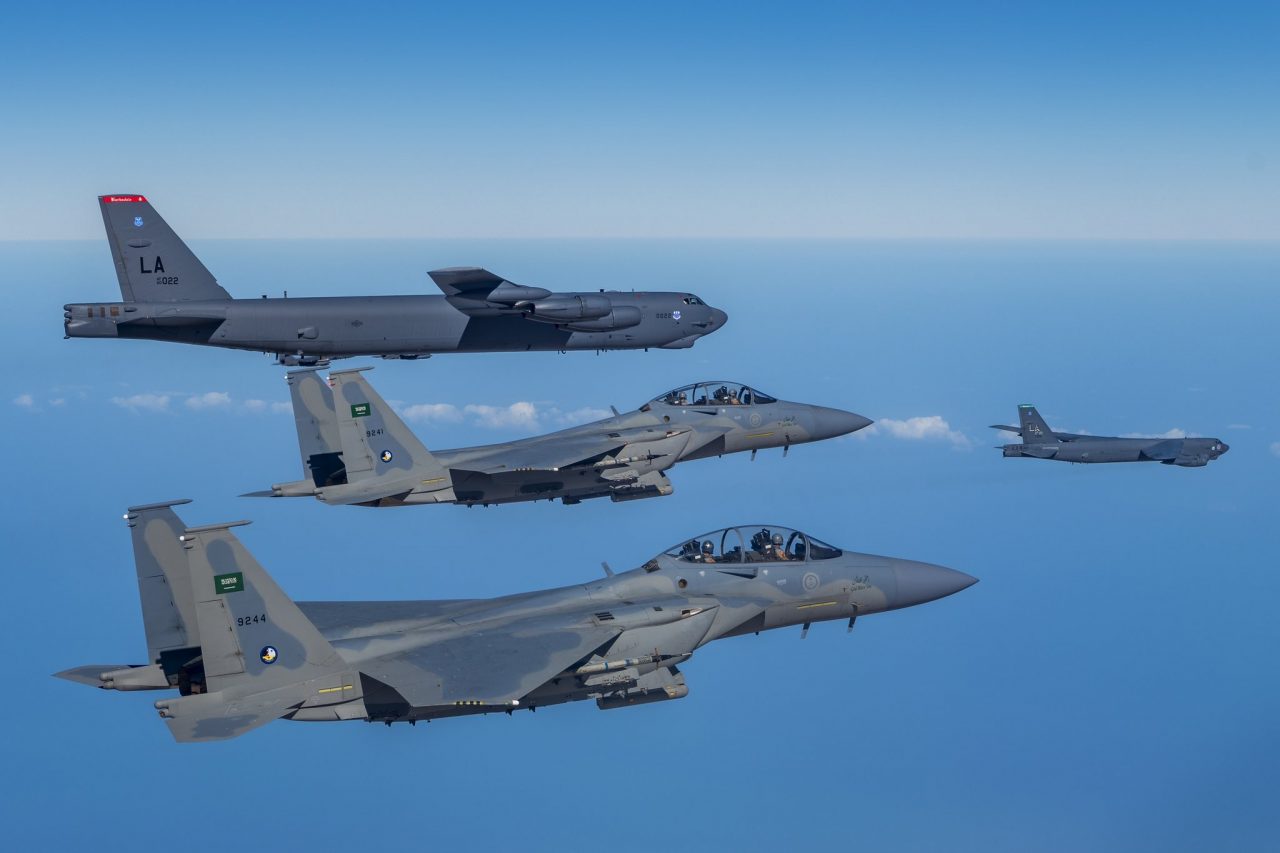
Iran has reportedly been invited to join the Mecca pact. However, it makes little sense for Tehran to join the Mutual Defense Agreement signed between Pakistan, Saudi Arabia, and Turkey. It would be akin to China joining the QUAD, or Russia joining NATO.
Mehdi Rahimi, head of the Iranian parliament’s Khaneh Mellat, made the claim during an interview with Iranian news outlet Al Mayadeen on August 22.
Rahimi said regional countries were moving toward establishing a “regional security umbrella,” adding that such a development would be favorable to Iran, as Tehran has long advocated regional security mechanisms.
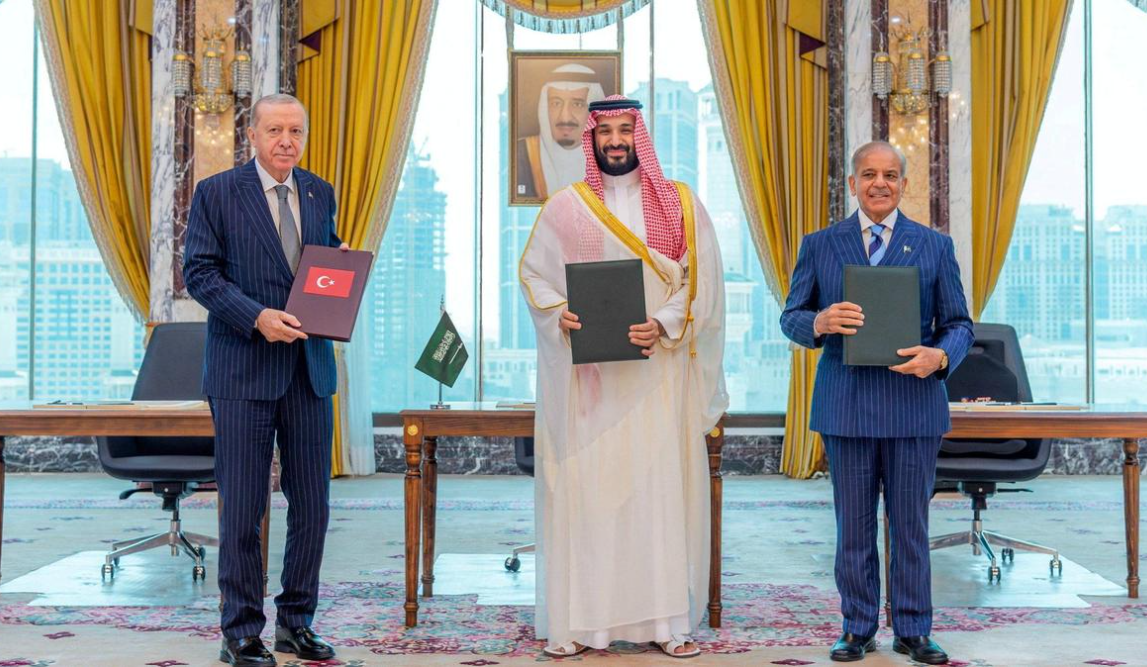
The Mecca Agreement was signed on August 7 by Saudi Crown Prince Mohammed bin Salman, Turkish President Recep Tayyip Erdogan and Pakistani Prime Minister Shehbaz Sharif.
Under the agreement, armed aggression against any one of the three countries would be treated as an attack against all three. This mutual defense clause is akin to NATO’s Article 5, and the pact has also been termed the “Muslim NATO”.
However, the Iranian foreign ministry has not yet confirmed the invitation, nor has any member of the Mecca pact.
Notably, during the signing of the agreement, the members of the Mecca pact clarified that the alliance was not directed against any country, particularly Iran. Turkey has also indicated that the alliance could eventually expand to include other countries. Egypt has already confirmed that it was invited to join the alliance.
However, given the historical, sectarian, and regional rivalry between Saudi Arabia and Iran, would Riyadh really invite Tehran to join the alliance, especially at a time when Iran has launched missile and drone attacks against all Gulf countries, including Saudi Arabia, and Iran-backed Houthi militants have enforced a naval blockade in the Red Sea?
The Arab-Azam (Persia) Rivalry
In West Asia, the Saudi Arabia-Iran rivalry actually pre-dates Islam.
Before the advent of Islam, while Iran was already the epicenter of massive empires like the Achaemenid, Seleucid, and Sassanid Empires, Saudi Arabia was considered a backwater between the two great empires of Persia and Rome.
In ancient Persian literature, Arabia was often conflated with uncultured people.
An old Persian saying – “The Arab of the desert eats locusts, while the dogs of Isfahan drink ice-cold water” – contrasts the backwardness of Arabia with the highly cultured life in Iran.
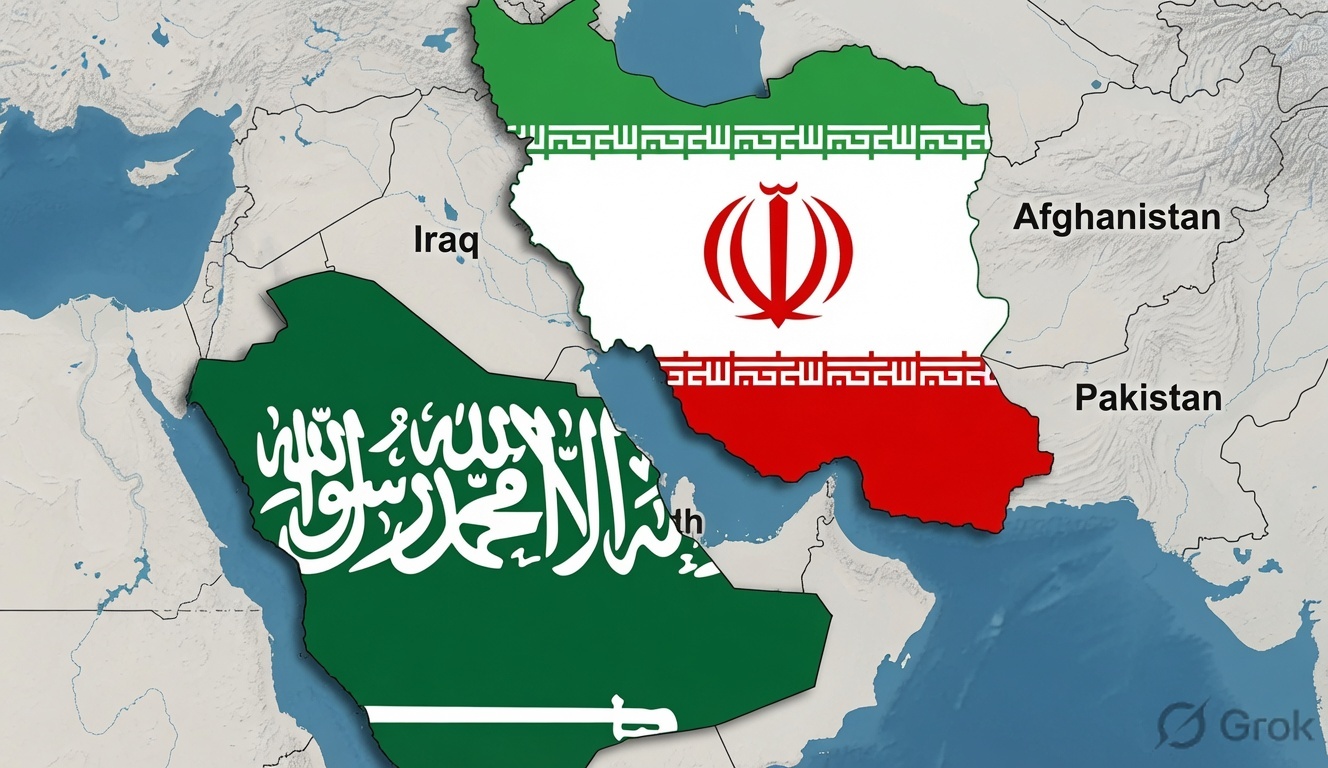
Similarly, in Arabia, Persia was referred to as ‘Azam,’ a pejorative term meaning “mute” or non-Arabic speaker. Historical anecdotes and poetry contrasted hardy desert Arabs with “decadent,” luxurious, or treacherous Persian court culture.
However, with the rise of Islam in Arabia, things changed, and in the 7th century, Muslim Arab armies conquered Iran.
Famous Iranian poet Ferdowsi lamented this change in fortune in his 10th-century epic ‘Shahnameh.’
For instance, Ferdowsi’s ‘Shahnameh,’ written somewhere between 977 CE and 1010 CE, says: “From drinking camel’s milk and eating lizards, the Arabs have reached such a point that they aspire to the Kayanian (Persian royal) crown. Spit on you, O revolving heavens, spit on you!”
After Persia converted to Twelver Shia Islam in the 16th century, the Arab-Iranian rivalry took the form of a Shia-Sunni sectarian conflict for the leadership of the Muslim world.
Notably, these ancient stereotypes have survived in the modern era as well.
Ayatollah Ruhollah Khomeini, in his book Kashf al-Asrar (The Unveiling of Secrets), wrote, “the savages of Najd and the camel herders of Riyadh.”
Najd is the central region of the Arabian Peninsula that is the historical heartland of the Al Saud and Wahhabism.
Kim Ghattas, in his 2019 article for The Atlantic – ‘What Jamal Khashoggi’s Murder Tells Us About the Saudi-Iran Rivalry‘ – wrote: “Khomeini had a visceral hatred of the Saudi royals, whom he described as ‘camel grazers of Riyadh and the barbarians of the [Saudi desert of] Najd.’”
These instances show the historical antecedents of the Saudi-Iranian rivalry.
However, the question is why, despite this deep-rooted rivalry, Saudi Arabia would want to make Iran part of a mutual defense alliance led by Riyadh?
Why Would Saudi Arabia Invite Iran To Join The Mecca Pact?
Iran’s inclusion in the Mecca pact will serve three purposes for Saudi Arabia.
One, the inclusion of the world’s preeminent Shia power will blunt the criticism of the Mecca pact that it is primarily a Sunni bloc.
However, more than that, it will help open the Strait of Hormuz, which the US has not been able to do so far. More than the UAE, Kuwait, or Qatar, Saudi Arabia’s economy depends heavily on petrodollars, and the longer the strait is blocked, the greater the economic cost for Riyadh.
According to security analyst Patricia Marins, “The inclusion or rapprochement of Iran in the Mecca Pact is, fundamentally, a diplomatic gambit to end Tehran’s economic suffocation and secure the reopening of the Strait of Hormuz.”
“Saudi Arabia and its neighbors saw their ports and refineries become targets, and their economies faltered under the blockade of the strait. They need to reopen the maritime route at all costs to salvage their development plans.”
However, for any such pact, Iran will also have to cut its military and financial support, or at least control its militias in West Asia, primarily the Houthis.
The Houthis have enforced a naval blockade of Saudi Arabia and targeted Saudi-linked ships in the Red Sea.
An agreement with Iran will help lift this blockade and will buy peace for Riyadh in Yemen as well.
In return, Riyadh will end Tehran’s economic suffocation.
“For the GCC, financing the neighbor’s reconstruction is not an act of charity, but a security strategy… The sovereign wealth funds of Saudi Arabia, Qatar, and Kuwait would inject billions into the Iranian economy, but the disbursements would be tied to the gradual dismantling of armed militia financing, and this remains a hurdle,” Marins added.
However, despite clear benefits for Riyadh, joining a Saudi-led alliance makes little sense for Tehran.
Why Iran Will Not Join the Mecca Pact?
As Europe is arming itself for a potential battle between Russia and NATO, hardly anyone remembers today that Russia and the erstwhile Soviet Union tried to join NATO not once but thrice.
In March 1954, after Stalin’s death and just five years after NATO’s establishment, Soviet Foreign Minister Vyacheslav Molotov sent notes to the US, the UK, and France. Moscow said it was ready to examine joining NATO as part of a broader European collective security system.
However, NATO countries rejected it as “completely unreal” and incompatible with NATO’s democratic and defensive character. Just one year later, in 1955, West Germany joined NATO, and the Soviets responded by forming the Warsaw Pact.
Had NATO accepted the Soviet Union into the alliance, perhaps there would have been no Cold War.
After the Cold War ended, Russia tried to join NATO on two more occasions.
Russian President Boris Yeltsin wrote to NATO in December 1991 stating that membership was a long-term political goal. US President Bill Clinton was relatively open to eventual Russian membership.
Russia joined the Partnership for Peace in 1994, and the 1997 NATO-Russia Founding Act established a framework for cooperation. However, the talks faltered, and Russia could not join NATO.
Putin also floated the idea in 2001. However, once again, the talks failed.
The fact that Russia was not allowed to join NATO, not just once but three times in nearly five decades, holds an important lesson in geopolitics – an alliance built to contain a power will never allow that country to join it.
Can we imagine China joining QUAD or AUKUS?
Similarly, Iran will be a paradoxical anomaly in the Mecca pact.
Furthermore, any rapprochement between Tehran and Riyadh will necessarily have to include an understanding on the Houthis, and perhaps on Hezbollah as well.
Iran has spent decades building these proxy groups to extend its influence across the Gulf. Betraying these groups at this stage would mean undoing decades of its work, and curtailing its own influence in the region.
Even if Tehran agrees to limit the Houthi activities, it’s hard to imagine Saudis and Iranians reaching an understanding on the role of Houthis in Yemen.
In other words, there are fundamental contradictions between the regional interests of Iran and Saudi Arabia, which can not be settled by Riyadh agreeing to shell petrodollars for Iran’s financial rehabilitation.
Not to forget that Iran is competing for the leadership of the Muslim world with all three countries of the Mecca pact – Saudi Arabia, Pakistan, and Turkey.
Further, all these countries are close strategic partners of the US. Turkey is also a NATO member.
Even after signing the Mecca pact, these countries will continue to maintain deep strategic defense partnerships with the US, adding another complication to Iran’s inclusion in the alliance.
Therefore, Iran’s inclusion in the Mecca pact is a non-starter and will never materialize, just like Russia’s attempts to join NATO never succeeded.
- Sumit Ahlawat has over a decade of experience in news media. He has worked with Press Trust of India, Times Now, Zee News, Economic Times, and Microsoft News. He holds a Master’s Degree in International Media and Modern History from the University of Sheffield, UK.
- He can be reached at ahlawat.sumit85 (at) gmail.com