The Ukrainian Army claimed to have recovered a Russian Kalibr cruise missile, disintegrated it, and analyzed it in depth, only to discover that it continues to be equipped with foreign components despite international sanctions.
Amid a barrage of missiles and drones unleashed by Russia on Ukrainian targets, the Ukrainian troops managed to retrieve a Kalibr missile, which was then disintegrated “board by board, component by component,” as highlighted by the official X account of the Ukrainian Army in a detailed thread.
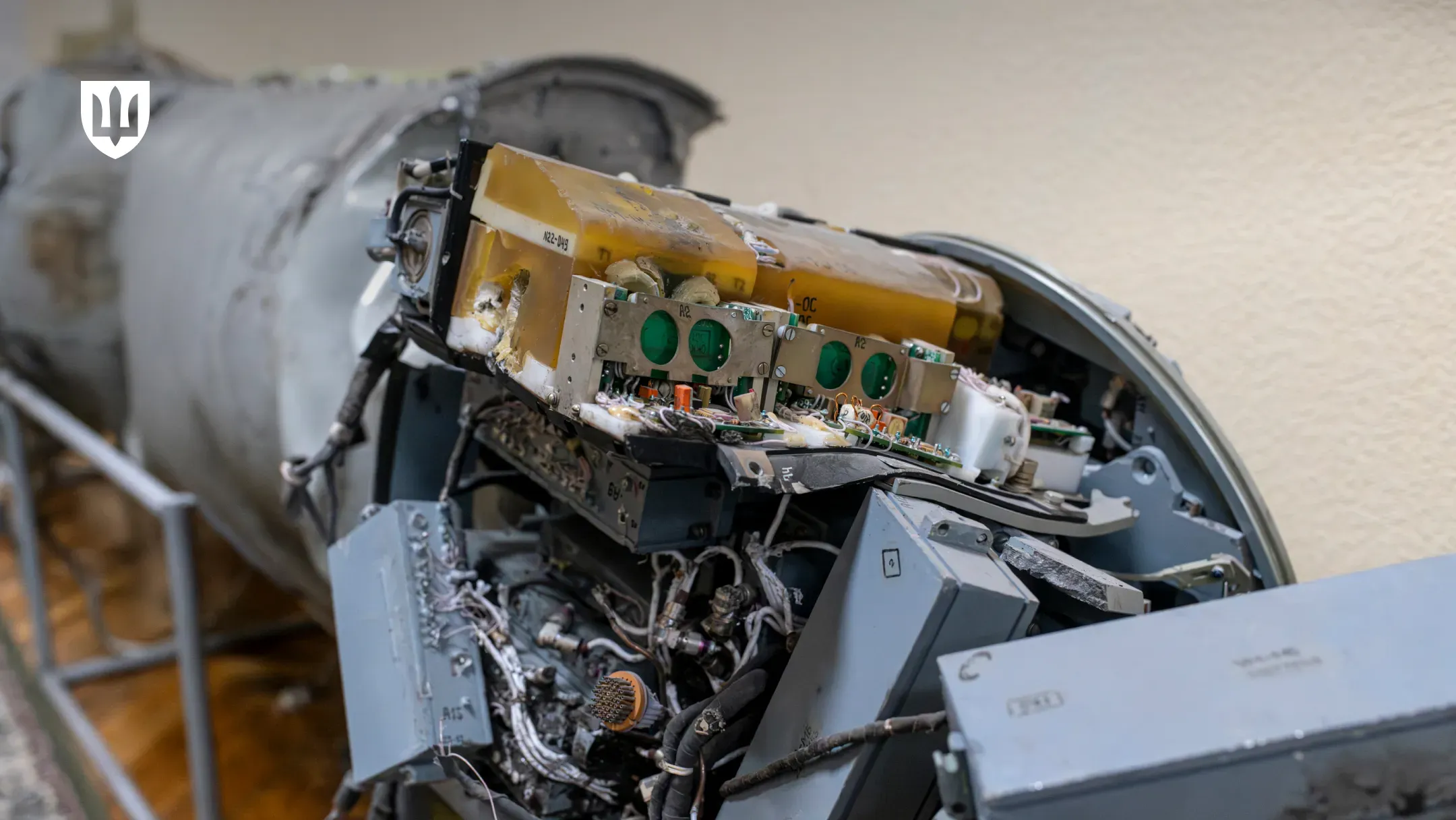
The Ukrainian military engineers and scientists fully disassembled several intercepted Kalibr missiles “down to the circuit board,” examined each component, compiled a complete structural and functional diagram, and identified manufacturers of the components, the Ukrainian Ministry of Defence (MoD) stated in an assessment report.
The Kalibr 3M14 is a subsonic long-range, terrain-following cruise missile capable of striking targets over 1,500 kilometers from the launch point. The missile carries a 450-kilogram warhead, has a four-channel guidance system (GPS satellite navigation, inertial system, radio altimeter, terminal radar homing), and can fly as low as 20 meters over water to minimize detection, the Ukrainian engineers confirmed.
Ukraine has regularly alleged that while the missile was designed to destroy port infrastructure and open areas, Russia has been using it against apartment buildings.
The Kalibr cruise missiles were part of the aerial strike unleashed by Russia earlier this month, as well as in the deadly strike of May 23-24, which was believed to be one of the largest strikes of the year.
The engineers analyzing the missile claimed to have found that about 80–90% of its guidance system electronics were of foreign origin, exposing leaks in the international sanctions imposed following Russia’s full-scale invasion in February 2022, which have since been repeatedly modified to make them more stringent.
No Impact of International Sanctions?
As the Ukrainian MoD stated, a Kalibr missile uses a combined control system composed of GPS satellite navigation, an inertial system, a radio altimeter, and a terminal homing radar.
“The guidance system circuit boards are more than 80-90% made up of foreign-made components. This is a confirmed fact, not an estimate: each part is marked and has been checked by military officials,” the Ministry emphasized in the report.
Intriguingly, the Ukrainian Defense Ministry states that although Russia made an effort to transition to domestic components between 2023 and 2024, the missile’s onboard computer (OBC), apparently produced in 2025, still used imported parts. The theory floated by the Ukrainian engineers behind this shift in strategy is that the domestic components were probably not up to standard.
“Experts suggest that the shift to domestic electronics may have reduced the accuracy of guidance systems and that manufacturers have reverted to a previously proven configuration,” the report markedly points out.
The MoD did not disclose the real origins of these components. Instead, the report stated that the MoD has identified primary designers responsible for developing Kalibr missiles, as well as all electronics manufacturers involved in their production. The collected data is being sent for additional processing in accordance with the sanctions policy.
However, we know that Kyiv had previously alleged that Russia procured crucial electronic components from countries such as China and Hong Kong, and that Central Asian countries, as well as Turkey, the UAE, and India, have been identified as possible conduits for obtaining Western-origin components.
Russian weapons recovered by Ukraine are routinely flagged as containing Western components. For example, the Russian S-70 Hunter drone downed in October 2024 was allegedly found with components from US companies such as Analogue Devices, Texas Instruments, and Xilinx-AMD, as well as from Swiss company STMicroelectronics and German firm Infineon Technologies.
The biggest troublemaker for Ukraine, Russia’s Geran-2 drone, also features Western components, as Vladyslav Vlasiuk, the Commissioner for Sanctions Policy of the President of Ukraine, revealed earlier this year. At the time, officials warned that the time it takes for Western components to reach Russia has been reduced to a “critical minimum.”
Similarly, missiles such as the Kh-101, Kh-69, Iskander, Kinzhal, Zircon, X-59, and even the Oreshnik have been alleged to contain foreign components. Therefore, the Kalibr containing foreign electronics is hardly a surprise, although the bold assertion that the parts were obtained to substitute less accurate Russian components is significant.
Nonetheless, the official X media account of the Ukrainian Army asks a straightforward question: “The question for Western governments and export control agencies is straightforward: the components have been identified, the manufacturers are known, the procurement routes are documented. What happens next?”
In its report, the MoD also pointed to the Kalibr’s SN-99 navigation system, which is classified as one of the crucial parts of the missile.
According to the report, the system traces its origins to Ukraine and was developed sometime in the 2000s. “It is currently in mass production in Russia, but its design base is of Ukrainian origin,” the report states.
Stressing the complexity of the supply chain, the Ukrainian Army’s official media account on X said, “The navigation system now used to target Ukrainian cities was built on Ukrainian engineering. And the broader electronics supply chain that keeps it accurate runs through Western component manufacturers — companies whose parts passed through Russian military procurement channels in violation of export controls.”
The Ukrainian MoD further believes that stocks of parts purchased before the sanctions against Russia took effect have not yet run out.
Furthermore, it noted that certain components of the Kalibr missile are also standardized across other Russian missile systems. For example, the onboard computer, tail section, and satellite navigation system are also used in Iskander missiles, and some modules are identical to components of the Bastion system.
However, more importantly, the Ukrainian MoD discovered that Russia has modified the Kalibr missiles to inflict damage over a wider area by making use of cluster munitions.
Putin Threatens Hypersonic Mayhem: Calls Oreshnik Missile Strikes “Experimental” — Much More To Come
Kalibr Now Has Cluster Warheads
“In 2026, experts from Ukraine’s Ministry of Defense noted a fundamental change: for the first time, a cluster warhead was identified in missiles shot down in spring this year, similar to that used on the Kh-101,” the Ukrainian Ministry of Defense has noted in its report.
Typically, these munitions are deployed from aircraft, artillery, or missile systems. However, they can also be dropped as bombs, fired as rockets, or launched via shells. Once released, the canister of the munition opens mid-air, dispersing dozens to hundreds of submunitions.
The report states that a modified warhead is anticipated to expand the missile’s impact area and enhance its performance against scattered targets, such as aircraft at hangars, airfields, and open locations.
According to the Ukrainian MoD, the Kalibr missiles employed between 2022 and 2026 had high-explosive fragmentation warheads with over 3,600 metal particles that could pierce up to 10 cm of concrete, meaning the addition of cluster munitions is a fairly new modification.
Taiwan’s HIMARS Makes Historic West Coast Debut Amid Rising PLA Threats. Here’s Why It Matters
It is worth mentioning that cluster warheads are generally regarded as dangerous for use against urban settlements because to their dispersal across huge areas. In fact, their usage is increasingly regarded as a conscious attempt to violate human rights, primarily because they cause significant collateral damage and civilian casualties.
These munitions have a high dud rate, meaning many of the submunitions released from the warhead fail to detonate upon impact.
This puts the civilians at risk long after hostilities have ended.
The 2008 Convention on Cluster Munitions prohibits the use, production, and stockpiling of cluster munitions. It has been signed by over 100 countries due to its indiscriminate nature and long-term risks, although countries like Russia and the US are not signatories. However, it must be added that Ukraine, too, has used cluster munitions against Russia in the ongoing war, as previously noted by the EurAsian Times.
Despite their potential to cause civilian harm, cluster munitions are still used because the simultaneous detonation of multiple bomblets helps in overwhelming hostile defenses. These small bomblets have low radar signatures, and the use of cluster warheads in larger salvos creates a decoy-like effect, making it harder for air defenses to prioritize targets.
- Contact the author at sakshi.tiwari13 (at) outlook.com
- Follow EurAsian Times on Google News