It is often said that while every country has an army, in Pakistan the army has a country, and the latest UN hunger report is a testament to this sad reality.
Since 2024, Pakistan has fought a brief war with India, exchanged missiles with Iran, has been engaged in a constant state of warfare with Afghanistan, and has played the mediator in the US-Iran War, while the number of malnourished people in Pakistan has increased nearly 37% in the last two decades.
This is even as hunger is declining globally. While in 2004-2005, around 14% of the global population experienced hunger, this number has declined to 7.8% in 2026.
Pakistan, however, stands out as a stark outlier: while hunger has declined sharply across the world, the number of undernourished Pakistanis has risen by millions, a direct consequence of the army’s dominance over the state and its consistent prioritization of geopolitics over human development.
The 2026 UN Hunger Report
Global hunger declined for a third consecutive year in 2025, with improvements recorded across every continent, according to a United Nations report.
The report estimates that around 645 million, or around 7.8 percent of the global population, faced hunger in 2025, down from 8.1 percent in 2024 and 8.6 percent in 2022, according to the State of Food Security and Nutrition in the World report, jointly prepared by five U.N. agencies.
However, despite global progress, recovery remains uneven across regions.
For the first time, Africa has become the continent with the largest number of people facing hunger, with 309 million people experiencing hunger in 2025, followed by Asia, where 292 million people experienced hunger.
While the number of people experiencing hunger has declined in both Asia and Africa, the decline has been much sharper in Asia.
“The center of gravity of hunger has shifted from Asia to Africa,” said David Laborde, director of the agrifood economics division at the Food and Agriculture Organization (FAO).
Much of the improvement in Asia has been led by India, home to nearly one-fifth of the world’s population, where hunger has fallen below 10%, aided by targeted welfare programs and rising agricultural productivity.
India provides free monthly food rations to approximately 813.5 million impoverished citizens through the Pradhan Mantri Garib Kalyan Anna Yojana (PMGKAY). Eligible beneficiaries receive 5 kg of wheat or rice per person per month, while Antyodaya Anna Yojana (AAY) households receive 35 kg. This massive food security program serves approximately 57% of India’s population to combat malnutrition and poverty and has been extended to run until December 2028.
In 2004-2006, 243.9 million Indians were undernourished; this number has declined to 142.5 million by 2023-2025, registering a 41.6% decline.
“Twenty-five years ago China still had a problem with hunger, but they solved it; India also has a problem, but they are putting lots of effort into actively resolving it,” Laborde told AFP.
However, even as India and China have lifted millions of their citizens from hunger, their neighbor Pakistan is moving in the other direction.
Pakistan Remains a Global Outlier on Hunger
India and Pakistan got independence from the British Empire in 1947.
In the 1960s, both countries had similar GDP per capita.
In 1961, India’s GDP per capita was US$87, while Pakistan’s was US$88.
However, by the 1980s, an average Pakistani was twice as rich as an average Indian.
For instance, in 1982, India’s GDP per capita was US$278, compared to Pakistan’s US$584.
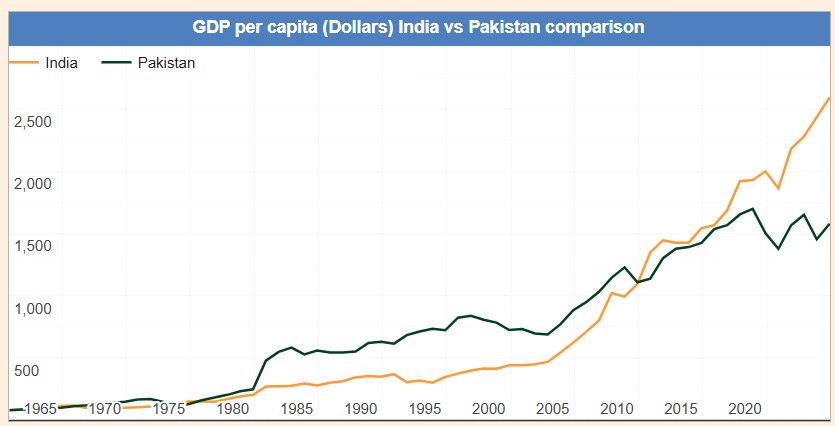
By 2024, the situation had completely reversed. In 2024, India’s GDP per capita was US$2592, compared to Pakistan’s US$1,578.
This trend is also visible in hunger statistics.
For instance, from 2004 to 2006, 243.9 million Indians were undernourished; this number declined to 142.5 million by 2023-2025, representing a 41.6% reduction.
However, during the same time, the number of undernourished people in Pakistan increased from 29.6 million to 40.4 million, registering a 37% increase.
Similarly, in India, the number of people unable to afford a healthy diet declined from 813 million in 2017 to 520 million in 2025. However, during the same time, the number of such people in Pakistan increased from 132.4 million in 2017 to 160 million in 2025.
The prevalence of severe food insecurity in Pakistan increased from 0.9 in 2014-2016 to 5.5 in 2023-2025.
In terms of prevalence of undernourishment in the population, Pakistan features among the top 4 in Asia, only behind Syria, Afghanistan, and Timor-Leste.
However, both Syria and Afghanistan have been suffering from civil war and foreign intervention for over one and two decades, respectively, and Timor-Leste is a small island country with a population of just 1.4 million.
Clearly, in the case of Pakistan, the hunger, undernourishment, and food insecurity are not a result of civil war, foreign intervention, or some natural calamity, but are self-inflicted wounds caused by the country’s military elites.
For instance, while Pakistan ranks at the bottom for hunger, undernourishment, and food insecurity, it ranks among Asia’s top countries in defense spending.
Pakistan ranks 8th in Asia by defense budget in 2025.
In 2026-2027, Pakistan announced a defense budget of US$10.8 billion, representing an 18% increase over 2025.
However, in terms of defense spending as a percent of GDP, Pakistan ranks among the top 4, behind only Israel, Saudi Arabia, and Singapore.
In 2026, Pakistan would spend 2.9% of its GDP on defense, even more than India (2.3%), Taiwan (2.1%), China (1.7%), and Japan (1.9%).
Pakistan is also a nuclear power and has the world’s sixth-largest standing army, behind China, India, the US, North Korea, and Russia.
As these data points make clear, Pakistan has no dearth of resources when it wants to mobilize them for the military, weapons systems, and defense modernization.
However, it seems that fighting hunger, food insecurity, and undernourishment is clearly not on Islamabad’s agenda. Instead, the Pakistani state is focused on playing big geopolitical games, competing with India militarily, internationalizing the issue of Kashmir, and trying to position itself as the leader of the global Muslim bloc.
In the last two years, Pakistan has fought wars with three out of its four neighbors.
Pakistan has also accepted that it funded and trained armed militants and terrorists for decades. It was also a frontline state in the US camp during the Cold War.
Islamabad armed and trained Taliban militants in the 1980s to defeat the Soviets in Afghanistan.
Pakistan also tried to play the mediator in the US-Iran War and is also part of Trump’s Gaza Peace Council.
In September 2025, Pakistan and Saudi Arabia signed the Strategic Mutual Defense Agreement (SDMA), which features a NATO Article 5-style mutual defense pact.
Under the treaty, “Aggression against one country shall be considered aggression against both.”
During the ongoing Iran War, Pakistan deployed 8,000 troops, a squadron of fighter jets, and an air defense system to Saudi Arabia under the mutual defense pact when Tehran launched drones and missiles against the Saudis.
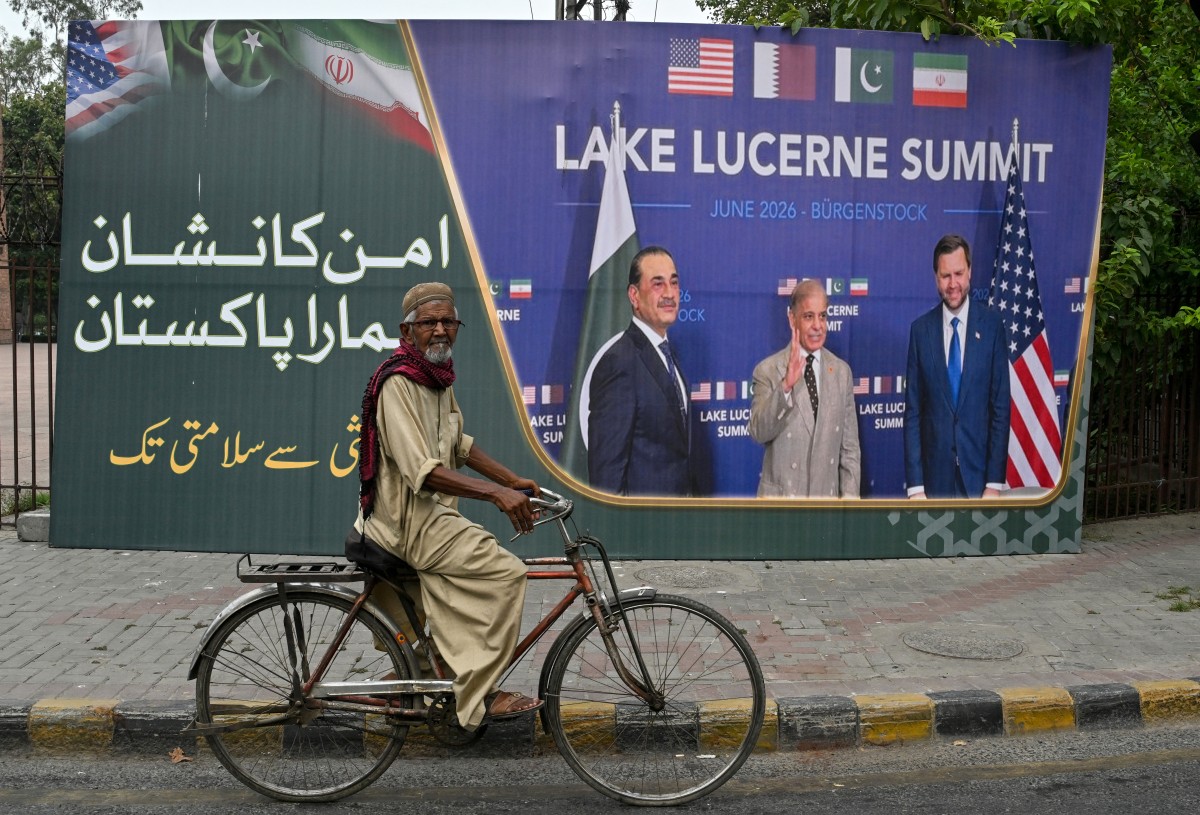
There are suggestions that Pakistani troops might also be deployed in Gaza as part of the international peacekeeping force.
However, beneath this grand geopolitical standing, the number of people suffering from hunger is increasing in Pakistan, even as the number of these people is declining globally.
In fact, this is a sentiment repeatedly expressed by Pakistani commentators as well.
For instance, Ahmed Rashid, renowned Pakistani journalist and author of Descent into Chaos and Pakistan on the Brink, has repeatedly argued that the military’s obsession with strategic depth in Afghanistan and confrontation with India has come at the direct expense of Pakistan’s economy and people.
“The army has always defined Pakistan’s national security goals. Currently it has two strategic interests: first, it seeks to ensure that a balance of terror and power is maintained with respect to India, and the jihadis are seen as part of this strategy. Second, the army supports the Afghan Taliban as a hedge against US withdrawal from Afghanistan and also against Indian influence in Kabul,” Ahmed wrote in his book Pakistan on the Brink.
“In Pakistan there is no such broad national identity or unity… The gap between the rich and poor has never been greater, and members of the Pakistani elite have rarely acted responsibly toward the less fortunate masses. Education and job creation have been the least-funded policies of Pakistan’s governments, whether military or civilian, and literacy levels are abysmal; there are now some 20 million youth under age seventeen who are not in school,” he added.
Similarly, Husain Haqqani, former Pakistani ambassador to the US and author of the influential book ‘Pakistan: Between Mosque and Military,’ has written extensively about how the Pakistani military’s focus on external geopolitical alliances has diverted attention and resources away from internal development, governance, and the welfare of the masses.
One major role of the government is to forecast global macro environment and take policy decisions to build buffers that can absorb external shocks and volatility, so that people and their livelihood are protected.
That’s not the case in Pakistan, where the colonial minded…
— Hussain Nadim (@HNadim87) April 3, 2026
The grand geopolitical games of Pakistani generals are routinely criticized within Pakistan for ruining the country’s economy.
Earlier, scholars like Ayesha Siddiqa explained in her excellent book ‘Military Inc.: Inside Pakistan’s Military Economy ‘ how the Pakistani military has built a vast, independent corporate empire through foundations, companies, and real estate holdings.
The book argued that this entrenched military economy distorts Pakistan’s development, weakens civilian institutions, and makes genuine democracy difficult by prioritizing the military’s institutional interests over those of the state and its people.
However, sadly, the Pakistani military is so deeply entrenched in the state’s economy and politics that the situation is not expected to change anytime soon.
Till then, Pakistan’s millions of hungry people are expected to foot the bill for Pakistani generals’ expensive geopolitical games.
- Sumit Ahlawat has over a decade of experience in news media. He has worked with Press Trust of India, Times Now, Zee News, Economic Times, and Microsoft News. He holds a Master’s Degree in International Media and Modern History from the University of Sheffield, UK.
- He can be reached at ahlawat.sumit85 (at) gmail.com
- Article Updated