Belarusian President Alexander Lukashenko recently announced that he has ordered the dispersal of Special Operations Forces (SOF) units along the border with Ukraine.
Lukashenko made the announcement during a recent government meeting, a video excerpt of which was published by the Telegram channel Pul Pervogo.
However, Lukashenko took care to clarify that the SOF units were deployed along the southern border allegedly to ensure security rather than to prepare for an offensive.
During the meeting, Lukashenko also warned that Belarusian citizens who violate labor discipline could be sent to the army.
Lukashenko said after a brief training period, these people could be assigned to SOF units deployed near the border with Ukraine.
Everyone who could not work should be sent to the army and to the southern border, he said.
Lukashenko further said that the same approach should be applied to those defense officers who fail to perform assigned tasks.
Deployment near the southern border with Ukraine is emerging as the new punishment transfer in Belarus. Notably, reports of the deployment of Belarusian Special Operations Forces along the Ukrainian border coincide with increased Belarusian military activity near the border.
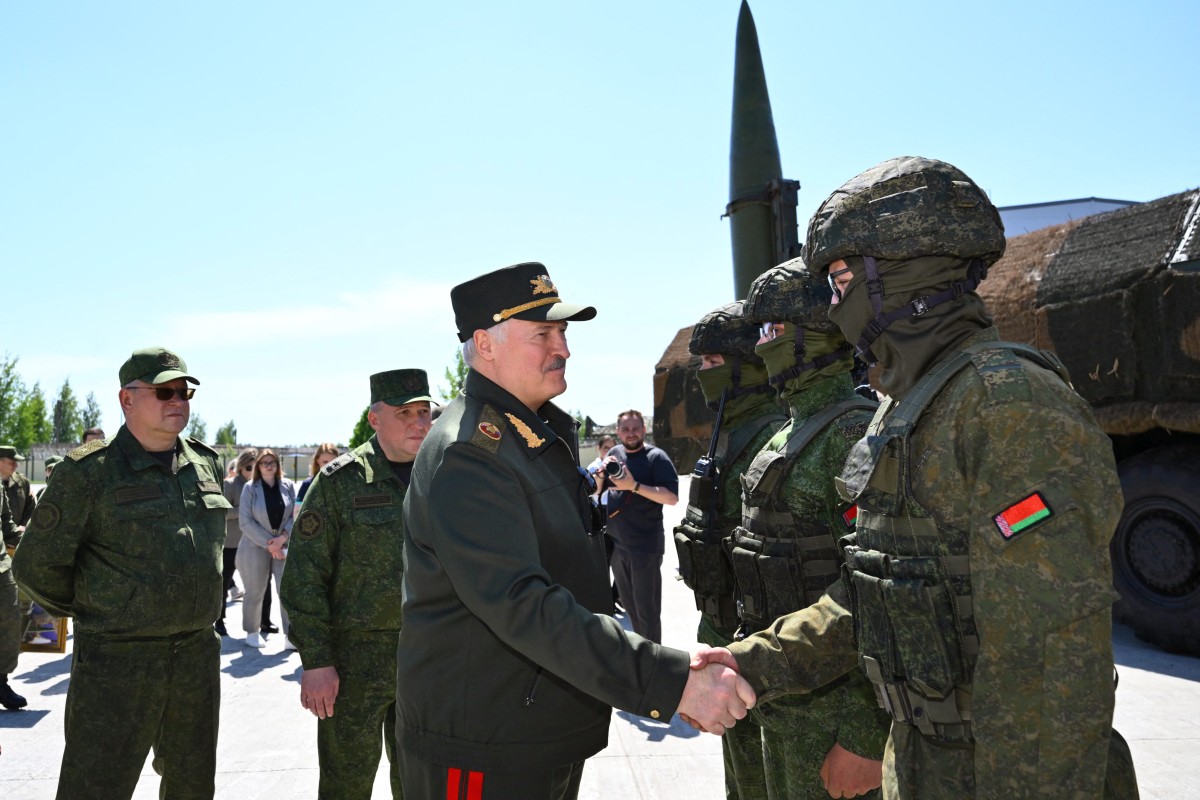
Belarus has been frantically building road infrastructure, ammunition storage sites and fuel storage facilities near the Ukrainian border, facilities that could prove decisive in case of a future military conflict with Kyiv.
Late last month, Ukrainian President Volodymyr Zelensky said that the construction of road infrastructure, as well as ammunition, fuel and lubricant storage facilities, is nearing completion along the Ukrainian-Belarusian border.
For instance, a joint training and combat center for the armed forces of Russia and Belarus is being developed in the city of Krichev, which will specialize in the maintenance and use of missile weapons.
In fact, according to Ukrainian intelligence, Russian internal documents explicitly describe the development of border infrastructure in Belarus specifically in the context of the objectives of the “special military operation.”
The deployment of the Special Operations Forces (SOF) by Belarus, as well as the frantic building of dual-purpose infrastructure along the Ukraine border, could give the impression that Russia might be planning a new invasion of northern Ukraine from southern Belarus.
In fact, in mid-May, Ukrainian President Zelenskyy and other Ukrainian officials publicly cited intelligence assessments indicating that Russia was planning new attacks launched from Belarusian territory toward northern Ukraine.
“We continue to document Russia’s attempts to draw Belarus deeper into the war against Ukraine,” Zelenskiy said on the Telegram messaging app after meeting military and intelligence officials.
Ukraine’s top military commander, Oleksandr Syrskyi, has also confirmed that Ukraine would increase forces and send reinforcements to its northern regions to ward off any possible misadventure from Russia from that side.
However, no large-scale Russian or Belarusian military movement was recorded near the Ukrainian border in either June or July.
A closer analysis shows that while the prospect of a new large-scale Russian ground invasion from Belarus remains negligible, Minsk is steadily consolidating its role as an indispensable logistical and industrial stronghold for Russia’s war effort in Ukraine, and would become even more central to Moscow in any broader confrontation with NATO.
In fact, in the four-year war against Ukraine, Belarus’s role has constantly evolved and gradually become indispensable.
According to Katia Gold, an expert on Eurasian security and Deputy Head of Foreign Policy at the New Eurasian Strategies Center (NEST Center), Minsk’s role in the Ukraine War has already gone through four distinct stages.
Phase 1: Belarus As A Launchpad
More than four years after the Ukraine War started in February 2022, many people have already forgotten that at that time Belarus also served as one of the launchpads for the Russian invasion.
Russian troops and equipment had been prepositioned in Belarus under the guise of joint military exercises. From Belarusian territory, Russian forces advanced south toward the Ukrainian capital along routes such as the west bank of the Dnipro River, aiming for a rapid seizure of Kyiv.
This northern thrust was one of the main axes of invasion, alongside attacks from Russia proper.
Belarus allowed its territory and airspace to be used for the staging and launch of the operation. Belarusian airfields hosted Russian combat aircraft. Missiles were launched into Ukraine from Belarusian territory.
However, Belarusian forces themselves did not directly participate in the ground invasion of Ukraine.
However, due to poor planning and spirited resistance by Ukrainian forces, the plans for rapid capture of Kyiv did not materialize.
Russia withdrew its forces from Northern Ukraine by mid-April, and since then Belarus’s supporting role in the Ukraine War also evolved.
Phase 2: Belarus As Russian Strategic Depth
By 2023, the nature of the war itself had changed.
The war that was supposed to be over in a week had turned into a war of attrition. With this, Russia’s expectations from Belarus also changed.
Rather than serving as a corridor for attacks on northern Ukraine, Belarus served as Russia’s strategic rear: providing training for its soldiers, repairing and maintaining its military equipment, and relieving pressure on Russia’s own military infrastructure.
In this role, Belarus served as a safe haven for training Russian troops and repairing its military equipment. A place that was secure from Ukrainian attacks.
This role was no different than what Pakistan played for the Taliban in the US-Afghanistan war, and what Europe was to play for Ukraine, providing training to Ukrainian troops and supplying them with military equipment.
Russia conducted regular joint exercises with Belarus, which were essentially fronts to train its newly mobilized soldiers.
Furthermore, even when Russia had withdrawn from northern Ukraine, the threat of another invasion from Belarus persisted. A threat Kyiv could not have ignored.
Therefore, Ukraine was forced to deploy its troops, heavy artillery, and air defense assets on its northern border, assets that could have been deployed in the fight against Russia.
During this phase, Belarus’s role became less visible but not less important. It suited Russia more to use Belarus as a secure rear area, rather than as an additional source of infantry.
By 2025-2026, however, Russia was facing not only the prospect of a long war, but also of a wider confrontation with NATO. Given these requirements, Belarus’s role evolved again.
Phase 3: Belarus As A Front For War With the West
As the war entered its fifth year, Russia needs Belarus less and less for its soldiers, and more and more for its other capabilities.
“Belarusian enterprises supply Russia’s defense industry with heavy vehicles along with optics, electronics, and other components, while repair plants and military facilities add capacity to an economy mobilized for war. Belarus also forms part of the economic ecosystem through which Russia has adapted to Western sanctions, with the two countries deepening industrial cooperation and developing new supply chains as access to Western markets and technology has narrowed,” Gold wrote in The Insider.
Belarus also serves a geostrategic purpose for Moscow. It serves as a crucial buffer state between Russia and NATO’s Eastern flank. With Ukraine transforming into a frontline state against Russia, Belarus’s role as a buffer state becomes even more crucial.
Belarus borders three NATO states: Poland, Lithuania, and Latvia. Belarus is also very close to Russia’s heavily militarised Kaliningrad exclave.
Between Belarus and Kaliningrad is the Suwałki Gap, the narrow stretch of territory connecting Poland with the Baltic states that is considered NATO’s most vulnerable territory in Eastern Europe.
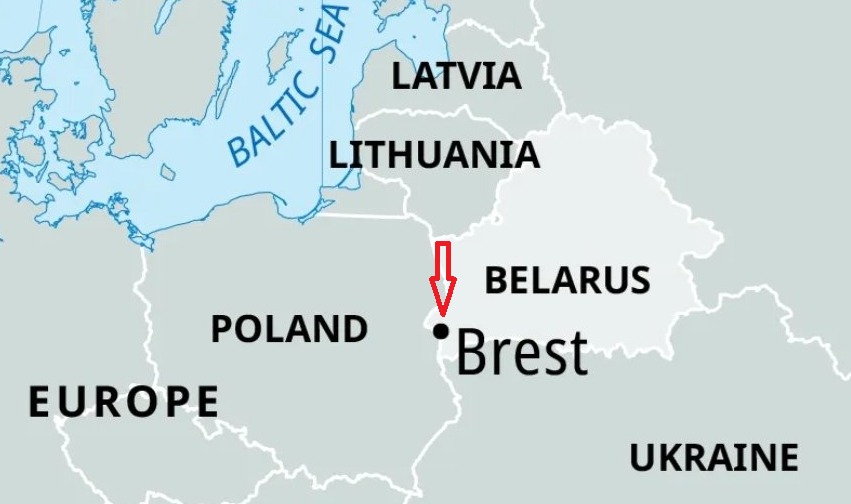
If NATO loses this territory, Russia gets unhindered access to the Baltic Sea.
Russia has already declared that it could use nuclear weapons if Belarus is attacked. It has also placed some of its nuclear warheads in Belarus, along with missiles such as Iskander and Oreshnik.
In case of a conflict with NATO, Belarus allows Russia to open a new front at NATO’s most vulnerable location: the Suwałki Gap.
Belarus, therefore, is crucial to Russia not just during the Ukraine War but also in case of a wider conflict with NATO, and Minsk can be more useful to Moscow not by supplying its poorly-trained troops, but by serving as a logistics hub, training ground, repair and maintenance center, and intelligence-collecting center. Minsk’s geography and industrial capacity also serve Russia’s interests.
However, therein lies Ukraine’s dilemma. How long can Ukraine ignore Belarus’s crucial enabling role in Russia’s war effort?
Zelensky has often come close to threatening direct military action against Belarus. However, so far both Zelensky and Lukashenko have avoided direct military confrontation. The question is, for how long can this status quo be maintained?
Also, is Belarus on its way to becoming the spark for a wider confrontation between Russia and NATO?
- Sumit Ahlawat has over a decade of experience in news media. He has worked with Press Trust of India, Times Now, Zee News, Economic Times, and Microsoft News. He holds a Master’s Degree in International Media and Modern History from the University of Sheffield, UK.
- He can be reached at ahlawat.sumit85 (at) gmail.com