The US has deployed its ‘Dark Eagle’ Long-Range Hypersonic Weapon (LRHW) in Guam, marking the first deployment of the weapon system in the frontline US territory in the Indo-Pacific.
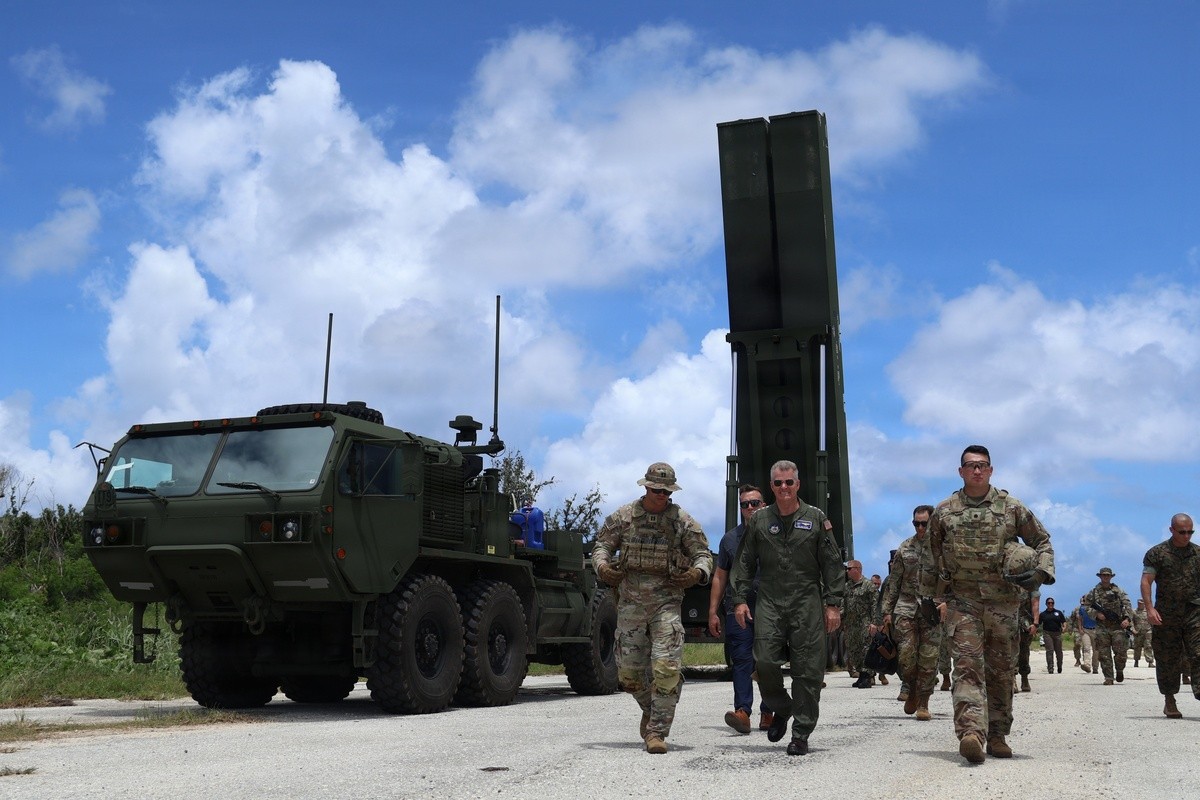
Dark Eagle was deployed to Guam for Exercise Valiant Shield, a multinational warfighting exercise conducted in the Western Pacific last month, the US Pacific Command stated. The photos confirming the deployment, published over the weekend, showed soldiers from the 7th Infantry Division (Multi-Domain Task Force – Pacific) training with the system in the presence of Adm. Samuel J. Paparo, commander of US Indo-Pacific Command.
Multi-Domain Command – Pacific is based on the recent merger of the Washington-based 7th Infantry Division and 1st Multi-Domain Task Force last month.
This is the first confirmation of the Dark Eagle’s maiden deployment to Guam during Valiant Shield, which was held across multiple locations in the Western Pacific, including in Japan, Guam and the Northern Mariana Islands. The exercises reportedly involved a host of different scenarios that may be relevant to a peer fight between the US and China.
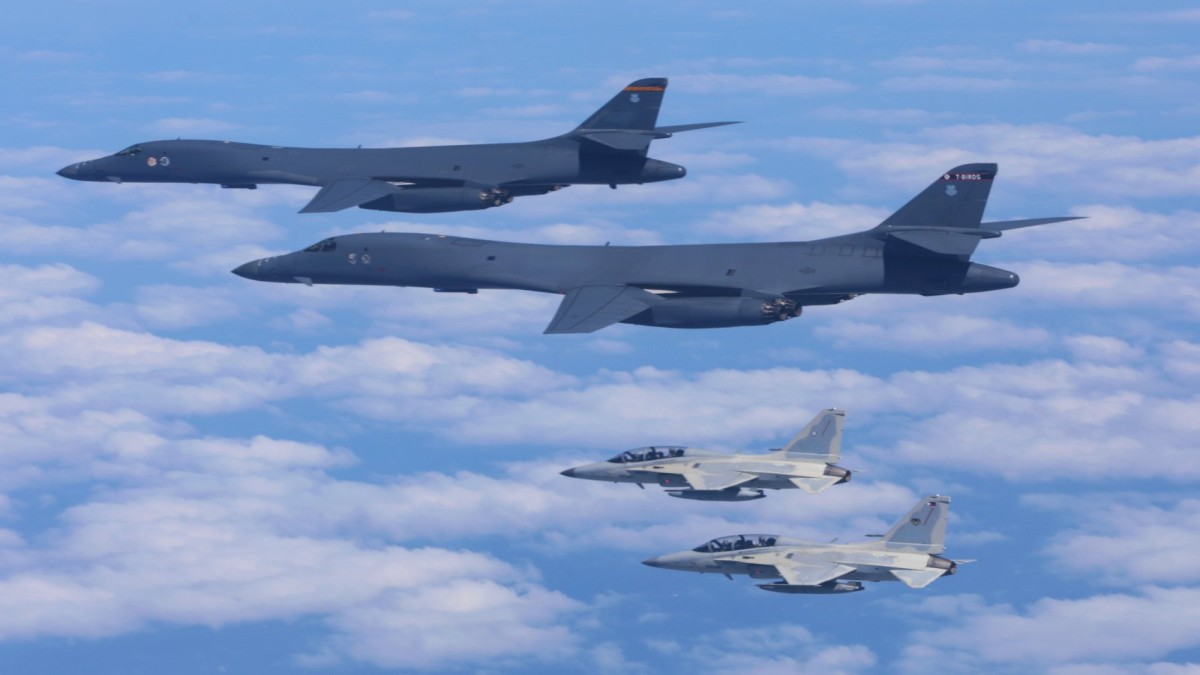
With this test, the Dark Eagle has become the latest entrant on a list of firsts during the multinational exercise, including the debut of the MQ-28 Ghost Bat drone, participation of New Zealand’s P-8A Poseidon, participation and live fire exercise, the B-2 bomber’s firing of AGM-158C
LRASM during a live-fire sinking exercise (SINKEX), the live-fire of US Marine Corps (USMC) Iron Dome air defense system, and a Japanese attack boat sinking a decommissioned amphibious assault ship, among other things.
Notably, this may be the second time the US Army has deployed the Dark Eagle for a multinational exercise focused on building capabilities against enemies like China. The hypersonic weapon system was earlier deployed to Australia for Exercise Talisman Sabre conducted in August 2025, as EurAsian Times also reported.
The US Indo-Pacific Command described that deployment as a historic milestone at the time, even though it gave no information on whether a live firing was conducted.
These deployments are significant as the United States continues to trail its adversaries, including China, Russia, and even heavily sanctioned countries like Iran and North Korea, in the global hypersonic weapons race.
Hypersonic weapons travel faster than Mach 5, or five times the speed of sound, and are highly maneuverable, making them extremely difficult to intercept. China has arguably emerged as the world leader in hypersonic capabilities, amassing a massive inventory of hypersonic missiles, ranging from the DF-17, the YJ-21 anti-ship missile, and the long-range DF-27 hypersonic weapon, to name just a few.
The deployment of Dark Eagle to Guam is even more significant, particularly because this Pacific territory is a linchpin of the Pentagon’s Indo-Pacific strategy. It is home to Andersen Air Force Base, Naval Base Guam, and other ports considered vital to supporting aircraft carrier and nuclear submarine operations, among other naval missions.

In any potential high-end conflict with China — whether triggered by an invasion of Taiwan or escalation in the South China Sea involving the Philippines, a US treaty ally — Guam would likely function as a critical staging base and power-projection node. At the same time, it is a crucial strategic site for homeland defense, enabling the US to repel enemies, respond to emergencies, and maintain an open and free Indo-Pacific.
The Dark Eagle would play an important role in any potential high-end conflict with China. Beijing has invested heavily in anti-access/area denial (A2/AD) capabilities along its coastline, leveraging its geographic advantages with layered sensors, air defenses, and long-range strike systems. This includes missiles such as the DF-26, which is capable of reaching Guam and is often referred to colloquially as the “Guam killer.”
The deployment of Dark Eagle, which has a range of about 2,776- 3,500 kilometers at Guam, would place key Chinese coastal targets, including air defense radars, command centers, missile launch sites, ports, and logistics hubs, within reach. This would allow rapid, precision attacks on high-value, time-sensitive targets deep within China’s A2/AD network, which relies on layered missiles, sensors, and defenses to keep US forces at bay.
According to a July 7 Congressional Research Service report, the missile is intended to hit heavily protected targets in contested areas.
Unlike traditional ballistic missiles with predictable trajectories, Dark Eagle’s boost-glide profile enables mid-flight course corrections, complicating enemy response. This capability will help suppress or destroy elements of China’s A2/AD bubble early in a conflict, creating windows for follow-on strikes by US stealth fighters, bombers, and warships.
Notably, the land-based, truck-launched Dark Eagle can fire hypersonic missiles at speeds exceeding 3,800 miles per hour. By ascending to the upper reaches of the Earth’s atmosphere and remaining just out of range of traditional air and missile defense systems, these missiles quickly fall on their targets, giving enemies little time to respond.
A Dark Eagle battery comprises four trailer-based launchers, each accommodating two canister missiles. The launchers are transported on M870 trailers, towed by eight-wheeled M983A4 HEMTT tractor-trailer trucks.
In addition, a six-wheeled command vehicle serves as the Battery Operations Center, supervising the Dark Eagle system’s operations.
It is designed to be road-mobile for rapid deployment and survivability against enemy targeting. It can be swiftly transported on the C-17 Globemaster III for global reach.
Dark Eagle’s mobile, shoot-and-scoot design will allow the launchers to relocate quickly after firing, reducing vulnerability to Chinese counterstrikes. In a hypothetical conflict scenario, this could essentially transform Guam from primarily a logistics and air or naval hub into an active offensive node, complicating Beijing’s planning and forcing it to divert resources to hunt mobile launchers or saturate defenses.
It is noteworthy that the LRHW Dark Eagle and other ground-based missile platforms are at the forefront of the Army’s Pacific initiatives to prepare troops for a possible conflict with China. “Aside from the Korean Peninsula, the tactics and gear necessary for mechanized maneuver are being traded out for motorized units equipped to combat adversaries in littoral, jungle and maritime areas,” as the USNI News noted.
Having said that, even though the Dark Eagle is positioned as a cutting-edge system that could take on the People’s Liberation Army (PLA) in a conflict, the stark reality is that the system remains marred by delays, consistently pushing back the Pentagon’s aspiration of becoming a hypersonic power.
Russia’s “Indispensable Ally” in Ukraine War: How Belarus Keeps Putin’s War Machine Up & Running
Dark Eagle Marred by Delays
After already slipping by more than two years, the Long-Range Hypersonic Weapon (LRHW) program is facing further delays due to unresolved production issues, a Government Accountability Office (GAO) report published on July 2, 2026, stated.
It stated that the hypersonic program consists of two main initiatives: an initial prototype battery with four launchers, eight missiles, and related support equipment, and a separate Middle Tier Acquisition (MTA) rapid-fielding effort to provide two additional batteries.
The first battery will not be fielded until at least the second quarter of fiscal year 2026, more than two years later than initially anticipated, the report said.
These findings were published just months after the US Army officials claimed in March 2026 that the unit would get its first operational missiles “soon,” implying that the service was in the final stages of fielding and beginning procurement of its first eight missiles. However, despite the publicized deployment in Guam, the service hasn’t formally announced if the battery has been operationalized with missiles.
The second battery has been delayed by at least six months due to “missing, inconsistent, and unclear work standards for missile production,” according to the GAO report.
Furthermore, the GAO report says that a modified missile type that has not yet undergone flight testing is part of the second battery.
The battery was originally supposed to arrive in the fourth quarter of fiscal year 2027, but it is now anticipated to arrive no sooner than fiscal year 2028. This is likely to have a cascading impact, delaying the delivery of the third battery as well, the GAO cautioned.
As the US works to close the hypersonic gap with Beijing, this exercise underscores both progress in rapid positioning and the persistent challenges in fielding sufficient numbers of mature, combat-ready weapons. Ultimately, Dark Eagle’s value will depend not just on its technical promise, but on resolving production issues and integrating it effectively into joint operations to credibly hold Chinese A2/AD targets at risk.
- Contact the author at sakshi.tiwari13 (at) outlook.com
- Follow EurAsian Times on Google News