US President Donald Trump said on Thursday that a nuclear deal with Saudi Arabia hinges on Riyadh recognizing Israel. The question is: will the US also press Pakistan to recognize Israel in exchange for some bilateral deal?
The new American condition comes despite Riyadh having long resisted joining the Abraham Accords, demanding a pathway to a Palestinian state.
It (recognition of Israel) was not mentioned in the civilian nuclear deal announced earlier, which had appeared to be a major triumph for the Saudis even as the US is targeting Iran over its nuclear program.
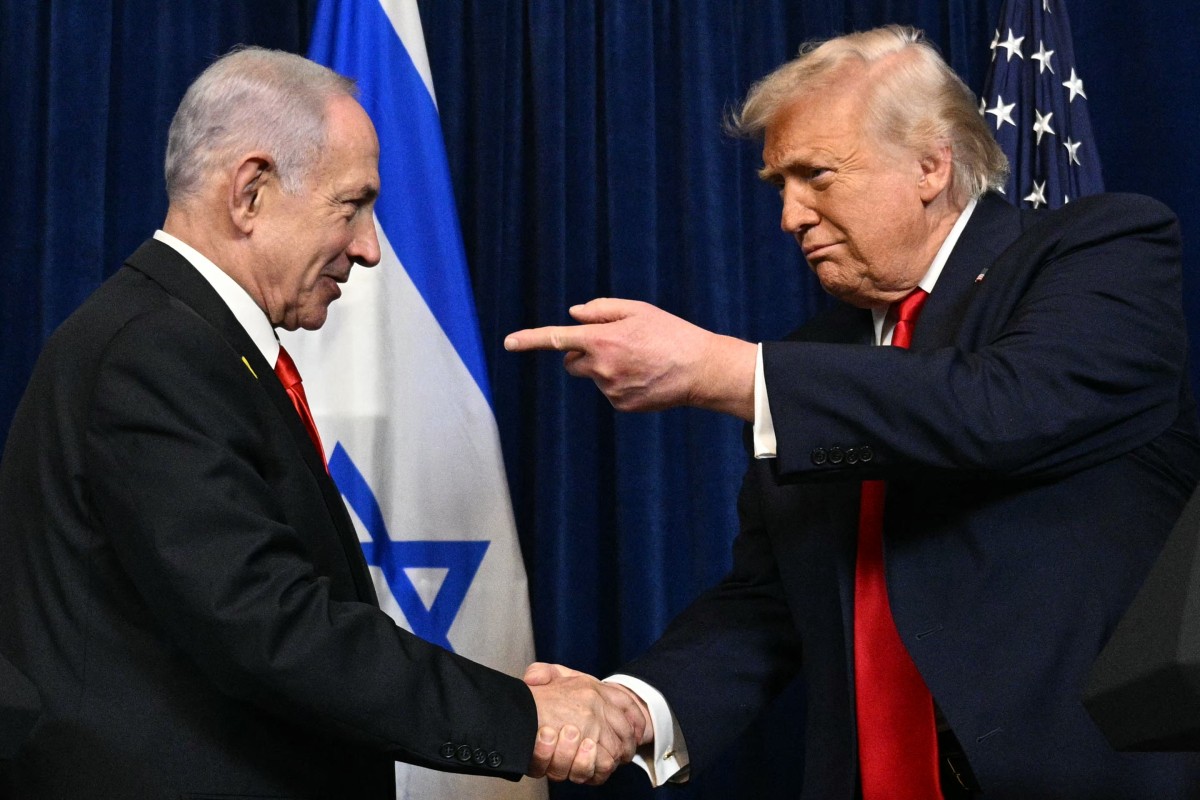
But Trump may have shocked the Saudis with his post on his Truth Social, saying the deal “will be approved, but is totally subject to Saudi Arabia joining the very respected and successful Abraham Accords.”
The White House insisted that Trump had previously told Saudi Arabia the deal was contingent on recognizing Israel.
“The president is always the final dealmaker. He has said if they don’t join the Abraham Accords, the deal is off,” Press Secretary Karoline Leavitt told reporters.
“The president has spoken directly with the Saudis about this in numerous conversations in the past, and the administration will continue to engage in those conversations.”
Israel’s Prime Minister Benjamin Netanyahu said recognition by Saudi Arabia, a regional power and home to Islam’s holiest sites, would mark a “historic leap” forward for peace in the Middle East.
Leavitt said she did not know of any calls between Trump and Netanyahu following the announcement of the Saudi agreement.
There was no immediate reaction from Riyadh.
Should it go through, the deal to establish a civilian nuclear program in Saudi Arabia would generate billions of dollars for American companies.
But with Trump’s latest announcement, it was unclear whether it would ever see the light of day.
If Washington “tries to force normalization on Riyadh, it’s not likely to work out very well,” said H.A. Hellyer, senior associate fellow at the Royal United Services Institute (RUSI), a leading UK defense and security think tank.
“Would Saudi decide to do a complete 180 on what it has declared for the past three years, or 30 years? Quite dubious,” he said.
Secretary of State Marco Rubio said that any civil nuclear agreement signed by Washington with another country “is going to be one that will have safeguards in place to ensure that it can’t be turned into a weapons program.”
Pakistan Next?
The Saudi-Pakistan Strategic Mutual Defense Agreement, signed in September 2025, has provoked questions about whether Trump might push Pakistan to recognize Israel.
Under the pact, formalized during a visit by Pakistani Prime Minister Shehbaz Sharif to Riyadh, both countries committed to treating any act of aggression against one as an act against both. The agreement built on decades of security cooperation, including Pakistani troop deployments and training support in the kingdom, as well as frequent Saudi financial assistance to Islamabad.
Pakistan maintains a policy of non-recognition of Israel. Successive governments have linked any change in that position to a resolution of the Palestinian issue.
Pakistani officials have stated that recognition would require the establishment of a viable, independent and contiguous Palestinian state based on the pre-1967 borders, with East Jerusalem as its capital, in line with relevant United Nations and Organization of Islamic Cooperation resolutions.
The Foreign Ministry has reiterated this stance on multiple occasions, including earlier this year when it rejected speculation about possible participation in the Abraham Accords.
Defense Minister Khawaja Asif and other officials have described normalization without such a settlement as incompatible with Pakistan’s fundamental positions. US officials have not publicly outlined any specific plans to press Islamabad in connection with the Saudi nuclear agreement.
President Trump had previously, in May, called for several Muslim-majority countries including Pakistan to join the Abraham Accords as part of wider regional arrangements. Islamabad rejected the suggestion at the time.
Pakistan’s MoFA (Ministry of Foreign Affairs) has said: “Unless a just settlement of the Palestine issue, satisfactory to the Palestinian people, is found, Pakistan cannot recognize Israel.”
Some observers suggest the defense pact itself could become a relevant factor: a decision by Riyadh to normalize relations with Israel might increase pressure on Pakistan to reconsider its position, given the formal mutual-defense commitment and the depth of the bilateral relationship.
Others point to domestic constraints inside Pakistan, including strong public sentiments against Israel.
Michael Kugelman, senior fellow for South Asia at the Atlantic Council, earlier said: Pakistan “would feel pressure to reconsider” its position if Saudi Arabia joined the Abraham Accords, but “a Pakistani government that joins them would risk committing political suicide.”
Israeli Prime Minister Benjamin Netanyahu, during a 2017–2018 visit to India, said: “We [Israel] are not an enemy of Pakistan and Pakistan should not be our enemy either.”
He repeated a similar line: Israel “is not an enemy of Pakistan” and Pakistan “should not behave like an enemy” towards Israel.
By Agence France-Presse and ET Online Desk