In a major milestone, the U.S. Navy’s Nimitz-class aircraft carrier remotely controlled an MQ-25 Stingray unmanned aerial refueller from more than 2,100 miles away, a capability that could eventually boost F/A-18 Super Hornets.
“In a historic U.S. naval aviation event, an aircraft carrier connected to and controlled an unmanned aerial refueler, the MQ-25A Stingray, more than 2,100 miles away,” the US Navy said in an official release.
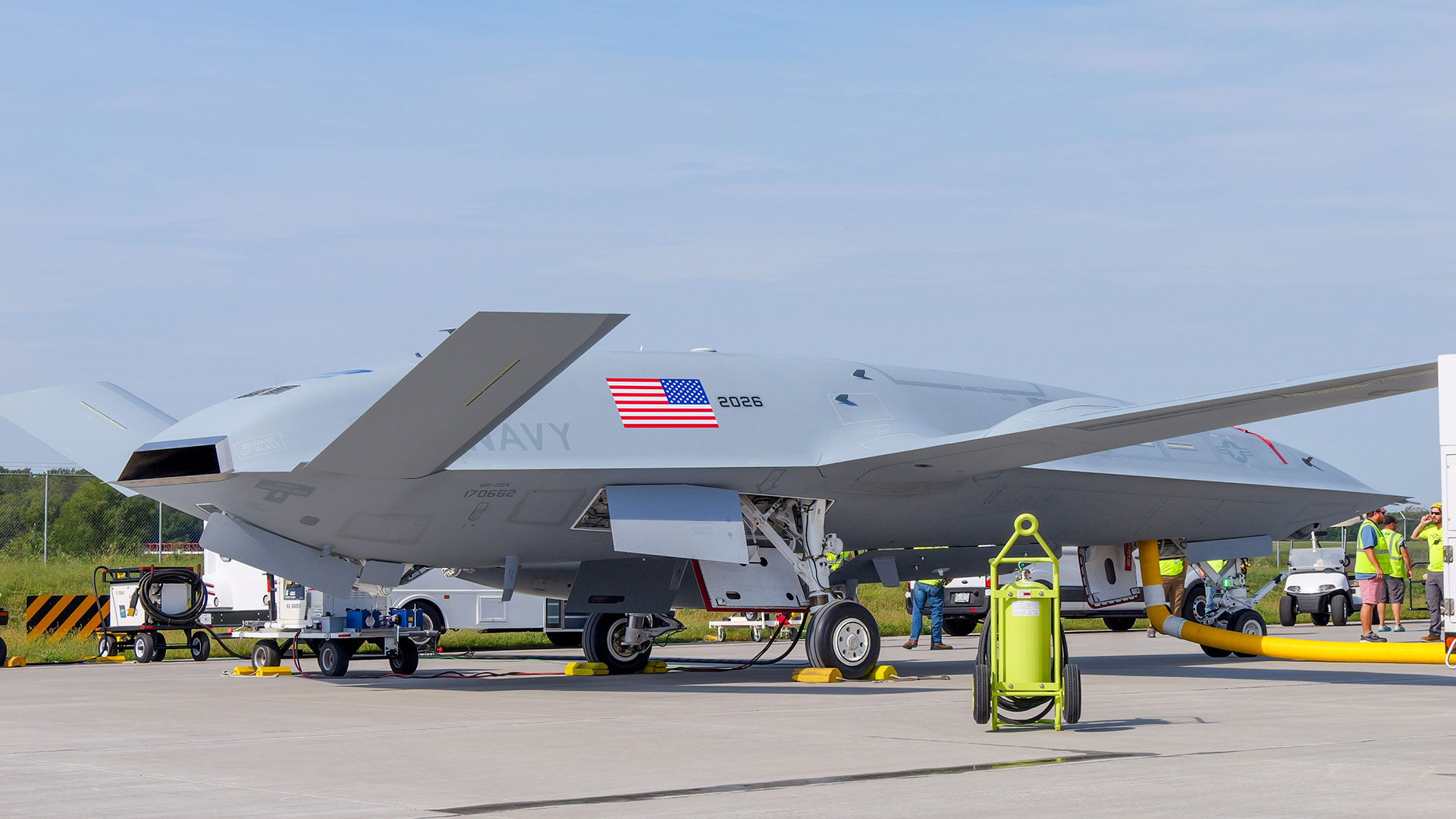
The MQ-25 Stingray is designed primarily as an unmanned aerial tanker, though it could also be used for intelligence, surveillance, and reconnaissance (ISR) missions.
During what the Navy described as a preliminary sea trial, the ship’s Unmanned Air Warfare Center (UAWC), used by Air Vehicle Pilots (AVPs) for controlling future MQ-25 Stingray airborne operations, employed its MD-5C Ground Control Station to establish a Beyond Line-of-Sight connection with an MQ-25A test aircraft through a Proliferated Low Earth Orbit (pLEO) satellite network, the service stated.
While the carrier was in the Pacific Ocean, Boeing kept the MQ-25 at its Illinois facility for the trial.
To provide command and control of the MQ-25A, the MD-5C GCS combined Lockheed Martin’s MDCX hardware and software with other government-made equipment and the Navy’s Command, Control, Communications, Computers, and Intelligence (C4I) network. The Navy also noted that this system will command and control the Navy’s future unmanned carrier aircraft and the Air Wing of the Future.
“This first-ever underway connection between a carrier-based UAWC and an MQ-25A aircraft proves that the Carrier Air Wing of tomorrow is a reality today,” said Capt. Daniel Fucito, program manager for the Navy’s Unmanned Carrier Aviation Program Office.
This marks a momentous step toward integrating unmanned systems into carrier air wings and preparing the Navy’s first carrier-based unmanned tanker for operational use. The trial was part of a series of build-up exercises intended to verify protocols, networks, and interfaces.
Before this, the MQ-25 Integrated Test Team, including Lockheed Martin, Boeing, and the US Navy, conducted pier-side and at-sea tests with the Unmanned Carrier Aviation Program Office’s (PMA-268) Unmanned Carrier Aviation Mission Control System team.
Although the test showed remote connectivity and control over a significant distance, the Navy did not record an autonomous flight, aerial refueling operation, or carrier landing.
Nonetheless, the Acting Secretary of the Navy, Hung Cao, said, “The MQ-25A Stingray’s carrier-based refueling capabilities enable F/A-18 Super Hornets to fly farther and longer. The integration of this unmanned aerial refueler demonstrates the transformational change our manned and unmanned asset integration provides the Fleet.”
Why Does This Long-Range Trial Matter?
This latest demonstration matters because it validated critical enabling technologies for unmanned carrier operations.
Notably, the earth’s curvature and the vast operating areas of carrier strike groups, such as the Pacific Ocean, limit traditional radio links. Routing commands and data through a resilient satellite constellation removes that constraint.
Against that backdrop, the latest trial confirms that the Navy’s MD-5C Ground Control Station architecture can operate in a realistic operational environment, not just in controlled shore-based or pier-side tests.
Furthermore, the successful use of a proliferated LEO satellite constellation from a moving warship proves that reliable beyond-line-of-sight command and control is achievable in a realistic at-sea environment.
Three U.S. Navy aircraft carriers feature Unmanned Air Warfare Center (UAWC) infrastructure using Lockheed Martin Skunk Works-powered MD-5 ground-control systems. The USS George H.W. Bush served as the fleet’s initial developmental testbed, while the USS Theodore Roosevelt and USS Ronald Reagan are officially designated as the Navy’s first and second fully operational, deployable drone-capable carriers.

Demonstrating that a carrier can continuously control an unmanned aircraft over intercontinental distances from its own Unmanned Air Warfare Center proves the viability of the shipboard control infrastructure already installed on these carriers.
This infrastructure is purportedly intended to support tankers and future uncrewed platforms performing intelligence, surveillance, reconnaissance, or other roles, enabling deeper manned-unmanned teaming between crewed and uncrewed platforms.
This capability counts because the MQ-25A is designed to serve as the Navy’s carrier-based unmanned tanker, taking over aerial-refueling duties that currently take time away from the F/A-18E/F Super Hornet.
By validating long-range control from the carrier, the Navy has shown that operators aboard the aircraft carrier can direct the Stingray to deliver fuel to fighters hundreds of miles from the deck.
Stingray refueling will extend the carrier air wing’s combat radius and time on station while keeping more Super Hornets available for strike, air superiority, or other primary missions instead of diverting them into “buddy” tanker roles during crucial deployments.
This would be a critical enhancement to the carrier wing’s capability in theatres like the volatile Indo-Pacific region, where distances are long and adversaries like China field sophisticated anti-access/area-denial systems.
In a potential conflict with China, American carriers may need to operate farther from contested shorelines to reduce vulnerability to long-range missiles and other threats. In that scenario, a reliably controllable unmanned tanker that can be controlled from the ship will allow the air wing to project power over long distances without staying close to the carrier or relying on land-based or allied tanker support that may be hard to obtain.
That said, a proliferated satellite network also adds resilience, particularly because such constellations are harder to disrupt completely than single high-value satellites or line-of-sight links. This will improve the survivability of the command-and-control chain under contested conditions, and in a conflict with a near-peer adversary like Beijing.
Operationally, this will also help the Navy achieve its manned-unmanned teaming objective. The MQ-25 Stingray, for one, has been positioned as a trailblazer for the “Air Wing of the Future,” and is expected to help establish procedures, networks, and infrastructure that will support not only tankers but also future uncrewed systems for intelligence, surveillance, reconnaissance, and potentially even strike roles.
Earlier this month, for instance, Boeing announced a successful trial of the Stingray’s Link 16 datalink-based Manned-Unmanned Teaming (MUM-T) command-and-control software during the Emerald Flag exercise at Eglin AFB, Florida.
The software was installed on a Beechcraft 1900D and a King Air E90 to demonstrate command and control between the two aircraft. This capability will eventually move into the MQ-25A and Super Hornet.
The latest trial is an important step before Stingray starts operating from carrier decks. The Boeing MQ-25 T1 test asset previously refueled three carrier-based aircraft—an F/A-18 Super Hornet, E-2D Hawkeye, and F-35C Lightning II —but it has yet to fly from a carrier. The first production-representative MQ-25 flew for the first time in April 2026, and the service plans its first carrier launch next year.
- Contact the author at sakshi.tiwari13 (at) outlook.com
- Follow EurAsian Times on Google News